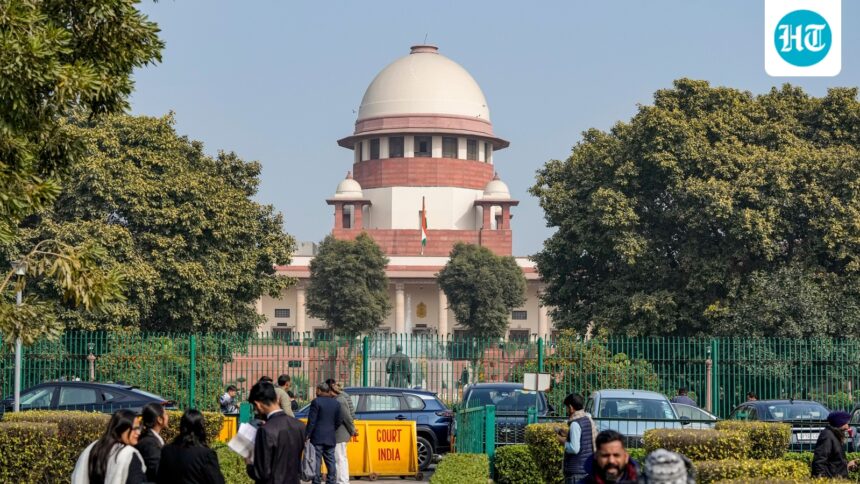
The Supreme Court ruled that offensive language, even the notorious offensive word copied verbatim in the ruling, does not become a criminal offense simply because it is vulgar or offensive, affirming that obscenity under criminal law requires a much higher threshold than profanity exchanged in anger.
The ruling, delivered by a bench of Justices Sanjay Karol and Vipul M Pancholi on Friday, is among the rare Supreme Court decisions to fully reproduce the commonly used English expletive while analyzing whether the offensive language exchanged during a quarrel amounts to criminal obscenity. The bench held that vulgarity and obscenity are two distinct concepts in law as it examined whether their use during a heated altercation entails criminal liability under Section 294(b) of the Indian Penal Code (IPC).
The court used the case to draw a clear legal distinction between obscene speech, which is punishable, and vulgar or offensive speech, which may be offensive but is not necessarily criminal.
The court partly accepted the appeal of Mani, who was convicted by courts in Tamil Nadu after a violent quarrel stemming from a long-running land dispute with his relatives.
According to the prosecution, the incident occurred when Mani confronted the complainant over a property dispute, during which he allegedly made a series of sexual and misogynistic assaults before attacking him with a hook, causing a broken nasal bone and other injuries. While the court upheld his conviction for causing grievous hurt using a dangerous weapon under Section 326 IPC, it quashed his convictions for obscenity under Section 294(b) and criminal intimidation under Section 506(2), holding that no crime had been proven on the evidence.
The ruling cited previous decisions regarding obscenity, stressing that the law does not criminalize every obscene or insulting expression. “For speech to be considered obscene, it must be shown that it was lascivious, appealed to lustful interests, and tended to corrupt and deprave the minds of those to whom it was exposed… Such words, no matter how offensive, unpalatable, or uncivilized, do not meet the requirements of Section 294(b).”
The court noted that expressions using the “f” word or profanity with sexual connotations may be offensive, shocking or highly offensive, and that alone does not make them legally obscene.
Drawing on dictionary meanings, the bench noted that “vulgar” language is language that is “extremely rude and offensive,” while “vulgar” language is rude and likely to upset people, often by referring to sex or the human body in an unpleasant way. However, the words could be offensive or offensive “without necessarily being obscene under the law,” she said.
The ruling reaffirmed previous Security Council precedent that vulgarity and profanity do not in themselves rise to the level of obscenity. Referring to the 2024 judgment in Apoorva Arora v. State (NCT of Delhi), the bench observed that obscene expressions may give rise to anger, revulsion or revulsion rather than sexual thoughts.