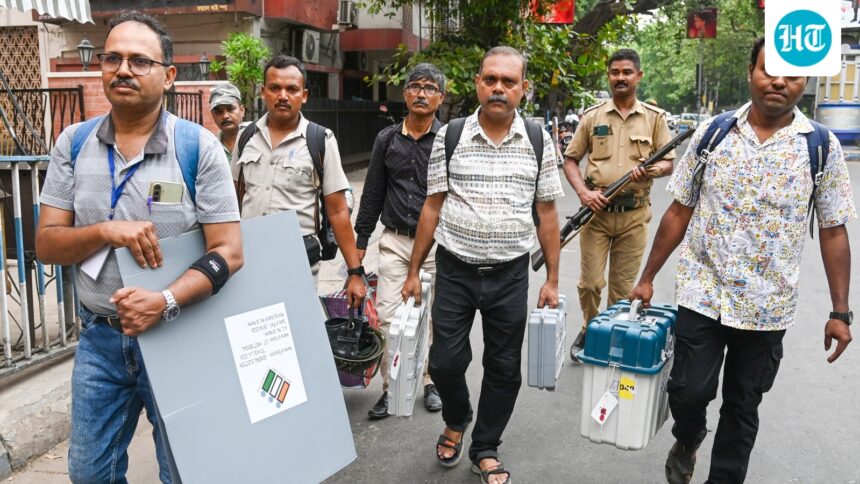
The Election Commission of India (ECI) on Tuesday published a supplementary list of voters for the second and final phase of Assembly elections in West Bengal, adding 1,468 names cleared by the appellate courts with the mandate of the Supreme Court and deleting six names.

The 19 courts – set up on March 20 by order of the Supreme Court – heard nearly 1,500 cases for the second phase of the elections, approved 1,468 applications and ordered the deletion of six names. In the first phase of the elections scheduled for April 23, the courts approved 139 names while examining 657 applications.
This means that nearly 2.71 million people flagged under the controversial logical inconsistency category in the Special Intensive Review stand disenfranchised without any hearing before the courts.
Their applications were rejected at the first stage of adjudication of logical inconsistency by judicial officials, but there was no time for a hearing before the tribunals – each of which is presided over by a former Supreme Court judge or Chief Justice – because the forums took too long to become effective.
“The names of 1,468 voters, which were earlier deleted from the electoral roll by judicial officials after the adjudication process, have been approved by tribunals appointed by the Supreme Court. These voters will be allowed to vote on Wednesday when 142 Assembly seats go to the polls. Six names have been deleted,” an IEC official said.
This development comes one day before the crucial second phase of the Assembly elections when 142 seats in seven districts in south Bengal, which are considered a stronghold of the ruling Trinamool Congress party, will go to the polls. In the 2021 elections, the TMC won 123 of these seats, and the BJP won 19 seats.
The results are scheduled to be announced on May 4. The BJP is hoping to deny Chief Minister Mamata Banerjee – whose seat in Bhabanipur goes to the polls on Wednesday – a fourth consecutive term.
Of the 2.71 million voters flagged as a logical discrepancy over issues such as name mismatches, misspellings and parent mapping, only 1,609 names were recovered across the entire election cycle: two before the nomination deadline, 139 before the first phase on April 23, and 1,468 before the second phase on April 29. The names recovered represent only 0.006% of the 2.7 million eligible court pleas.
“Voters whose names have been removed by judicial officials can continue to apply to the appellate courts, and if their names are cleared after Monday, they will be included in the future voter list — but not for this election cycle. Once the model code of conduct is lifted, the electoral roll will be reopened for review and the names cleared by the courts will be restored,” West Bengal Chief Electoral Officer Manoj Kumar Agarwal said.
TMC questions ECI’s intentions
“The inclusion of more than 1,600 people and the deletion of a small number shows the kind of work done by the IEC,” TMC said. “The restoration number itself is an example of the chaos created by the Election Commission of India,” TMC MP Sushmita Dave said. “This is nothing against the thousands upon thousands of people who have been denied their right to vote.”
Meanwhile, the BJP said the courts had worked too broadly and the TMC had “no right to talk about inclusion or deletion of voters”. “We found that the TMC filled Hindu names through Form 6 to achieve two things – first, to create fear among tribal and other identified communities that their votes would be deleted, making them believe that Hindus will not vote for TMC, and second, to create a negative narrative against the SIR process and the BJP that Hindus are being targeted,” party spokesperson Debjit Sarkar said.
Earlier this month, the Supreme Court ordered that people whose inclusion on electoral rolls had been approved by the Courts of Appeal at least two days before the poll would be entitled to vote, significantly relieving the previous freeze on voter rolls and providing relief to many caught up in the ongoing special intensive review process.
“The names of voters at the polling stations, whose names have been included or deleted, have been uploaded on the website. We will also provide a copy of the updated list to political parties, candidates, returning officials and district election officials. Individual voters will be informed through booth level officials,” the above-mentioned IEC official said.
The 19 Courts of Appeal were formally established by the European Credit Commission notification of 20 March 2026, following the Supreme Court order of 10 March. Each court is headed by a former judge of the Supreme Court or the Chief Justice of the Supreme Court. The intention was originally to add names to the lists only until nominations closed. By the deadline for the first phase on April 6, only two cases had been cleared.
The Supreme Court then invoked its powers under Article 142 of the Constitution and ordered the IEC to implement any approved appeal orders by April 21 for the first phase and April 27 for the second phase by issuing a supplementary revised electoral roll.