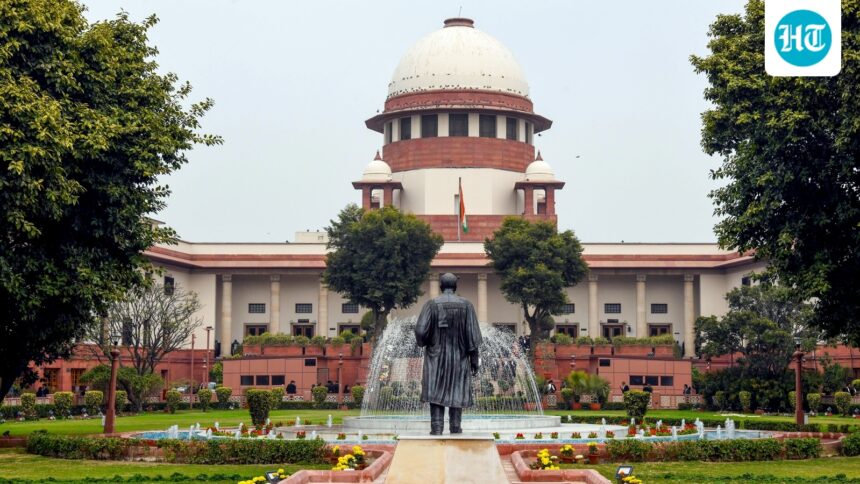
The Supreme Court on Tuesday ruled that unaided private schools cannot adjudicate the eligibility of children from weaker and disadvantaged sections merely by sending their names by the state, holding that denial of admission in such cases would negate the constitutional promise of education.

Expressing a firm view on the implementation of the Right to Education framework, the court emphasized that implementation of the 25% quota for such students in unaided schools is not just a legal requirement but a “national task” linked to the Constitution’s commitment to equal status.
A bench of Justices PS Narasimha and Alok Aradhe held that once the state government completes the admission process and allocates the student to the school, the institution is bound to grant admission without delay. The court explained that any disagreement with the selection can only be raised before the competent authority, but it cannot be used as a reason to refuse or postpone admission.
Read also: State can intervene when religious rights affect secular activities: Supreme Court
The ruling came as the court dismissed an appeal filed by a Lucknow-based private school challenging an Allahabad High Court order directing it to admit a girl child from a weaker section. The school had refused admission due to doubts about the student’s eligibility, even though her name appeared on the final list sent by the state authorities.
Confirming the reasoning of the Supreme Court, the Supreme Court made it clear that the statutory scheme under the Right of Children to Free and Compulsory Education Act, 2009 (RTE Act) leaves no room for such discretion at the school level. The court noted that once the state screens applications and assigns students, “the school has no choice but to grant admission.”
The court stressed that any delay or refusal at the school level directly undermines the child’s fundamental right to education under Article 21A.
Read Also: Asiatic Tomorrow Committee Moves SC Amid Poll Delay
The ruling reaffirmed the concept of “neighborhood school” embedded in the RTE Act. The court described it as a conscious constitutional strategy aimed at dismantling entrenched social barriers and promoting integration among children from diverse socio-economic backgrounds.
By stipulating that at least 25% of entry-level seats in unaided schools be reserved for children from the weakest and disadvantaged groups, the law seeks to transform schools into shared civic spaces that promote equality, dignity and inclusion. The bench noted that this framework is not merely an administrative framework but is rooted in the Constitution’s vision of objective social justice.
“Ensuring the admission of these students must be a national task and an obligation of the appropriate government and local authority,” the court said, adding that effective implementation has “an exceptional capacity to transform the social structure of our society.”
The ruling goes beyond the immediate conflict to establish a broader framework of accountability. She identified several “stakeholders” responsible for implementing the right to education, including governments, local authorities, neighborhood schools, parents and teachers, stressing that each has a specific role in ensuring that no child is denied access.
Notably, the Court also highlighted the responsibility of the judiciary in this ecosystem, stating that courts must “go that extra mile” to ensure that parents facing denial of admission receive prompt and effective remedies. The bench stressed that procedural hurdles or institutional hesitation cannot be allowed to undermine a fundamental right, especially when it comes to children in the foundation phase of education.
Clarifying the operational aspect, the court held that even if the school had reservations about the state’s choice, it must accept the child first and pursue its objections separately. The Council noted that this speed is crucial to prevent interruption of the child’s education and within the framework of the right to education.
The ruling also stressed the need for transparency and accountability in admission processes, including advance disclosure of available seats.
The Supreme Court rejected the school’s petition, concluding that the success of the RTE Act depended on its strong and faithful implementation. She said that the 25% quota for children from the most vulnerable groups is not a symbolic provision but a transformative tool aimed at achieving the constitutional promise of equal opportunities.