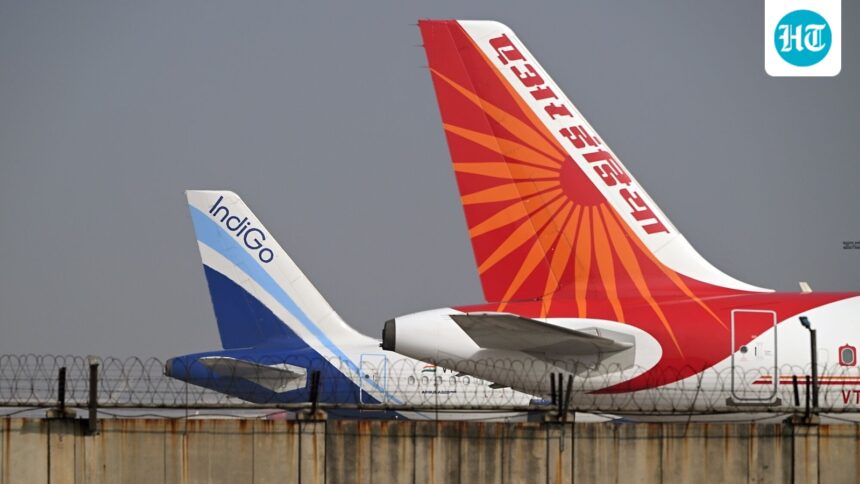
The Federal Cabinet approved A $A Rs 10,000-crore fund to protect airlines from fluctuations in jet fuel prices even while offsetting losses incurred by fuel sellers.

One-time budget support $Rs 10,000 crore will allow oil marketing companies (OMCs) to supply aviation turbine fuel (ATF) at fixed prices to Indian airlines for domestic and international operations.
“Budget support will be in the form of interest-free advance payments to oil management companies through grant applications from the Ministry of Petroleum and Natural Gas. Support will be provided to oil management companies to facilitate stable ATF pricing for airlines during the ongoing period of extraordinary fuel price fluctuations arising from the West Asia crisis,” the government said.
An IndiGo spokesperson said: “We are grateful to the Government of India, Ministry of Civil Aviation, Ministry of Petroleum and Natural Gas and concerned authorities for announcing support for aviation turbine fuel (ATF) price stabilization for scheduled Indian airlines.”
Read also| Oil prices rise again amid new Gulf tensions and the impasse of the Iran-US peace agreement
“This timely intervention is a welcome relief that reflects the government’s understanding of the critical role aviation plays in connecting people and enabling economic growth, while fostering an environment that enables airlines to better serve passengers and contribute to India’s journey as a global aviation hub,” the spokesperson said.
Welcoming the decision and thanking the government, an Air India spokesperson said: “This progressive measure provides much-needed support to the Indian aviation ecosystem and reinforces the government’s commitment to enhancing connectivity for the people of India, while enabling airlines to serve passengers more effectively.”
Read also| $Aviation fuel price relief package worth Rs 10,000 crore‘Much needed support’: Air India at the centre $Aviation fuel price relief package worth Rs 10,000 crore
This announcement comes at a time when the aviation sector is affected by unprecedented fluctuations in global ATF prices in the wake of the West Asia crisis. International ATF prices rose nearly 2.5 times from Rs 60.50 per liter in March to Rs 142 per liter in May. ATF represents approximately 40% of an airline’s operating costs.
While a cap has been placed on the ATF price for domestic operations, Indian carriers continue to procure ATF for international operations at import parity rates (IPP), which are based on the price of crude oil.
The government said the group will compensate international oil companies for losses resulting from rising international ATF prices when the prevailing independent energy producer exceeds the benchmark price set under the approved mechanism.
The government also said that when international ATF rates moderate, the difference will be recovered from the OMCs and returned to the Consolidated Fund of India and that the arrangement will continue until the entire subsidy amount is recovered and settled.
“The mechanism provides greater predictability in fuel costs by adopting a fixed price arrangement for domestic and international operations, thereby reducing the exposure of airlines to sudden rises in fuel prices,” a government statement said.
She said the arrangement will be implemented through a memorandum of understanding between the participating airlines and OMCs, with the signature of the Ministry of Civil Aviation and the Ministry of National Planning.
“Under this one-time arrangement, participating airlines will procure only ATF from OMCs for a period of up to three years, subject to annual review or until the advance amount is fully recovered, whichever is earlier,” the government added.
“The airlines will enjoy stable ATF pricing which will save them the certainty cost to a large extent especially during the uncertain energy pricing situation due to the ongoing Middle East war,” said Kapil Kaul, CEO and Director, CAPA India.
Sahil Mahajan, Partner, Aviation, Airports and Hospitality, PwC India, said, “The Cabinet’s move to stabilize ATF fares is a timely intervention for an industry where fuel accounts for nearly half of operating costs. By shielding airlines from extreme volatility, it protects margins and enables more predictable prices for consumers. It also gives the sector important breathing room to rebuild resilience amid ongoing geopolitical uncertainty.”
A monitoring committee composed of representatives from the Ministry of Civil Aviation and the Ministry of National Planning and Expenditure Management will supervise the implementation, verification of claims, reconciliation and settlement. The government said all claims and refunds will be subject to review.
“The ATF price stabilization support will be effective for a period of thirty-six months with provision for annual review or until the full amount advanced is recovered/settled, whichever is earlier. The proposal may be extended beyond thirty-six months with the approval of the competent authority if the text is not fully rectified within this period,” the government said.
The proposed mechanism will provide enhanced stability and predictability in ATF pricing to Indian airlines, enabling better operational and financial planning, the government said. It also said that the mechanism will also protect OMCs from losses caused by volatile and rising ATF prices during the ongoing West Asia crisis.
“This measure will help protect and sustain domestic and international air connectivity, ensuring continuity of air services. It will reduce the transmission of fuel price shocks to passengers, helping to mitigate price fluctuations. This arrangement will support continued air connectivity to remote, regional, and Tier II and III cities, promoting balanced regional development and inclusive growth,” the government said.
She added that this measure will have positive impacts on tourism, hospitality, trade, exports, regional development and investment.