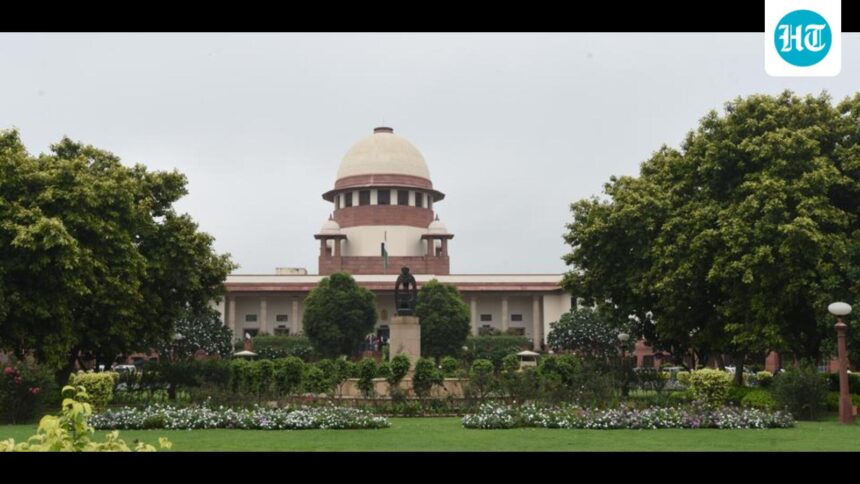
The Supreme Court on Wednesday refused to entertain a petition challenging the Union government’s directions on playing and singing of the patriotic song Vande Mataram, stating that the circular issued on January 28 was purely “advisory in nature” and did not impose “any legal obligation” or penal consequences for non-compliance.

A bench of Chief Justice of India Surya Kant and Justices Joymalia Bagchi and Vipul M Pancholi termed the petition “premature” and based on a “vague apprehension of discrimination”, stating that there was no substance to show any coercive action or discrimination emanating from the Union Home Ministry’s circular.
“What is mandatory? Nothing is mandatory. It is just advice,” the council commented during the hearing, stressing that no penalty, punishment or negative consequences were imposed on those who choose not to sing or play the patriotic song.
In its response to the petition filed by Mohamed Sayed Nouri, the court said: “We are not inclined to accept this petition because the petition is premature.” The court repeatedly pressed the petitioner’s counsel, advocate Sanjay Hegde, to prove any legal burden or consequence arising from the circular.
“What is the legal burden? Where is the notice addressed to you? The circular only states the protocol…what to do, playing the patriotic song. We can still understand whether your organization will receive notice or penalty imposed. It will not be necessary for the petitioner or his organization to be subjected to any direction or penalty,” the bench said, noting that neither the petitioner nor his organization has been subjected to any direction or penalty.
Hegde said terms such as “respect” and “proper decency” used in the post could create an implicit obligation, placing a “huge burden” on those who might choose not to participate. He stressed that patriotism cannot be forced.
The bench was unconvinced. “Freedom of expression means singing as much as it means not singing,” she noted, adding that the advice is merely establishing a protocol for occasions when the national song is played. “It is a premature fear. When there are consequences or sanctions, come to us. At present, you have some vague fear of discrimination, which has no clear connection to the impugned advice.”
Distinguishing previous rulings such as the Bijou Emmanuel case (1986), where consequences followed for students who refused to sing the national anthem, the court observed that there was no such punitive framework here. “We agree that Bijou Emmanuel is the correct referee. But what happened there? There had to be consequences if no one sang… What is the punishment here? We couldn’t find anything,” the bench said.
In the Bijoy Emmanuel case, the court held that expelling students on the basis of their “religious faith which they conscientiously hold” was a violation of the Constitution of India. Three children were expelled from a school for not singing the national anthem because it conflicted with their Jehovah’s Witness religious faith.
Making it clear that judicial intervention would only be justified if the consultation was translated into coercive action, the court asked the petitioner to deal with it if any discrimination or actual punishment arises. The bench told Hegde: “Come to us when you are discriminated against on the counseling list… when there is a climate in which you are discriminated against.”
“When there are consequences or sanctions, come to us… You have some vague concerns about discrimination, and it has no clear connection to the impugned advice.”
Solicitor General Tushar Mehta defended the circular, citing fundamental duties under Article 51A of the Constitution and questioning whether citizens need to be formally advised to respect national symbols. He noted that the petitioner who claims that patriotism is not mandatory “does not deserve the leniency of this court,” to which Hegde responded that “the right to say so is the highest form of patriotism.”
The Home Ministry issued a circular on January 28 to mark the 150th anniversary of Vande Mataram by Bankim Chandra Chatterjee. It established a detailed protocol for celebrating the national song on official and public occasions, including stipulating that it must be performed before the national anthem when they are played together.
The circular specified occasions for its performance, such as civil inauguration ceremonies, the arrival and departure of the president and governors from state functions, and some ceremonial occasions that include the national flag.
Schools have been encouraged to incorporate community singing of the national song. It is expected that audience interest will be entertained when viewed, with limited exceptions, such as during film screenings.
The Supreme Court stressed that the notification does not amount to making participation mandatory or imposing any penalty for non-compliance.