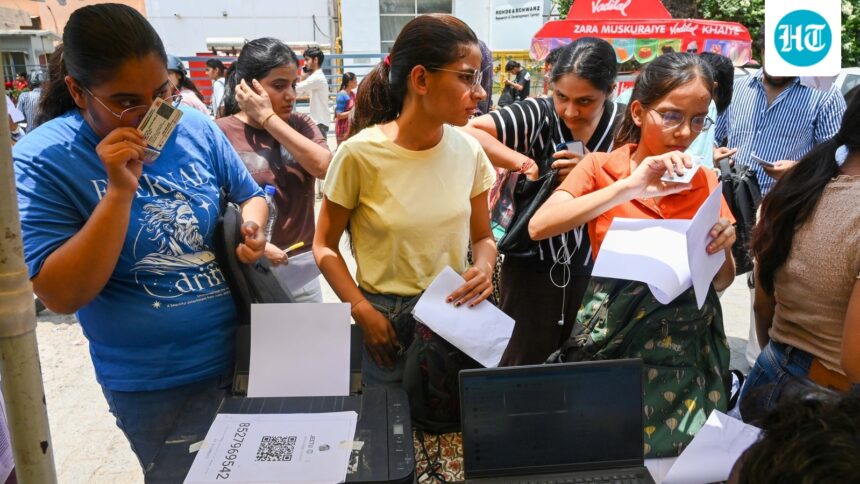
Several students who appeared for the sociology paper for the University Grants Commission National Eligibility Test (UGC-NET) on June 30 have alleged that the test was leaked, leading to demands for a probe into the National Testing Agency (NTA), which is yet to issue any statement on the allegations.

The UGC-NET, which is conducted twice a year, determines eligibility for Junior Research Fellowship (JRF), Assistant Professorship and admission to Doctor of Philosophy (PhD) programs in Indian universities and colleges.
The new allegations come weeks after the NTA faced criticism over the leak of National Eligibility Test with University Entrance Test (NEET-UG) papers for 2026 and days after translation errors were reported in UGC-NET social science papers. The latest leak of the paper has already been raised by Opposition Leader Rahul Gandhi, who accused the central government of “failing to safeguard” the future of thousands of aspirants.
The students claimed that a 100-page PDF containing handwritten questions prepared by subject experts at the National Testing Agency was distributed before the exam, with approximately 90 questions and answer options that matched the actual sociology paper.
The allegations came to light after Haryana president Deepak Dhankar, president of the Aam Aadmi Party’s student wing, Association of Students for Alternative Politics (ASAP), posted a video on Instagram and YouTube on July 6 claiming that a sociology paper had been leaked the night before the exam. The video also features Ankit Singh Phogat, who alleged that individuals claiming access to government recruitment papers and entrance exams had contacted him months before the June exams, submitting leaked papers for exams including UGC-NET, Council of Scientific and Industrial Research National Eligibility Test (CSIR-NET), Haryana Teacher Eligibility Test (HTET) and Assistant District Attorney (ADA).
According to Dankar, the alleged network demanded $2.25 lakh per candidate and claimed to be working across Bihar, Uttar Pradesh, Delhi and Rajasthan.
HT has a copy of the alleged leaked PDF. Two staff members linked to the question-making process at the National Testing Agency, who requested anonymity, said the format of the document matched the internal template used to prepare the question banks.
“The PDF file contains the questions submitted by subject matter experts along with specifics, question numbers, reference sources and difficulty levels. “It is sad that a confidential document leaked from the NTA building when the agency is supposed to have a fool-proof system,” said a faculty member.
Another faculty member said the document also contained the supervisors’ initials, approval dates, and correct answer choices. “It is a genuine document and it is unusual for such a document to be issued by the NTA,” he added.
The questioning process takes place under strict security protocols inside a highly isolated and restricted facility inside the NTA office building in Delhi where subject matter experts prepare and moderate the questions without access to external communication devices.
The UGC-NET Sociology test is conducted in a single three-hour computer-based test (CBT) session, comprising 150 multiple-choice questions carrying 300 marks. It includes 50 questions in general aptitude (100 marks) and 100 questions in sociology (200 marks), with no negative marking.
Since the test is taken in a cognitive behavioral therapy (CBT) setting, the final question paper will not be available to the public immediately after the test.
Aishwarya Puri, a tutor at coaching platform Adda247, said in a YouTube video that she shared screenshots of the alleged PDF file with a student who appeared for the exam. Demanding an investigation, she said: “The student confirmed that the questions, including the answer options, were completely identical. This means that the paper was leaked.”
A candidate from Dr BR Ambedkar University Delhi said the PDF file in circulation left students “feeling distressed” and “cheated” and demanded that the NTA clarify the authenticity of the document.
A candidate from Jawaharlal Nehru University (JNU) who attended the exam told HT that the questions and even the sequence of options matched the PDF file. “The document’s metadata showed that it was created at 4am on June 30, hours before the 3pm inspection, and requested an investigation into the alleged breach,” he said.
Another candidate from Delhi University (DU) said, “After translation discrepancies during the exam, the distribution of a PDF file containing around 85-90 questions identical to the paper has increased our concern. NTA should clarify the authenticity of the PDF file in circulation and be transparent and accountable.”
HT was unable to independently verify whether the questions in the alleged leaked PDF were identical to those asked in the exam. PDF metadata can also be modified using readily available software.
Meanwhile, LoP Gandhi claimed that the leaked paper was sold for him $2.25 lakh across multiple states. Criticizing the Centre, he said the recurring controversies surrounding the NTA showed that the government had failed to protect the interests of exam aspirants.
NTA did not respond to HT’s requests for comment.