India and Australia are expected to conclude an agreement on commercial supply of uranium to support New Delhi’s nuclear power generation goals and unveil measures to enhance cooperation in maritime security and defense during Prime Minister Narendra Modi’s visit to Melbourne, people familiar with the matter said.

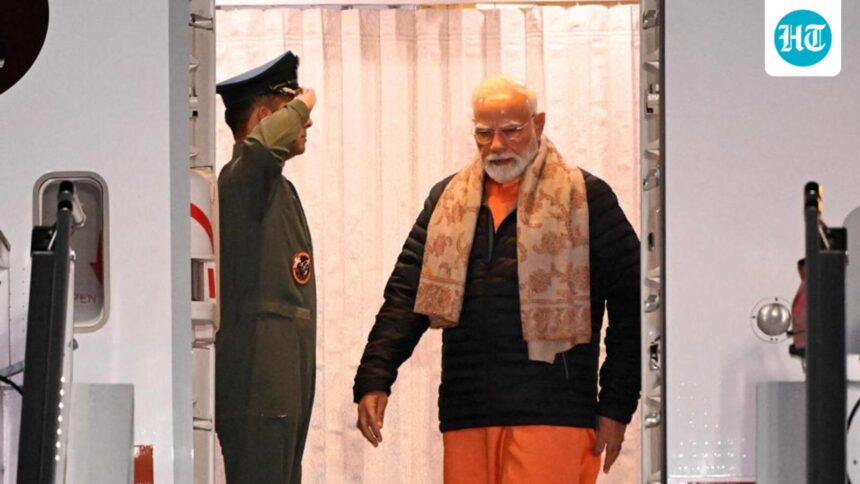
Modi arrived in Australia from Indonesia on Wednesday evening as part of a three-country tour that will also take him to New Zealand. He said on social media after his arrival in Melbourne that the visit would add vitality to bilateral relations, and that he looked forward to holding talks with Prime Minister Anthony Albanese on Thursday.
The uranium commercial supply agreement, which will build on the civil nuclear agreement signed by India and Australia in 2014, is expected to be finalized during the visit, the sources said. Australia has the world’s largest uranium reserve – about a third of the global total – and has sent only one shipment of uranium to India, in 2017.
The two sides have been negotiating a trade deal for some time, and Vishwesh Negi, Joint Secretary for Oceania and Indo-Pacific Affairs in the Ministry of External Affairs, said at a recent press conference that there had been “substantive, forward-looking talks” that raised hope for a “logical outcome.”
This development comes on the heels of India’s new Shanti Law, which reforms the nuclear sector, and the agreement between India and Canadian company Cameco earlier this year to supply 22 million pounds of uranium ore concentrate. It is also in line with India’s plans to increase nuclear power generation to 100 gigawatts by 2047, with Nuclear Power of India planning to build 18 more reactors.
Cooperation in the field of maritime security and defense will be strengthened through the new arrangements scheduled to be unveiled during the Prime Minister’s visit. The sources said that the two sides are expected to unveil a new roadmap for joint maritime security cooperation after enhancing cooperative maritime domain awareness activities using patrol aircraft.
The India-Australia Joint Declaration on Security Cooperation, which was finalized in November 2009 to facilitate cooperation in the areas of defence, counter-terrorism, non-proliferation and maritime security, will be updated to match the ambitions of both sides and reflect the growth in defense and security cooperation, the sources said.
The two sides are currently holding defense policy talks and defense service personnel talks, and there are regular meetings between the two defense ministers. Besides conducting naval exercises that have increased in scope and complexity, India and Australia signed a Mutual Logistics Support Agreement in 2021, allowing warships to access each other’s bases.
Modi’s visit will strengthen India’s vision in Mahasagar and the Indo-Pacific region by strengthening ties between two Quad partners who play greater roles in stabilizing the region, the people said. In a departure from established protocols, Australian Governor-General Sam Mostyn will travel from the capital, Canberra, to Melbourne to meet Modi.
Modi will also address the India-Australia CEO Forum at a time when the two sides are engaged in negotiations to upgrade the temporary trade deal to a comprehensive economic cooperation agreement. Since the signing of the Economic Cooperation and Trade Agreement in 2022, India’s exports to Australia have doubled, rising from $4 billion in 2020-21 to $8.5 billion in 2024-25. Total bilateral trade reached $24.1 billion in the period 2024-2025.
Modi will also address a community event at Marvel Stadium, where he will be joined by Albanian. The Indian community in Australia has become an important pillar of bilateral relations, and the number of people of Indian origin now numbers nearly one million.