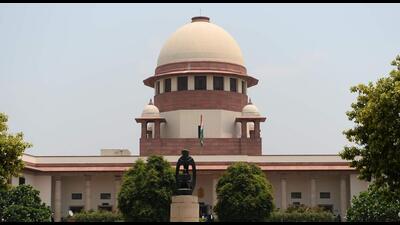
The Supreme Court on Monday cleared the way for the formation of an inter-state water tribunal to adjudicate the long-running Pennayar river water dispute between Tamil Nadu and Karnataka, saying there was no legal bar to the central government resorting to the statutory process under the Inter-State River Water Disputes Act, 1956.
The verdict came after talks between Tamil Nadu and Karnataka failed. (AFP)Reading the operative part of the judgment, a bench headed by Justice Vikram Nath said it found “no impediment” to the Center setting up a water tribunal to resolve the dispute and directed that Tamil Nadu’s complaint be placed before a tribunal set up by the central government. The bench accordingly disposed of the original suit filed by Tamil Nadu in 2018.
“We find no impediment to the central government constituting a water tribunal to settle the dispute. The complaint of the state of Tamil Nadu will be placed before the water tribunal constituted by the central government. Accordingly, the case is disposed of,” said Justice Nath, headed by a bench comprising Justice NV Anjaria.
This judgment ended the Supreme Court’s direct involvement with inter-state disputes under Article 131 of the Constitution, effectively transferring the resolution of the Pennaiya dispute to a special judicial forum under the Inter-State River Water Disputes Act (ISRWDA).
The judgment follows the failure of talks between Tamil Nadu and Karnataka, which the court had earlier helped by ordering the formation of a negotiating committee in January 2024. That mediation exercise was officially declared unsuccessful in November 2024, leaving the constitution of the tribunal as the only statutory option.
More Read
Disposing of the case and upholding the tribunal’s verdict, the court confirmed that the Center can invoke the ISRWDA process if negotiations fail.
The Pennayar River, also known as the South Pennar, originates in Karnataka and flows through Tamil Nadu to join the Bay of Bengal. Tamil Nadu has for decades accused Karnataka of building check dams, reservoirs and diversion structures on the river without consultation, thereby affecting irrigation and drinking water supply in the state’s northern districts.
In 2018, Tamil Nadu invoked the Supreme Court’s original jurisdiction under Article 131 by filing a case against the Karnataka and Central governments alleging that Karnataka’s unilateral schemes were illegal and unconstitutional.
More Read

During earlier hearings, the Supreme Court had repeatedly flagged that disputes of this nature were best resolved through the statutory framework under ISRWDA rather than through protracted judicial proceedings.