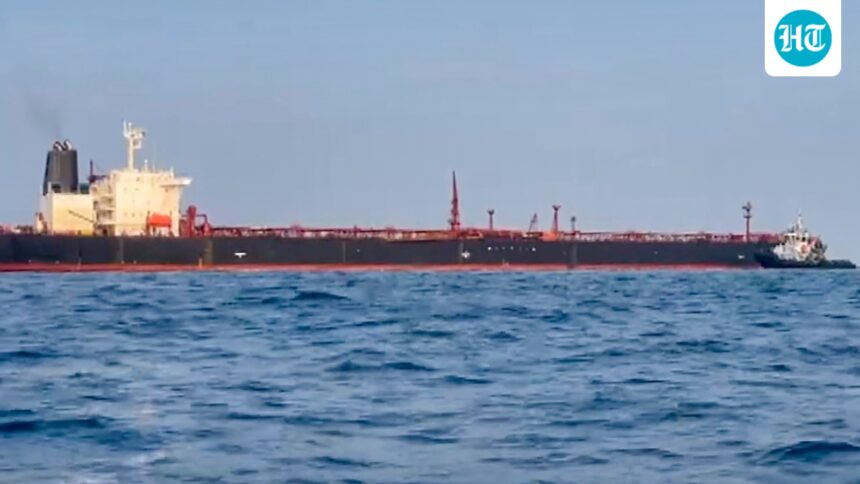
The Russian oil tanker, Aqua Titan, arrived at the new port of Mangalore on Sunday morning after it reversed course in the South China Sea and abandoned its voyage to Beijing.

According to ship tracking company Marine Traffic, the Cameroon-flagged ship arrived at port at around 11:30 a.m. This comes just four days after reports that the Russian tanker laden with oil, originally bound for China, made an abrupt change in Southeast Asian waters in mid-March and began heading toward India.
However, at the time, External Affairs Ministry spokesperson Randhir Jaiswal denied the answers regarding the tanker and said he would provide updates after gathering information about it.
The next day, on March 19, Rajesh Kumar Sinha, Special Secretary of the Ministry of Shipping, said during an inter-ministerial press conference that the tanker Aqua Titan, which is carrying crude oil, is expected to arrive at the new port of Mangalore on March 21.
Earlier this month, the Trump administration granted a 30-day “temporary” waiver to India to purchase Russian energy amid the escalation of the US-Iran war and the broader conflict in the Middle East.
US Treasury Secretary Scott Besent said the temporary waiver is intended to ease global pressure as Iran aims to “take global energy hostage,” a remark that came in the wake of the closure of the Strait of Hormuz, one of the world’s largest oil passages, and other surrounding issues.
Days later, Bloomberg reported that Indian refiners had bought 30 million barrels of Russian oil since the United States gave the green light for purchases to help the new India deal with the global oil crisis.
Read also: ‘Targeting commercial shipping is unacceptable’: India’s message amid Strait of Hormuz blockade and Iran-US war
Later, US President Donald Trump also stated that he had made the decision to concede to relieve some pressure amid the ongoing tensions.
Later, White House press secretary Carolyn Leavitt explained that Trump agreed to concede to New Delhi because “our allies in India were good actors.”
“We came to this decision because our allies in India were good actors and had previously stopped purchasing Russian oil under sanctions. So, as we work to smooth out this temporary gap in the world’s oil supply caused by the Iranians, we have temporarily allowed India to accept Russian oil,” Levitt said.
Last week, the Indian-flagged oil tanker, Jag Ladki, docked at Mundra port in Gujarat, carrying around 80,886 metric tons of Murban crude from the UAE. The tanker left the UAE port of Fujairah on March 15, a day after the terminal was attacked.
Two weeks ago, India received its first crude oil ship, which arrived after passing through the conflict-hit Strait of Hormuz. The Liberian-flagged ship, Shenlong Suezmax, loaded the crude from the Saudi port of Ras Tanura, transited safely through the waterway and arrived at a port in Mumbai.
Besides the oil tankers, two Indian-flagged ships, Shivalik and MT Nanda Devi, carrying liquefied petroleum gas, arrived in India last week.