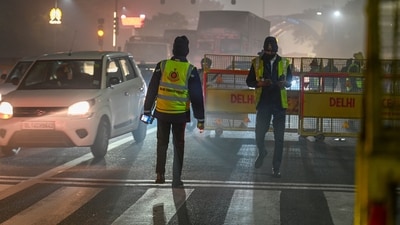
The Public Works Department (PWD) will work on a pilot infrastructure project aimed at making the Ring Road signal-free with U-turns at Rajghat and Shanti Van crossings in central Delhi, officials said on Thursday.
Image for Presentation (Raj K Raj /HT Photo)Project, approx ₹49.02 lakh rupees, will help ease the ongoing traffic jams.
“Continuous traffic disruptions have been reported at the two intersections which serve as a major link for commuters traveling between North, Central and East Delhi. Both the intersections will remain closed and extended U-turns at least 100 meters apart will be provided to ensure moving traffic,” said an official.
Both the crossings witness heavy traffic throughout the day, often resulting in long queues and frequent slowdowns, especially during peak hours, officials added. Traffic police officials flagged for delays at these junctions due to signalized intersections and turning movements that obstructed traffic flow.
The proposed infrastructure will focus on implementing a U-turn-based traffic management scheme that involves restricting certain right turns and streamlining vehicular movement through certain turning points. Officials said such interventions are aimed at reducing signal dependency, reducing crossing conflicts and improving average travel speeds.
More Read

“The trial will allow the department to assess the project’s effectiveness before considering similar interventions at other congested junctions along the Ring Road. The expansion will be based on traffic performance and ground evaluation after implementation,” the official said.
The ring road near Rajghat has four lanes on both sides. Experts say that while it is possible to make U-turns across the width of the road, its impact may be limited.
“Making a U-turn requires an additional lane, which may not be possible without design changes. However, since the road is wide enough, a U-turn can be made at a suitable place for vehicles to crawl. We cannot say that it will drastically reduce traffic congestion, but it can help reduce waiting time at red lights,” said S Velmurugan, Chief Traffic Engine and Chief Traffic Engine and Safety Engine, DCRIRIRIR.
More Read
Experts also suggest that creating signal-free stretches usually snarls traffic, giving the impression of reducing congestion rather than actually solving it.
Moreover, increasing vehicle speeds without intersections or red lights makes these stretches unsafe for pedestrians.
HT had earlier reported that the Ring Road is one of the busiest arterial corridors in Delhi. Congestion at key intersections often leads to cascading delays across adjacent stretches, affecting travel times.