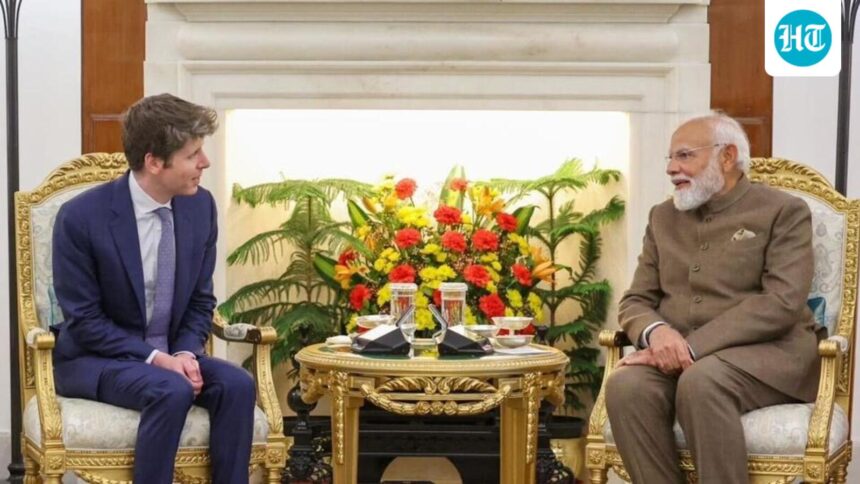
Prime Minister Narendra Modi held bilateral meetings with the CEOs of OpenAI and Qualcomm – Sam Altman and Cristiano Amon – on Friday, on the sidelines of the AI Impact Summit held in New Delhi from February 16-21. No official details of these discussions were immediately published.

“Great meeting with Prime Minister Narendra Modi today to talk about the incredible energy surrounding AI in India,” Altman posted on Modi responded by saying, “It was a very good meeting indeed. India is making huge strides in the world of artificial intelligence. We call on the world to invest in our talented youth and add vitality to this sector.”
Likewise, for Amon, PM Modi posted, “Happy to meet Mr. Cristiano R. Amon, President & CEO, Qualcomm. We discussed how Qualcomm can work with Indian innovators and startups in AI and other future technology areas. We also talked about working closely in the world of semiconductors and chip manufacturing.”
Modi’s meetings were part of a broader set of engagements with technology leaders and heads of state during the summit. On Friday morning, the Prime Minister chaired a roundtable with 16 CEOs of artificial intelligence companies and deep tech startups. The meeting was held behind closed doors.
He subsequently held seven consecutive bilateral meetings. Four of them were with leaders from Liechtenstein, Slovakia, Sri Lanka and Mauritius. In addition, Modi met with António Guterres, Secretary-General of the United Nations.
Speaking at the summit’s opening event on Thursday, Altman said: “On our current trajectory, we believe we may be just two years away from early versions of true superintelligence… and by the end of 2028, more of the world’s intellectual power could be located inside data centers than outside of them.”
Altman said that the pace of progress requires a new type of international institutions. “We expect that the world may need something like the International Atomic Energy Agency for international coordination in the field of artificial intelligence, especially to have the ability to respond quickly to changing circumstances,” he said.
Meanwhile, in his keynote speech, Amon said that AI will replace operating systems and applications in mobile phones with AI agents, marking what he described as a fundamental transformation in the mobile industry.
“We expect AI to fundamentally transform the mobile industry as the (AI) agent will be at the center and you can access the agent from your mobile phone, glasses, necklace or anything you wear,” he said. “It will replace a lot of the operating systems and application definitions we see today, and this is the new future of technology, including the future of mobility.”
Qualcomm and Tata Electronics on Friday announced a partnership to manufacture Qualcomm automotive modules in India at Tata Electronics’ upcoming semiconductor assembly and testing facility in Jagirud, Assam, under the ‘Make in India’ initiative. The modules, which integrate Snapdragon Digital Chassis chips with other components, are used in vehicle systems such as digital dashboards, infotainment and connectivity, and are intended to meet growing demand from automakers.
Read also:Prime Minister Modi meets European Union leaders on the sidelines of the Amnesty International summit
OpenAI on Wednesday announced the launch of ‘OpenAI for India’ at the India AI Impact Summit. The initiative aims to expand access to artificial intelligence across the country and build local capabilities in partnership with Indian companies, starting with the Tata Group. As part of the plan, OpenAI and Tata will develop AI-ready data center capacity in India, with OpenAI becoming the first customer for TCS’ HyperVault data center business.
The Tata group also plans to roll out ChatGPT Enterprise across its workforce over time, starting with TCS employees. OpenAI said it will expand certification programs in India, partner with educational institutions by offering more than 100,000 ChatGPT Edu licenses, and open new offices in Mumbai and Bengaluru later this year.