This will be the first time that Vivo’s ‘Ultra’ flagship will make its debut in the Indian market. The X100 Ultra never got here, nor did last year’s X200 Ultra. About time. There were understandable business considerations at the time, including currency valuations, questions about demand versus shipments that made financial sense, and a lens system that wasn’t as mature as we hope it is now. Third time’s lucky, with Vivo’s third generation flagship ‘Ultra’. The X300 Ultra joins existing flagship rivals from Samsung and Xiaomi, who have, for various periods of time, already figured out the details (and the guts) to sell their Ultra flagships in this market. But there are a set of related questions that you must answer.

Vivo X300 Ultra price is $1,59,999 and is expected to sit at the top of Vivo’s smartphone portfolio, effectively taking over the flagship mantle from the impressive X300 Pro. But again, Ultra is better than Pro, in any scheme of things. There’s the X300 Ultra, followed by the X300 Pro (which is right next door $1,09,999), X300 (approx $75,999) and X Fold5 ( $1,49,999) to one side. The fact that the X300 Ultra will join the X300 FE ( $79,999 onwards), which we will analyze separately (my feeling is that its significance is much higher, especially when pricing is taken into account), bolsters Vivo’s flagship portfolio. The competition is tough, with both the Samsung Galaxy S26 Ultra and Xiaomi 17 Ultra priced $1,39,999 onwards, the latter benefiting from Leica’s camera partnership.
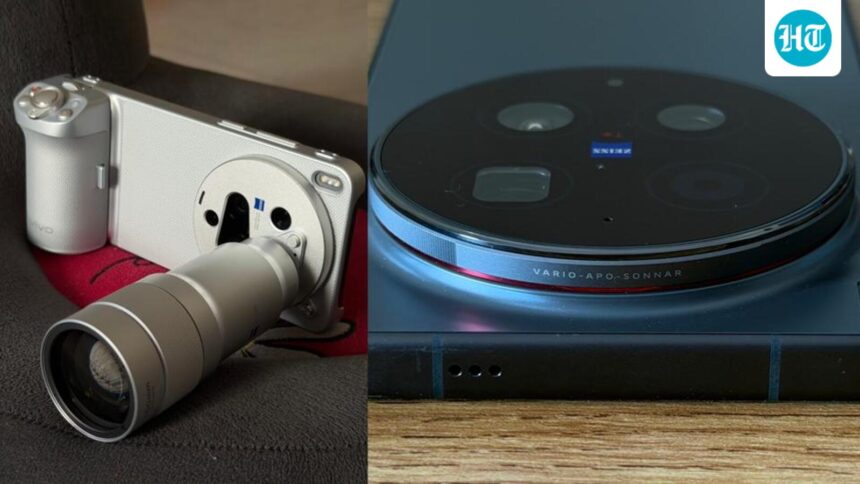
There is also a lens perspective while playing. The Vivo X300 Ultra can be purchased with the Photography Kit $2,09,999 — This includes the Telephoto Extender Gen 2, Telephoto Extender Gen 2 Ultra and Imaging Kit. Each can be purchased separately as well, which is what I recommend. The 400mm Telephoto Extender Gen 2 Ultra makes a lot of sense, if you’re comfortable carrying it, and it won’t cost you a lot $27,999. 200mm Telephoto Extender Gen 2 costs $15,999.
Photography, as a starting point
The Vivo X300 Ultra conversation should be handled through the camera and photography proposition before anything else. The real Zeiss influence is evident from the start in this triple camera setup which has a 200MP wide camera, a 200MP periscope telephoto camera (this is a key detail for lens accessories) and a 50MP ultra-wide camera which is not a weak link at all if that’s what you assumed when looking at the megapixel numbers. The effect that Vivo and Zeiss are going for here is the choice of focal length.
The camera app will default to 14mm, 35mm and 85mm focal lengths, with the latter particularly taking advantage of Vivo’s standard continuous settings image stabilization technology. And that’s before the Telephoto Extender Gen 2 and Telephoto Extender Gen 2 Ultra have 200mm and 400mm equivalent focal lengths. I’ll talk about these lenses in a moment, because they deserve their own moment in the spotlight. However, do you remember the question I asked earlier in this article? What you need to decide is whether the phone’s large lens attachment (which will also have a thick mountable case) is cumbersome or convenient in your book? I know my answer, and of course you may not agree.
However, it’s important to note the great work Vivo and Zeiss have done with the X300 Ultra’s cameras. As a starting point, the hardware used is top notch. It’s a troika on the back, with a 200MP LYTIA 901 sensor, a 50MP LYT818 ultra-wide sensor and a 200MP telephoto sensor. Interestingly, Vivo has once again pushed the envelope with optical image stabilization across the three lenses here – the primary view is CIPA 6.0 standard, the ultra-wide is CIPA 6.5, and the telephoto lens, given its unique requirements, adheres to the CIPA 7.0 standard.
Not to be confused by the specs and benchmarks, you’re not going to get a more stable smartphone for panning shots and action photography, than the Vivo That’s how good Vivo and Zeiss’ stabilization technology is.
The Camera and Imaging Products Association, or CIPA, is a Japan-based international trade body that maintains CIPA standards. The CIPA 7.0 stabilization standard is the latest at this time and the Vivo X300 Ultra is the first in the Indian market to use this technology. The Huawei Pura 90 Pro Max is the other, although it is not sold on these shores. What became immediately apparent, and I say this as someone who has experienced previous flagships in the
Close-up and artificial intelligence
Think of the Vivo What I miss is the option to turn on full AI image processing (when using the X300 Ultra with or without the Telephoto Extender Gen 2 attachment), something the Xiaomi 17 Ultra offers as an option in case unprocessed realism is something you prefer. I say this, because there are cases at 800mm zoom and beyond, and if the frame is complex, the AI processing becomes very clear.
There’s a good balance to how colors are adjusted, with a very palpable richness to most images, without any hints of over-saturation or unnatural hues. That’s right, as you’d expect a “superphone” to be around in both daytime and low-light photos. If you thought the Vivo X300 Pro was the company’s best camera effort yet, this presents a new reality to work with. Small details elsewhere are important too, like 4K60fps video recording on all the rear cameras, as well as the front.
My favorite is the new Refined photography mode, followed by the Zeiss (Natural) mode – the former gets exactly the exposure and colors as the human eye sees the frame, and the latter is ideal if you prefer a higher exposure without ruining the colours.
However, Vivo needs to do some work on the camera app, which is a confusing mix of zoom levels in ‘X’ measurements and focal length in ‘mm’ measurements. To be fair, most users will be more comfortable with X numbers instead. The primary lens on the Vivo Here, it works at 1x and this means you get a more focused and tight view of the subject.
The X300 Ultra has no camera control button, which is a glaring oversight for an ultraphone with such serious photography credentials. I also couldn’t find a way to reuse the power key to be customizable, when the camera is in use.
Heaviness and gravity
Amidst all the camera focus, it’s quite natural to lose attention on the other elements that make the Vivo X300 Ultra a premium phone. The design is one of those designs, and it’s done well enough. Eclipse Black in particular looks elegant. There is a large camera island, which is noticeably larger than the one on the Xiaomi 17 Ultra. This is perhaps where Samsung has done well enough to maintain a distinct personality with the Galaxy S26 Ultra.
The overall design language is very similar to flagship phones, also because the physics of the optics and battery capacity need space to work with. Lovely, even for somewhat large and cumbersome phones. The build quality is very good, with attention to detail coming out exactly as you would expect. For example, the engravings on the camera ring are something that experts expect and appreciate.
Vivo has upped the 6.82-inch Zeiss Master Color display in terms of size and resolution from the previous generation Ultra flagship, which never made it to India. Of course, with Zeiss’s extensive influence on the camera, having a screen is no match The photographic output would not make any sense. And as for things that simply work, the 6,600mAh battery uses what Vivo calls Solid State Battery 2.0 technology.
In the real world, that simply means roughly two days of battery life under normal workloads, and even with heavy camera use, you’ll still have more than a day before that charge drops to 15% and requires plugging in the charger.
It’s incredible how good the Vivo X300 Ultra is as a camera and as a phone. You can have personal preferences for overall tone and tuning between the three groups (Xiaomi-Leica, Oppo-Hasselblad and Vivo-Zeiss), but the truth is that Zeiss’s improvements and Vivo’s generational improvements peg this on the same level as the Xiaomi 17 Ultra in terms of personal preference for most photographic preferences.
Since the Qualcomm Snapdragon 8 Elite Gen 5 is the beating heart, and the X300 Ultra rarely detects heating on the back panel even after a few minutes of 4K60fps video recording, the key to this is the liquid cooling vapor chamber, which has wider coverage than before. Just one of the many things Vivo engineers took care to improve. I’m glad that Vivo sells the X300 Ultra in only one version (16GB + 512GB), which makes things uncomplicated.
Questions you must answer
It needs an uncomplicated set of specs, too, because the real problem in deciding which Telephoto Extender Gen 2 Ultra and Telephoto Extender Gen 2 accessories to buy is. Especially before you spend a lot of money on these things. Chances are, if you feel the need, you have a separate digital camera system already in place. Would you give that up for an AI photography experience that may or may not satisfy you?
Secondly, the Telephoto Extender Gen 2 Ultra is noticeably heavier and bulkier in comparison – try walking around in public with it. It’s heavy, it’ll get unwanted attention, and you don’t want dust getting inside it either. You get the idea. The more compact Telephoto Extender Gen 2 was perhaps the limit to which this initiative should have gone. Last but not least, when the X300 Ultra’s telephoto sensor can deliver very sharp and detailed handheld zoom images at 1195mm, is there really a need for a separate lens?
(Vishal Mathur is technology editor at Hindustan Times. When he’s not understanding technology, he’s often searching for an elusive analog space in a digital world.)