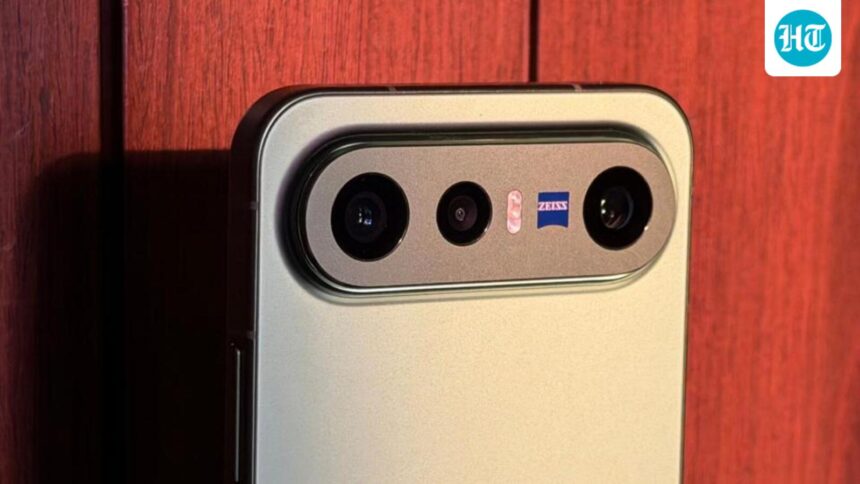
There’s something to be said for the absolutely gorgeous design of the Vivo X300 FE, or Fashion Edition. It all comes together into something incredibly endearing, proving once again that the most beautiful phones don’t have to be the most expensive. This color. Camera module design. Overall thinness. This isn’t a compromised thin phone either, as it’s powered by the flagship Qualcomm Snapdragon 8 Gen 5 chipset, and Vivo has given Zeiss enough photographic credentials that might worry many digital cameras. A compact pioneer, rare as this breed is, and top-notch in specifications across the board.

the $Price: $79,999 for 12GB + 256GB specs $89,999 for the 12GB + 512GB version is, in my estimation, more revolutionary than anything else. This will be in conversation with the Samsung Galaxy S26 ( $79,999 onwards) and Xiaomi 17 ( $89,999) in terms of screen size as well as photographic display. The Xiaomi 17 with Leica credentials sets the standard for this category of devices by far. Vivo has fitted the X300 FE perfectly into the lineup, falling between the X300 (approx $75,999) and X300 Pro (approx $1,09,999) and I expect both the phones to get some revised market prices very soon.
With Vivo’s current flagship offensive (I’ll call it that; the competition is bound to be worrying), it’s necessary to evaluate the photography aspect first. The X300 FE combines a 50MP main wide camera and a 50MP telephoto camera alongside an 8MP ultra-wide camera, on a camera island that’s little more than a thin strip of real estate not much wider than the Suez Canal if we get the metrics right. Look closely and you’ll notice slightly older-generation optical sensors, but that’s nothing to worry about (it’s not meant to be an Ultra or Pro phone), all things considered. It’s also a nice contrast to the larger designs that phones tend to have these days. We now have three distinct design languages - the island style that Vivo’s X300 Ultra, Good choice you have.
For a fair share of the demographics that regularly use a phone camera, the Vivo X300 FE Troika will offer absolutely instant photography. Anything it lacks in sensors is more than made up for by this generation’s image processing pipeline. The key here is that this camera is much better overall compared to phones in this screen size and thickness range – the Galaxy S25 FE, the Google Pixel 10a, and, by and large, the limited versatility of the Apple iPhone Air. Zeiss gives Vivo the real trump card in the X300 FE, as does the camera app which tends to keep a lot of functionality within it that you’ll start to discover layer by layer over time.
Six Zeiss-style bokeh effects, a street photography mode, and a flash portrait reminiscent of larger DSLRs will work pretty well. The flip side is that there are a lot of settings you have to go through in the days after you buy the Vivo X300 FE, before things become more restrictive and controlling in how you want the camera app to be. Once you get past that effort, this is a great enough camera setup that deserves to be in a flagship. There’s nothing to complain about, either in terms of detail, how colors are handled, or dynamic range across lighting conditions. However, the clarity of AI boosting of certain images is not lost on anyone – toning that down, or giving a clear and obvious toggle of choice for the user, may be the way to go.
There is a clear and obvious enhancement to some of the images which adds a sort of unnatural touch (at least visible to more discerning eyes; Instagram audiences probably won’t notice it much). Compared to some other Vivo flagships of this era, the X300 FE’s images look a little cooler in terms of color temperature – is this a factor of the sensor versus the image processing pipeline? Some adjustments may be needed in some images, if you prefer more natural and warmer colours. This is especially true in landscapes, where the greenness of the grass tends to be a bit sparse.
However, overall, the photography results across lighting conditions are impressive. Especially when you start zooming in (and I’m talking about the phone’s telephoto camera, not the telephoto extender). Depending on preference, tonal changes are very much on the agenda with a number of photographic modes, optimized by Zeiss. One could argue that Vivo could have done without the 8MP ultra-wide sensor, which isn’t in the same ballpark as the more capable wide and telephoto sensor.
There’s simplicity to the design of the Vivo X300 FE, and it’s nice to see a flat design that provides the foundation for clean lines and consistent lines. It looks much thinner than it actually is, which isn’t really a bad thing. What I’m reviewing here is the Urban Olive color, and while the aerospace aluminum does its bit for a reassuring build, there’s something about the finish treatment that resists fingerprints and smudges fairly well. This is one of those still-rare compact phones, with a 6.31-inch screen size key to that footprint, which also doesn’t compromise on performance. Keep in mind that this is not a small phone, rather it is relatively more compact when placed facing the base.
Partly a need for differentiation and partly a need for this kind of form factor to keep temperatures under control, using a Snapdragon 8 Gen 5 chip with 12GB of memory makes a lot of sense. One could argue whether it should be 12GB or 16GB taking cues from the direction of the Xiaomi 17 Ultra or Xiaomi 17, but there’s no doubt about the flagship level specs here – and that means performance just as much. Having a 6,500 mAh battery in a phone this compact is no easy feat, as is being able to get through a 6.5-hour screen on time with 25% battery remaining.
A compact flagship phone that is actually a flagship phone remains as rare as a unicorn. The Vivo The design makes it even more impressive, and the price ensures that this isn’t a powerhouse, but it’s actually the final piece of the big puzzle of the X300 flagship portfolio.
(Vishal Mathur is technology editor at Hindustan Times. When he’s not understanding technology, he’s often searching for an elusive analog space in a digital world.)