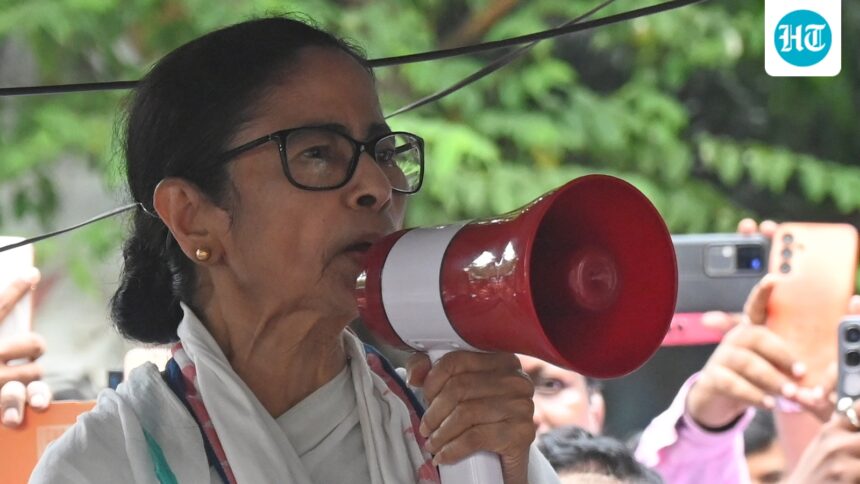
Trinamool Congress founder Mamata Banerjee has launched a personal outreach to recalcitrant and wavering legislators and called a meeting at her Kalighat residence in Kolkata today, in a bid to stop further defections and bring together the party that is facing the first split in its 28-year history.

Mamata Banerjee, 71, who suffered an internal meltdown after the BJP ended her 15-year rule, has in the last two days contacted several MLAs from Howrah, Murshidabad and North Dinajpur, party sources told news agency PTI. Many of them were seen at meetings of the rebel camp led by expelled legislator Ritabrata Banerjee.
Ritabrata’s camp took control of the TMC legislative party on Wednesday after 58 of the party’s 80 members supported his installation as leader of the opposition, a claim accepted by TMC leader Rathendra Bose.
The row was sparked by another meeting in Kalighat where allegations surfaced that the signatures of several MLAs were “forged” on a letter proposing her selection as leader of the opposition.
“She is talking to the legislators individually and asking them to attend a meeting in Kalighat on Friday. The efforts are to keep communication channels open and explore the possibility of reconciliation,” a senior TMC leader told PTI.
The meeting is widely seen as a test of Banerjee’s continued control over cross-border lawmakers, with attendance figures the main indicator.
Division may exceed assembly
The bleeding you are trying to stop extends beyond the pool. More than 100 municipal councilors have resigned from the party, along with leaders including former transport minister Sinhasish Chakraborty, who resigned on Wednesday.
Communication is not limited to the association either.
The TMC has 28 members in the Lok Sabha and 13 members in the Rajya Sabha, and the leadership fears the rebellion could spread to its parliamentary ranks.
Multiple reports said that at least two trusted MPs – one each from the Lok Sabha and Rajya Sabha – have been tasked with contacting their parliamentary colleagues and dissuading them from joining the “new Trinamool” the rebels say they are building.
This concern was underscored on Friday by veteran Rajya Sabha MP Sukhendu Sekhar Roy, who told a TV channel that a similar reaction to the Assembly rebellion was “likely in the Lok Sabha as well”, and warned that the party might “disintegrate and cease to exist”. Roy said he remained in the party only formally.
However, Ritabrata Banerjee said he had not spoken to any MP in seven days, according to ANI.
Senior loyalists rallied behind the head of the transitional military council. Lok Sabha MP Sudip Bandyopadhyay dismissed the rebels, telling PTI that those who left her had “no political standing without her”. MP Sujata Roy told the agency that the BJP may try to stage an operation in the party’s parliamentary units as it did in the Assembly, but added that Banerjee “has fought bigger battles and will bounce back.”
Abhishek is a worker
Mamata Banerjee’s task is complicated by the rebels’ framing of the revolution. 58 local aid organizations stressed that their fight is not against her, but against the growing influence of her nephew and former national secretary-general, Abhishek Banerjee.
A day after the legislative party’s takeover, several rebel lawmakers insisted that she remain the party’s top leader rather than be reduced to chancellor. “We want the party to work under her leadership,” rebel Gulshan Mulik told reporters.
The crisis erupted a month after the TMC lost power in West Bengal to the BJP, which won 207 of the 294 TMC seats to the TMC’s 80, and formed the first BJP government in the state under CM Suvendu Adhikari, himself a former TMC leader, on 9 May.
The TMC got 40.8% of the votes compared to the BJP’s 45.84%, a much narrower gap than suggested by the number of seats. This indicates a consolidation of Hindu votes behind the BJP, HT reported. The split arose over allegations that the signatures of several MLAs were forged on a letter proposing Sobhandeb Chattopadhyay as the leader of the opposition.
The allegations center around an earlier meeting at the same Kalighat residence, where the resolution was drafted and the signatures of several absent MLAs were appended – a matter that is now under a CID investigation and was also raised by CM Suvendu Adhikari.
On Thursday, Banerjee also visited Kalighat temple and offered prayers. For the leader who founded the Transitional Military Council in 1998 and led it for nearly three decades, the immediate battle is no longer about power, but about preserving the organization she built and preventing its further disintegration.