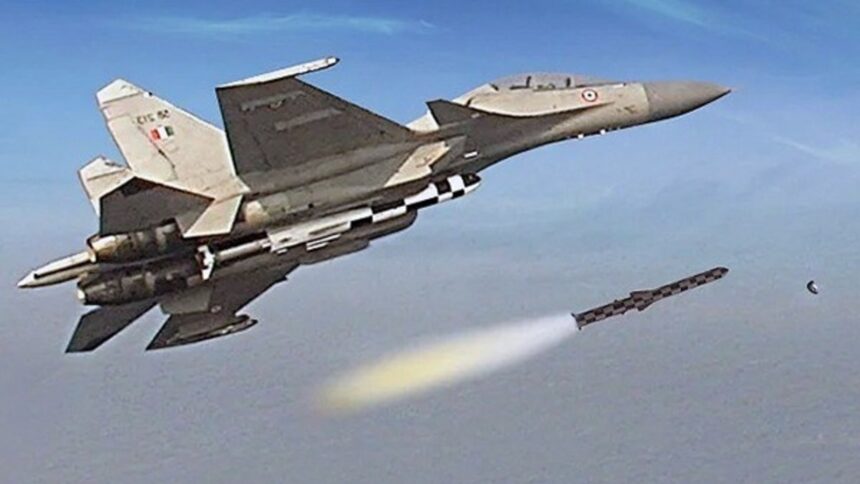
The four-day Operation Sindoor was India’s first stand-off weapons war with the Indian Armed Forces using SCALP, Rampage, Crystal Maze and BrahMos missiles and 155 mm Ex-Calibur long-range howitzer shells. The counter-terrorism operation was different from the 2018 surgical strikes and Operation Bandar (Balkot) of 2018 as the Indian armed forces crossed the Line of Control in Jammu and Kashmir to strike terror camps in occupied Kashmir and up to Manshera in Pakistan’s Khyber Pakhtunkhwa province.

During Operation Sindoor, the Indian Armed Forces used only long-range missiles against nine terror camps in Pakistan and Occupied Kashmir, including the LeT headquarters in Muridke and Lahore and the JeM headquarters in Bahawalpur. While the Indian Armed Forces targeted terror camps in PoK using loitering munitions, a BrahMos missile and a SCALP missile were used to destroy JeM facilities in Bahawalpur, and a Rampage missile and a Crystal Maze missile were used against Muridke.
Not only this, India has used deadly radar munitions like Harpy and Harop to destroy Chinese air defense systems in Lahore, Sialkot, Sargodha and Karachi. Such was India’s dominance and lethality that prompted Pakistan to shift all its operational air platforms to its two air bases in Quetta and Peshawar to escape Indian missiles. The same was the case with Pakistani naval assets, which were transferred to naval bases in Balochistan such as Umara, Pasni and Gwadar.
While Indian S-400 and Meteor air-to-air missiles shot down at least six Pakistani fighters and surveillance aircraft in the air, the air-launched BrahMos missile damaged a number of fighters and transport aircraft on the ground during the strike on 11 air bases during the high-intensity operation.
If the long-range missiles did their job in the Pakistani hinterland, the Indian Army, using Ex-Calibur munitions, crushed Pakistani bunkers over an area of 50 kilometers across the Line of Control. The firing was so intense that the Pakistani army abandoned its positions at least 10 kilometers across the Line of Control.
Although only the Indian Air Force used air-launched BrahMos missiles, the Army and Navy were on standby with their missiles at launch sites. However, the most important aspect of Operation Sindoor is that the Indian air defense system intercepted the Fateh-1 missiles and Turkish drones launched by Pakistan without any minimum collateral damage.
After Operation Sindoor, India invested heavily in standoff weapons and loitering ammunition as there would be no contact war in future. It also asked the Indian Air Force to take necessary precautions to ensure that its hand planes are beyond the reach of Pakistani radars and air defense systems. The fact is that India has moved to the next level of standoff weapons with Russia’s 160 km range RVV-BD air-to-air missiles, 300 km range missiles like PULS, and next generation surface-to-air missiles to protect Indian warships. Future warfare is not about increasing the number of troops, but about advanced technology as the era of ground battles ends.