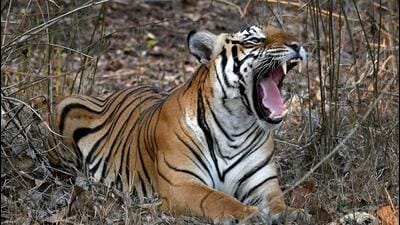
The Goa government has opposed the Supreme Court-appointed Central Empowered Committee (CEC) report that recommended a tiger reserve notification in the state, calling it “vague and without legal or factual basis”.
The CEC, which looked into the matter on the orders of the apex court, recommended that a tiger reserve in Goa be notified in two phases (PTI files)In an affidavit filed in the Supreme Court, Goa Additional Chief Conservator of Forests K. Ramesh Kumar said the committee, which submitted its report to the apex court in November last year, had failed to “apply its mind” to ground realities. The apex court had earlier asked the committee to look into the matter.
Goa approached the Supreme Court challenging the High Court’s July 2023 order that mandated the creation of a 745-sq km reserve in the Madhei region – a move the state has resisted for years.
The CEC, which looked into the matter at the behest of the apex court, recommended that a tiger reserve in Goa be notified in two stages: areas adjacent to the Kali Tiger Reserve in Karnataka should be notified first, followed by other areas.
HT has reviewed a copy of the affidavit dated January 23 by the state government. The apex court will next take up the case on February 16.
More Read

Goa’s primary argument against tiger conservation hinged on the absence of a resident tiger population. Kumar’s affidavit argued that any such proposal must be predicated on the presence of breeding or resident tigers and argued that the CEC report focused on relocating local villagers rather than proving the existence of resident tigers.
“The matter before the CEC was that, in the light of existing facts and circumstances, the Kotigao-Mahadei Forest Complex of Goa consists of five protected areas viz. Mahadei Wildlife Sanctuary, Bhagwan Mahavir Wildlife Sanctuary, Bhagwan Mahavir National Park, Netravali Wildlife Sanctuary and Kotigao-Mahadei Wildlife Sanctuary. Whether an area is reserved or not, a tiger is not a tiger. Declaring it as a reserve is predicated on the presence of breeding/residential tigers in the area concerned,” Kumar said in his affidavit.
“However, a bare perusal of the report shows that the CEC has completely failed to undertake any meaningful exercise to ascertain the presence (permanent or transient) of the tiger population in the Kotigao-Mahadei Forest Complex. Instead, the CEC has proceeded on a false premise by focusing on the location and location of the local population rather than the location of the local population. The population has proceeded as if a tiger conservation notification is a foregone conclusion and the only thing that needs to be checked.” Identification of the area and relocation of the occupants,” the affidavit said.
More Read

It added that Goa already had a framework of protected areas that were scientifically managed and ensured comprehensive protection for all species, including tigers; Conservation of tigers was not necessary only in Karnataka.
“The lack of resident and breeding tigers and the presence of a few transient tigers passing through the region does not automatically necessitate the declaration of the region as a tiger reserve, while the safeguards provided in such regions are sufficient to ensure adequate protection for the transport of tigers.
Goa also underlined that the 2022 National Tiger Conservation Authority (NTCA) report noted that there is no presence of tigers in any of the areas currently proposed to be declared as tiger reserves.
The CEC has recommended that the tiger reserve be implemented in two phases — in the first phase around 468.6 sq km of Kotigao and Netravali Wildlife Sanctuary, which is adjacent to the Kali Tiger Reserve in Uttara Kannada district of Karnataka, will be declared as a core area. km and Bhagwan Mahavir National Park is 107 sq km as the proposed tiger reserve buffer area.
To be sure, NTCA has supported the idea of a tiger reserve in Mhadei Wildlife Sanctuary since 2011. It reiterated its recommendation in 2016 and then again in 2020 after a tiger and its three cubs were found poisoned in the forest it claims is not Goa’s permanent home.
For the Goa Foundation, the environmental group that brought the original case to the High Court, the reserve is an important safeguard against poaching and encroachment. It has not filed its response with the Goa government but said it will do so soon.