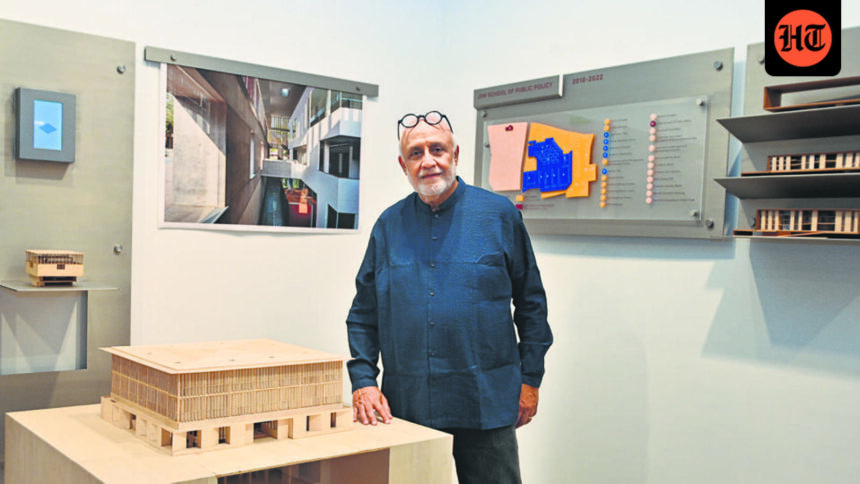
MUMBAI: It has been less than 24 hours since VB Gandhi Marg in Kala Ghoda, where architect-urban-educator Rahul Mehrotra’s studio is located, was cordoned off. Just the previous day, the street and its connected byways were evacuated and vehicles were prevented from entering. A stretch along the road has been converted into a cozy outdoor dining space with shade sails to complete the look, and elsewhere, a potter has set up a booth on the grounds. It was an important moment for the city, as CM Devendra Fadnavis was inaugurating Mumbai’s first pedestrian zone.
But a day later, an hour before noon, it’s back to business as usual. The street is once again filled with lawyers, visitors, brunch patrons, the odd digital creative and their camera-wielding ally looking for an angle for their next content. Parked cars replaced outdoor dining, crowding the newly paved gray basalt stretch on both ends.
Mehrotra, founding director of RMA Architects, who divides his time between Mumbai and Boston, and is here for his new exhibition, smiles as he relays some information about the inconvenience caused by the opening — and, ultimately, endlessly, watches it with indifference. Having played a vital role in designating the fort area as a protected area in the mid-1990s, Mehrotra’s vision for the area is distinctly different from the one implemented on the ground. He saved his comment for later in our conversation, but feels that the obsession with creating a “postcard city” took her away from planning. “Preservation is really a critical tool for planning,” he insists.
Excerpts from the interview:
You have a new show, Contexts, curated by Ranjit Hoskote, dedicated to your work and RMA Architects studio. The last time we saw an exhibition of your practice was four years ago (curated by Kaiwan Mehta). How different will this one be?
Over 15 years ago, Ranjit, Kaiwan and I had conversations about the need to bring architecture into galleries and museums. While art occupies a large space in these institutions, architecture is still largely absent. At the same time, we despair of the built environment around us. This led us to work on three exhibitions [in 2016, 2018 and 2021].
The latest edition, of which Ranjit took the lead, is thematically linked to a conference the three of us held in March entitled “Radical Context.” In this exhibition, Ranjit was investigating the idea of how one can visualize nuance and imagine more radically reading the context in which architects work—context, as we describe it when we teach students in architecture school, is the climate, the physical makeup of a place, and the geology of the site. Some of the more ambitious of us are digging into the hidden history of the site. But one can also place his work in a much broader context of politics, culture, and society. Ranjit is interested in trying to understand how architecture feeds from this broader reading and makes it truly embedded in its setting.
The show was organized independently by him, with almost no involvement from me except for giving him the material of his choice. For me, it was an extraordinary experience, because I began to see a completely new outlook on my work, which I probably felt intuitively, but was unable to express.
Over the past few years, Mumbai has witnessed a radical transformation. The coastal road continues to redefine the city’s coastline, and new metro lines and link roads are being planned, often at the expense of forests and mangroves. What are your thoughts on the direction the city’s development is taking?
Let me illustrate this anecdotally. When I opened these amazing highways to the public – and I used them, of course – I tried to get a reaction from my colleagues. It was always limited to phrases like, “Now, I can reach the airport in 20 minutes,” or “I can finally come from Bandra to have dinner in South Bombay.” These were clearly reactions that came from the car-owning elite, which felt stifled in terms of their individual mobility.
If you look at this more objectively, I think the bigger question, not the ethical one, is the trade-offs that we’ve chosen, which is how many people will benefit from this infrastructure. In Mumbai, only 10 or 12% of people will use or own a private car.
This means that, in a time of climate change and rising sea levels, the massive disruption to the infrastructure of the waterfront environment only benefits a maximum of 12 percent of the population. Now, if 70% of people use the train system, could we instead invest a small portion of that money in air-conditioned trains and stations, modern restrooms and catering facilities, or stations designed to improve last-mile connectivity?
Any city develops through evolutionary and evolutionary situations. Social anthropologist Clifford Geertz used the term “turnaround” to describe Indonesian rice farmers who, because of a World Bank project, were forced to become more productive. So, instead of growing one or two crops, they had to do multiple crops – growing three to four crops at a time – making the system very complex. It became very productive, but it led to internal “convolution” or complexity, which although incredibly effective was prone to glitches. Evolution could have included diversification into multiple modes.
In the context of cities, this is important.
In Mumbai, the last evolutionary movement was New Bombay. Since then, we have never imagined the city as a larger environment. It’s all about getting around. Redevelopment is the ultimate fantasy of evolution – we are able to accommodate more people as we build vertically, but we keep all our assets in a limited space, and make the same space more complex to use.
For any city planning, the relationship between livelihood, housing and mobility is crucial – the holy trinity! Hence the location of amenities follows logically. If mobility is efficient and supported, we can open up well-connected and affordable territories for people to live. Today, the oil crisis has caused the collapse of American suburbs, because they depend on individual mobility to create a practical relationship between housing locations and livelihoods. Unfortunately, we in Mumbai do not pay enough attention to this trinity of areas.
Having invested so much in Mumbai’s built heritage and influencing the politics surrounding it, do you feel that the city authorities today are sensitive to heritage?
The city is in an aimless hurry! For many, it is a golden goose and everyone tries to extract as many eggs as possible as quickly as possible. It is now clear that the relationship between politicians and developers is stark. Therefore, infrastructure is planned and selected to exploit the value of the lands. Therefore, in my opinion only greed drives the city.
It seems that our leadership and elite have lost the ambition to build a good society, and are focusing on the good life. Unless one can put people at the center of perceptions of planning and control or calibrate this greed, we will never be able to have a society centered on civility, the world, the commons, equality, and greater compassion toward the poor in the city.
Anthropologist Arjun Appadurai describes what is happening in our city as “the proliferation of mass construction weapons.”
Mumbai is perhaps the most expensive slum in the world. I am amazed when I go to the homes of wealthy friends; The quality that surrounds them is incredibly dilapidated. You reach an oasis and this does not make the city healthy. If the transitions between public and semi-public, sacred and semi-private and private spaces are not smooth, it is not a great city. In many Of the cities we admire, whether in Europe or elsewhere, this transition from public to private is usually very smooth. In Indian cities, it is brutally surprising. This is a good indicator that we have not gotten our urban form and our larger urban culture right.
Your studio is located in Mumbai’s first pedestrian zone. Do you think this is a step in the right direction?
When we talk about making the pedestrian zone a historic district like the Fort District, it has to be done as a much broader planning exercise. This means that one has to address parking and alternative modes of public transportation such as buses that facilitate the movement of people who decide not to bring their cars. It also means pedestrianizing many other streets at once, so they can work as a network. Infrastructure must be conceptualized holistically. You have to anticipate the implications of that infrastructure, who will benefit from it, and then develop a strategy to implement it. I think what we see 100 yards from Kala Ghoda is at best an expensive and poorly designed icon.
As a young architect in Mumbai, you worked very closely with the late historian Sharada Dwivedi. Together you have written nearly a dozen books, including Bombay: The Cities Within Us. How influential is it as a force in your life?
Sharada was very important for my work in Mumbai because it was an insight into a ‘Bombay’ that I didn’t really know.
I grew up in Mumbai and of course I knew the city and its culture, but I wasn’t nostalgic for the old lost city of Bombay. In hindsight, I am very grateful to Sharadha for sensitizing me to the origins of Mumbai beyond what I researched as a student. [at CEPT in Ahmedabad and Harvard University in Massachusetts].
Spending time with her, researching and accessing the archive, helped me understand more deeply the processes that shaped Mumbai. By learning about these processes – social, cultural and institutional – I was able to better understand the city’s DNA. It was this understanding that later equipped me, for example, to work with my colleagues Sandhya Sawant, David Cardoz, Voi Nissen, and Shyam Chainani, among others, as we got the fort area designated as a protected area.
Sharada has helped build this trust. She was a friend and partner in the scholarship we built, and was the best vehicle for me in trying to understand the politics that surrounded me as a professional in Mumbai.
She is married to architect Nondita Correa Mehrotra, daughter of the late legendary architect Charles Correa. Given your shared backgrounds, what do you enjoy discussing most?
For the most part, my wife worked with Charles Correa and was actually a partner in many of his later projects after the 1990s, which is when we also married. I had worked with him for three years before that, but then I felt like I should have an independent practice and not let those two lives overlap. And so I continued to work with him until his death. We have since worked together on a few projects. I think the great thing is that we don’t spend our evenings discussing architecture, but when we travel together we enjoy visiting buildings and cities and make architecture central to the time we spend together.
How did the late Charles Correa influence your work?
What I appreciate are two things. One was his professionalism. He was extremely professional, not only in the way he worked, but in his ideological and ethical positions, and in the sense of responsibility he felt towards his clients and the wider community. I think he carried that as a very conscious burden. Furthermore, I also learned the responsibility that an architect has to express, share and communicate his values, position and what he believes is important to society.
A dream you have for Mumbai that has not yet come true?
The Mumbai we should all dream of is a city where everyone lives in dignity. And I think the only solution, given the size of the city, is to shift very quickly to big urban visions, which is before we invest in infrastructure and other approaches that open up affordable serviced land and mobility that can connect us all in an equitable way. So, land, equality of land and dignity of living are the most important. I believe that if people have homes they can live in with dignity, they will build their livelihoods, and they will survive. But the house would be very central to this fantasy.