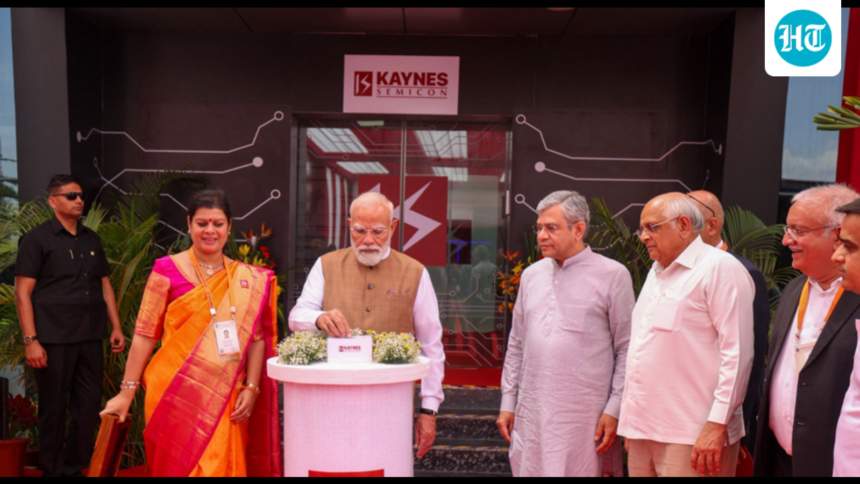
Prime Minister Narendra Modi on Tuesday hailed the pace of growth of India’s semiconductor ecosystem when he inaugurated Kaynes Technology’s semiconductor manufacturing facility in Sanand, Gujarat.

He recalled that he was in Sanand on the last day of February to start production of Micron Technology and returned on the last day of March to the Kaynes facility. “This is not a coincidence. This is evidence of the pace at which the semiconductor ecosystem is growing in India,” he said.
Modi inaugurated Micron’s assembly, testing and packaging facility on February 28, making it the first American semiconductor company to manufacture in India. Kaynes Technology is an Indian electronics manufacturing company. Its facility in Sanand will focus on semiconductor packaging and production of smart power modules for global markets.
Modi said that the units manufactured in Sanand will reach American companies and from there will supply energy to the entire world. “The success of the slogan ‘Make in India, Make for the World’ will resonate in every corner of the world,” Modi said. He added that the products manufactured at the facility have been reserved for export, making them ready for commercial operation from day one.
“A new bridge has been built between Sanand and Silicon Valley,” Modi said. “In the coming days, many Indian companies, through global collaboration, will provide flexible supplies of semiconductors to the world. Today is ‘Make in India, Make for the World’ day.”
Modi said that India’s ambitions in the field of semiconductors have moved from politics to production. He added that the decision to make India self-reliant in the field of semiconductors was taken during the Covid-19 pandemic. Under the Indian Semiconductor Mission (ISM), launched in 2021, 10 projects have been implemented $1.6 lakh crore is ongoing across six states.
The Cainz facility was built with a production capacity of 6.33 million units per day, with investments of approximately $3,300 crore under ISM.
Modi said the government has moved to the next stage with the launch of India Semiconductor Mission 2.0, which has been included in this year’s Union Budget. The aim is to build an integrated Indian semiconductor ecosystem that can play a key role in domestic and global supply chains, he said.
Modi said India is actively promoting industry-led research and training centers to build a future-ready workforce. “The government is on track to exceed its target of training more than 85,000 semiconductor design professionals. Under the Chips to Startup programme, around 400 universities and startups have been given access to modern design tools, resulting in the design and development of more than 55 chips to date.”
He cited industry estimates that put India’s current semiconductor market at around US$50 billion $4.5 million crores. Modi expected it to exceed $100 billion by the end of this decade. “This shows how huge the potential is in this sector in India.”
Modi noted India’s inclusion in PAX Silica, a US-led initiative to secure the global silicon supply chain among countries, including Japan, South Korea, the UK and Israel, in February. He spoke about the National Critical Minerals Mission and $1500 Crore Recycling Scheme.
Modi said the rare earth corridor linking Odisha, Andhra Pradesh, Tamil Nadu and Kerala, which was announced in this year’s budget, will integrate mining, refining and manufacturing into a single national network. He said self-reliance in semiconductors would strengthen India’s position in the areas of artificial intelligence, electric vehicles, clean energy, defence, and electronics.
Modi cited progress in quantum computing, opening up of the space sector to private players, and steps taken to increase the share of nuclear power in India’s energy mix as part of the country’s long-term technology and energy security strategy. “India’s mantra is that this era of the 21st century is not just a time for economic competition; it is a time to shape the technological landscape of the future.”