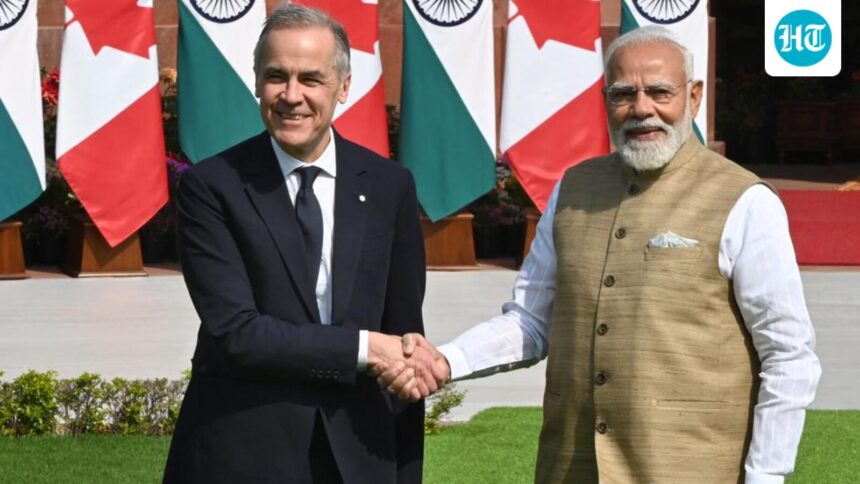
India and Canada on Monday confirmed agreements on critical minerals and supply of uranium ore and finalized terms of reference for negotiations on a free trade agreement, with Prime Minister Narendra Modi and his Canadian counterpart Mark Carney vowing to build on the normalization of relations by expanding trade and deepening security cooperation.

Carney is on a four-day visit to India as part of efforts by both sides to rebuild relations that fell into disarray in 2023 after former Prime Minister Justin Trudeau claimed Indian government agents were linked to the killing of a Khalistani separatist. The rapprochement began when Modi met Carney on the sidelines of the G7 summit in Canada last June, and the two sides later unveiled a roadmap to reset the relationship.
Along with a memorandum of understanding on mining and processing of critical minerals, the Indian Ministry of Atomic Energy and Canada’s Cameco Corporation, one of the world’s largest publicly traded uranium companies, signed a $2.6 billion agreement to supply 22 million pounds of uranium ore during the period 2027-2035. The two sides confirmed their plans to increase bilateral trade, with Modi and Karni stressing the importance of enhancing trade and investments by concluding a trade agreement during the year.
“Since our first meeting, our relations have been filled with new energy, mutual trust and positivity. I thank my friend Prime Minister Karni for the growing momentum in all areas of cooperation,” Modi said during a joint media interaction in Hindi.
“Our goal is to reach $50 billion in trade by 2030. Unlocking the full potential of economic cooperation is our priority. Therefore, we have decided to finalize the Comprehensive Economic Partnership Agreement (CEPA) soon,” Modi said.
Carney, the first Canadian Prime Minister to visit India in eight years, expressed his support for strengthening trade and defense ties in a world witnessing a “profound transformation.” “Like India, we know that the certainties that have governed trade, security, finance and diplomacy for more than a generation have been overturned,” he said, speaking in French.
Carney said the two countries aim to conclude a comprehensive economic partnership agreement “by the end of this year” in order to “reduce barriers, increase certainty and open opportunities for exporters, investors and workers.”
Just over a month after his speech at the World Economic Forum in Davos in which he called on “middle powers” to join hands to confront great power rivalry, Carney said India and Canada were working to expand a “valuable partnership” to chart their own course for the future. Nostalgia is not a strategy, he said, and countries that have partnerships “to build a more inclusive, sustainable and prosperous future” will succeed in this new era.
Modi noted that Canadian pension funds have invested $100 billion in India, reflecting their “deep belief” in the country’s growth, while Carney said these funds have $2 trillion in capital and see potential for growth, especially in infrastructure.
Bilateral trade in goods will reach 13.32 billion Canadian dollars in 2024, while bilateral trade in services will reach 19.61 billion Canadian dollars in the same period. The two sides had called off talks on the free trade agreement shortly before relations collapsed when Trudeau alleged that the Indian side was involved in the killing of Hardeep Singh Nigar, whom New Delhi had labeled a terrorist. India rejected the accusations as “ridiculous” and both sides reduced visa regulations and expelled dozens of diplomats as relations deteriorated.
Work to reset the relationship began with behind-the-scenes meetings between security and intelligence officials from both sides in late 2024. These discussions, which helped address security concerns on both sides, paved the way for senior leadership meetings after Carney won the general election last April.
P Kumaran, Secretary for the East in the Ministry of External Affairs, said at a press conference that Karney’s visit represents an “important inflection point” in bilateral relations, and that the normalization of relations has begun to translate into tangible economic results. He said that over the past year, the two sides have steadily stabilized and normalized relations, and the renewed partnership will focus on reliable technology ecosystems, energy security and talent mobility.
The two sides also decided to launch the India-Canada Defense Dialogue, and Modi said this growing cooperation in the field of defense and security reflects the “deep mutual trust and maturity of our relationship.” He added: “We will work to strengthen defense industries, raise awareness of the maritime field, and military exchanges.”
Carney said the two sides will renew defense and security cooperation through maritime cooperation in the Indo-Pacific region and “practical coordination and cooperation on our shared security interests.”
Against the backdrop of India’s growing energy and rare earth needs, Carney promoted Canada as a reliable source of gas and important minerals. “As India seeks access to critical minerals for its manufacturing, clean technologies and nuclear plans, Canada’s resource base and world-leading companies position it as a strategic partner,” he said.
In addition to supplying fuel for nuclear reactors, the two sides agreed to work together in the field of small modular reactors and advanced conventional reactors. Canada will join the International Solar Alliance and the Global Biofuels Alliance, and the two sides will organize a bilateral renewable energy and storage summit this year.
Noting India’s plans to increase renewable energy capacity by 500 gigawatts and double the share of LNG in the energy mix by 2030, Carney highlighted Canada’s role as a reliable supplier of the world’s lowest-carbon LNG. He also said India could be an important partner in Canada’s drive to double the size of its electricity grid by 2050.
Carney stressed the importance of people-to-people relations between the two sides, highlighting the role of the nearly two million-strong Indo-Canadian community in business, science, culture and government. He said Canada is home to 400,000 Indian students, which is double the number in the United States and four times the number in the United Kingdom.
The new Canada-India Talent and Innovation Strategy, with 13 partnerships to deepen educational ties, will include collaboration with McGill University, the University of Toronto and the University of British Columbia in areas such as artificial intelligence, health sciences and digital architecture.
“People-to-people relations are the driving force of our relationship… New partnerships are being announced between several universities in the areas of artificial intelligence, healthcare, agriculture and innovation. We also agreed for Canadian universities to open campuses in India,” Modi said.
India and Canada also entered into a trilateral Memorandum of Understanding with Australia on technology and innovation cooperation and agreed to establish a center of excellence for pulse protein to enhance food processing systems and nutrition-sensitive food systems. Canada is among the largest suppliers of pulses to India.
Another MoU between the All India Council for Technical Education and Canada’s Mitacs for the Globalink Research Internships program will provide fully-funded training courses to 300 Indian students annually for three years in disciplines such as STEM and humanities. The two sides also finalized memorandums of understanding to promote renewable energy and cultural cooperation. Universities and institutions have concluded a total of 24 memorandums of understanding and partnerships in areas such as artificial intelligence, healthcare and innovation.