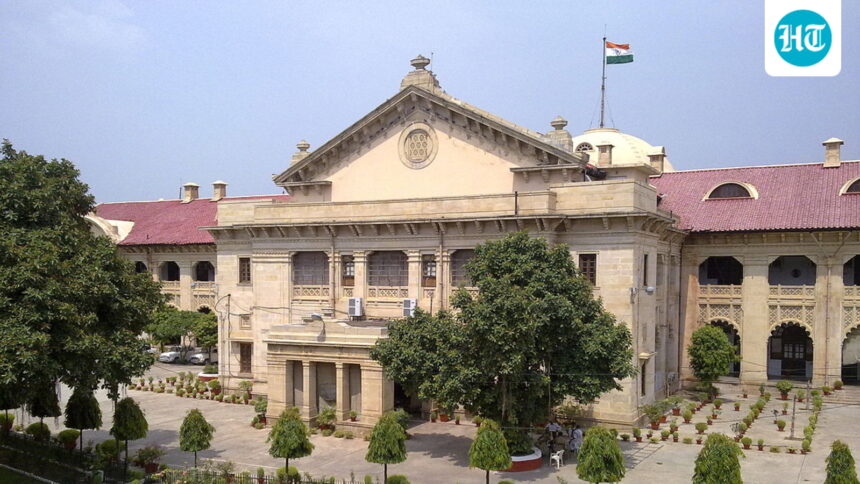
The Allahabad High Court issued a sharp rebuke to the police and bureaucracy in Uttar Pradesh, citing “targeted” actions and killings. During a hearing, the Supreme Court accused the police of working “to please their political superiors” rather than being loyal to the Constitution.

“The vertical loyalty of officers is not towards the Constitution, but towards the polity. Field officers, who have a keen awareness of the economy of transport, calibrate their behavior to please their political superiors,” Justice Vinod Diwakar said in his 31-page judgment in Rajendra Tyagi and others v. State of UP and others.
The bench made these observations while quashing a criminal case against three members of a Ghaziabad-based family accused under the UP Gangsters Act.
In light of the misuse of the law, the court stated in its findings that the strict law had been invoked in a commercial dispute.
Read also | Allahabad HC grants bail to rape and murder accused, criticizes weakness of forensic IR
Highlighting police irregularities in the arrest of Lalita Tyagi, a 35-year-old housewife, the court said she was arrested the next day after filing an FIR without any evidence against her.
“Confronting killings, selective repression and targeted use of the law”
While the specific case was one of a family being portrayed as an organized gang without any evidence of intimidation or violence, the court made sweeping observations about the entire police system in the country.
She spoke of selective killings and crackdowns, saying the state was still driven by the “feudal mentality” of politicians and bureaucrats. “Murder encounters, selective crackdowns and targeted use of gangster law against troublesome individuals have periodically attracted judicial notice,” the bench stated.
“Uttar Pradesh, by virtue of its demographic size and political importance, has historically been a crucible of political domination, driven by the feudal mentality of politicians and bureaucrats,” Justice Diwakar said in the ruling.
The court further emphasized that officers who are perceived as “loyal” are given appropriate positions in the state, while those who act independently are punished.
“Officers who are perceived as loyal are rewarded with favored positions – urban and lucrative district commissioners – while those who show independence are punitively transferred to unimportant assignments,” the court said, adding that this was a “well-known fact.”
Read also | It is time to make top bureaucrats criminally liable: from Allahabad to the UP government
“Treating the rule of law as a practical inconvenience”
The court stated that a “large section” of officers in the state had resorted to viewing the rule of law not as a “constitutional obligation but as a practical inconvenience.”
The panel endorsing its ruling highlighted arrests without due process, registration or cancellation of FIRs for “ulterior motives,” and provisions for preventive detention being invoked “arbitrarily.”
“Procedural safeguards under the Criminal Procedure Code, and now the Bharatiya Nagarik Suraksha Sanhita, are routinely bypassed. Injunctions are complied with in form but defeated in substance,” the court said in a sharp rebuke. Justice Diwakar expressed “deep concern” regarding the role of the home secretary, who is the highest bureaucratic authority in the state’s law enforcement system and the administrative head of the home department.
“Instead of acting as an independent constitutional authority charged with implementing the government’s vision, policies and programs through impartial executive action. The Council stated that some of the officers who rose to the position of Minister of the Interior acted, in practice, as self-serving conduits.”