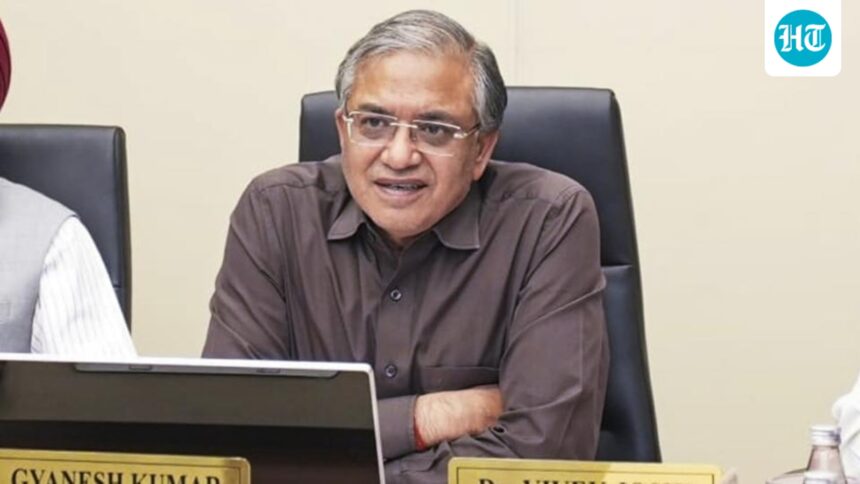
Rajya Sabha Speaker CP Radhakrishnan and Lok Sabha Speaker Om Birla have dismissed the Notice of Opposition against Chief Election Commissioner (CEC) Gyanesh Kumar arguing that the allegations lack necessary evidence, have already been “decided” or are currently under judicial review.

Their separate but similar orders, each 17 pages long, distributed to lawmakers, concluded that while “the allegations are relevant to the political debate, they do not prima facie meet the high constitutional standards for deportation proceedings.”
Lok Sabha Speaker Om Birla also issued a similar order.
The presidents of both chambers said that given the unique constitutional role of the Election Commission, “any proposal to remove the Central Election Commission must be examined with the utmost care and caution, striking a delicate balance between preserving the institutional independence of the Commission and the right of members to submit a proposal.”
She added that for this request to be accepted, there must be “reliable material that reveals a prima facie case.”
Read also | Lok Sabha and Rajya Sabha reject opposition notices seeking removal of CEC Ganesh Kumar
“Misconduct is not conceivable.”
It warned that accepting a proposal “based on administrative disputes or political perceptions” would jeopardize the “independence” of the polling body. “The notice does not show ‘misconduct’ as contemplated under Articles 324(5) and 124(4) of the Constitution,” the order explained.
The two top officials focused on constitutional and legal provisions in the face of “misconduct” allegations against Kumar, the first CEC to face an impeachment notice.
“All non-BJP parties, like-minded parties, we are in touch with each other, and we will get back to you very soon and share our thoughts on this,” said Derek O’Brien of TMVC. Independent MP Kapil Sibal asked whether it was within Radhakrishnan’s jurisdiction to decide the case as a quasi-judicial authority.
In response to the first charge that Kumar’s appointment to the CEC post was compromised — the allegation was that the Leader of the Opposition had defected to Kumar’s appointment and that before becoming the CEC, Kumar had served in senior positions in the administration, revealing his “deep institutional embeddedness within the executive” — the order stated that “the allegations, even if purported to be factually correct, do not amount to any act of misconduct attributable to the CEC.” Central Election Commission.”
The order added that there is a pending litigation over Kumar’s appointment and the Supreme Court has not provided any interim relief or stayed the application of any provision of the law on how the CECs are appointed. It said Kumar had “no individual role in the selection committee proceedings” and that “prior service in government, in and of itself, cannot be construed as an indication of bias.”
“It is an indisputable fact that the vast majority of CECs since the 1950s had served in government prior to their appointment to the CEC, and that experience has never been treated as a basis for a presumption of bias.”
Read also | Exclusive: Why Birla Radhakrishan rejected impeachment notice against CEC Kumar
“partisan behavior”
The second accusation relates to Kumar’s statements regarding allegations of irregularities in the preparation of electoral lists. She said the CEC applied different standards to members of two different political factions – a possible reference to Kumar responding forcefully to allegations of misconduct.
“If any allegation is made in relation to the work of the Chief Electoral Commissioner or any other members of the Commission, it is recommended that such allegations or doubts be addressed during the periodic press conferences held for several decades,” the order said.
She added that while there could be “differences of opinion about the appropriateness of such responses, in the absence of clear and provable evidence of abuse of power or unlawful conduct,” this “cannot amount to such misconduct as to warrant impeachment.”
“Obstructing the investigation”
The third allegation is that the Election Commission of India, under Kumar, did not cooperate in the investigation into election fraud. “In this context, it is firmly suggested that once the legal process is initiated through registration of an FIR, the appropriate recourse for the aggrieved parties or investigating authorities lies in approaching the appropriate court or appellate forum for seeking relief in accordance with law. The mere initiation of such legal proceedings per se, cannot in any way be construed as constituting ‘misconduct’ on the part of the CEC,” the order said.
Read also | Exclusive: EC President Gyanesh Kumar promises a level playing field as five states prepare to vote
Bihar sir
The fourth claim, relating to the SIR of electoral rolls in Bihar, was also dismissed on the ground that “under Article 324(1) of the Constitution, the Election Commission of India is vested with general power to supervise and direct, inter alia, the preparation of electoral rolls.” The order noted that the Supreme Court looked closely at the SIR process. “The issuance of certain observations or directions by the court, with the aim of promoting transparency, accessibility and procedural fairness, cannot, by any reasonable standard, be construed as an indication of ‘misconduct’ on the part of the CEC. Such judicial intervention is an integral part of constitutional oversight and does not in itself imply any wrongdoing,” the order said.
Noting that the court has not yet issued its final ruling, the order said that “any attempt to draw adverse inferences or attribute misconduct at this stage would amount to a premature and unwarranted preemption of the judicial process.”
SIR expansion
The fifth charge concerns the national expansion of the SIR and the alleged political consequences of such action. The order noted that the polling body is constitutionally mandated to “conduct a review of the electoral rolls and ensure their authenticity” and that the finding of doing so “unfavorable to a particular political spectrum is at most a matter of personal opinion and cannot, in and of itself, provide a valid basis for an allegation of misconduct.”
“It is important to emphasize that impeachment proceedings, especially in relation to a high constitutional office, cannot be based on vague and subjective concerns or perceived political consequences, but must be based on clear, specific and sustained foundations. Thus, the impugned assertions, being by their nature speculative, do not meet, prima facie, the threshold required to prove ‘misconduct’.”
Read also | Raghav Chadha on why he didn’t sign CEC’s impeachment notice: ‘Why do you blame me?’
Contempt of court
The sixth allegation related to non-compliance with Supreme Court directions relating to reviews of electoral rolls. “In judicial proceedings, particularly those involving the constitutional rights of citizens to be included in electoral rolls, the court may issue interim directions which shall be binding on all parties involved,” the order said. She added that the refusal to follow these “is appropriately dealt with by the court’s contempt-based jurisdiction. In this backdrop, the present charge fails to disclose any prima facie case of ‘misconduct’.”
“Independence and constitutional fidelity”
The seventh allegation is that there was a failure on the part of the Election Commission of India to maintain independence and constitutional fidelity after Kumar came to power.
The order found that this claim was “cast in broad, generalized and inferential terms” and “lacked any specificity.”