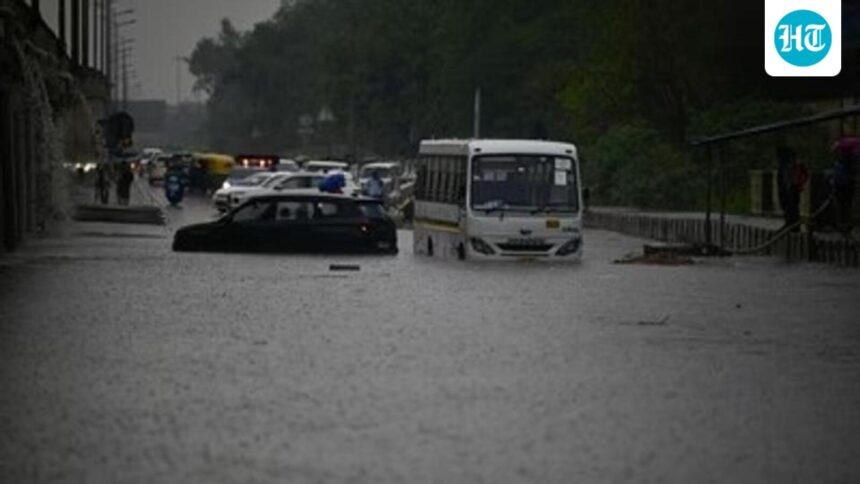
Every few weeks, another Indian city offers a grim reminder of widespread municipal failure or neglect. A wave of heavy rain is enough to paralyze traffic for hours. Roads disappear underwater, or worse, collapse completely. Freshly laid asphalt causes potholes to appear within months. Garbage accumulates despite expensive municipal contracts. Sewage water flows into residential colonies. Water shortages coincide with floods. Electricity supplies remain uncertain in large swaths of the country. Public transportation is either largely inadequate or overcrowded. The air becomes increasingly unbreathable, while open spaces disappear under the harsh concrete.

The collapse of India’s urban infrastructure is no longer accidental. It’s my system. It affects almost every metropolitan city, but nowhere is it more evident than in India’s rapidly expanding tier II and tier III cities. The obvious question is: why?
The first instinct is to blame a lack of money. India’s urban infrastructure certainly requires huge investments. The World Bank estimates that India needs hundreds of billions of dollars over the coming decades just to keep up with urbanization. Municipal corporations remain financially weak, property tax collection is poor, and many local bodies depend almost entirely on state governments for resources.
However, lack of money is only part of the explanation.
India today is the fourth largest economy in the world. We have the resources to build thousands of kilometers of highways, airports that rival the best in the world, impressive railway stations, and stunning bridges. We have demonstrated extraordinary engineering ability when political priority aligns with administrative decision.
So why do ordinary citizens continue to live amid broken sewer drains, overflowing garbage, erratic water supplies, and crumbling roads?
The answer lies not so much in economics as in governance.
Urban governance has become one of the weakest links in India’s democratic architecture. Responsibility is divided between municipal corporations, development authorities, state governments, public works departments, water boards, electricity agencies, transportation companies, and many specialized bodies. Accountability disappears in this bureaucratic maze. Each institution has partial authority, but none bears full responsibility.
Corruption exacerbates the problem immeasurably. Contracts are often awarded not on the basis of competence but on the basis of patronage. Roads are frequently dug up by different agencies due to lack of coordination. Reforms become lucrative opportunities rather than permanent solutions. Preventive maintenance, which costs relatively little, is ignored until expensive reconstruction becomes unavoidable.
But there is another explanation. Those with decision-making power are often insulated from the consequences of their failures. This has deep historical roots. Colonial India institutionalized spatial inequality. The British created the Civil Lines, wide, tree-lined enclaves with wide roads, reliable services, and meticulous maintenance. The Indians inhabited crowded settlements outside these distinct areas. Urban planning itself became an instrument of hierarchy.
Independence brought about a shift in political power, but it did not fundamentally change the geography of privileges. Today, civil lines have acquired different names but still enjoy remarkable flexibility. In Delhi, Lutyens’s Delhi remains distinctly different from large parts of the capital. The wide roads, uninterrupted electricity, efficient sanitation, carefully maintained parks, and prompt municipal attention contrast sharply with neighborhoods where citizens daily face overflowing drains, broken sidewalks, and neglected civic services.
The same pattern exists in state capitals. Those responsible for urban governance often inhabit islands protected from the reality experienced by the vast majority of citizens. It’s hard to get more picky about the potholes we never encounter, the overflowing garbage we never smell, or the public transportation we never use.
Our goal of building “smart cities” is laudable. Digital governance, smart traffic systems, surveillance networks, integrated command centers, and data-driven planning can improve urban management. But no amount of digital sophistication can compensate for unreliable drinking water, dysfunctional sewage systems, collapsing roads, or inadequate sanitation. Sensors cannot replace sanitation. Artificial intelligence cannot replace competent municipal administration.
Gated communities are also not the solution. Across India’s cities, wealthy citizens are increasingly retreating behind high walls, private security, power generation, independent water supplies, and privately run sanitation. These enclaves provide the illusion of isolation from urban dysfunction. But cities cannot survive as archipelagos of privilege surrounded by oceans of neglect.
There is also an uncomfortable truth that citizens themselves must face. We have become overly tolerant of civic failure. The road collapses. We complain for a day and adjust our way. Garbage accumulates; We avert our eyes. Violations multiply. We move around them. illicit construction proceeds; We assume that nothing can be done. We are coming to terms with what should spark continued popular anger.
Democracy cannot function through periodic elections alone. It requires ongoing civic engagement. Resident welfare associations, citizens’ groups, urban planners, civil society organizations and local communities must demand measurable standards of transparent governance and accountability.
The true measure of a nation’s progress is not merely the height of its skyscrapers or the speed of its highways, but the quality of life its citizens can live. Until that happens, our dreams of global leadership will continue to stumble in the holes beneath our feet.
(Pavan K Varma is an author, diplomat and former Member of Parliament (Rajya Sabha). Views expressed are personal)