“To determine the nature of the disputed area we must take into account… the ten established principles [by SC] “In the Ayodhya case,” the Supreme Court ruling said.

The Madhya Pradesh High Court on Friday declared the structure of the Bhoshala-Kamal Maula Mosque in Dhar to be a Hindu temple to Goddess Vagdevi (Saraswati), in a ruling that built, to a notable extent, on the principles of the Supreme Court’s 2019 Ayodhya ruling.

A Supreme Court bench of Justices Vijay Kumar Shukla Alok Awasthi quashed the 2003 ASI order that had regulated worship at the site between Hindus and Muslims. Instead, it asked the state government to consider allocating separate land within Dhar district for the Muslim community to build a mosque. Jain’s claim for the position did not convince the bench.
The immediate dispute centered on an Archaeological Survey of India order in 2003 that allowed Muslims access to the complex for Friday prayers; Hindus were allowed to hold traditional ceremonies on Basant Panchami every year, and were allowed entry every Tuesday. It was this arrangement, governing the memorial that had been under the control of the ASI since 1904, that the Hindu petitioners had objected to as unconstitutional and illegal. This also led to the larger question of whether or not the main structure existed Temple or mosque.
The Ayodhya framework is derived from 10 principles
To determine the religious character of the site, the court relied on the 2019 Supreme Court judgment of Ram Janmabhoomi. The Attorney General had collected 10 principles from this ruling and presented them to the court.
The court wrote in The 242-page judgment read, “The judgment in the Ayodhya case was arising out of a civil suit which was dealing with a claim of ownership of the disputed area. In the instant case, we are of the view that we have to determine the character of the disputed area on the basis of historical literature, architectural features, ASI survey reports etc. To determine the character of the disputed area, we have to take into account the above ten principles laid down by the Supreme Court in the Ayodhya case.”
The principles covered, among other things, the standard of proof, which relied on probability, not mathematical certainty; The scope of judicial investigation, such as proving faith, worship and continuity; and the weight to be given to ASI reports.
Objections to the application of the same principles
Several parties have argued that the Ayodhya ruling – which allowed the construction of the Ram Mandir where the Babri Mosque was demolished in 1992 – does not apply. Senior advocate Salman Khurshid, for one of the defendants, submitted that in the Ayodhya case, the deity known as Ram Lalla Virajman was treated as a legal entity and a named party, which was not the case in the present proceedings.
The defendants also cited the Places of Worship (Special Provisions) Act 1991, saying it barred the petition because the law freezes religious character with effect from 15 August 1947.
The court rejected this argument, saying that the law excludes monuments covered by the Ancient Monuments, Archaeological Sites and Monuments Law of 1958, and the Ancient Monuments, Archaeological Sites and Monuments Law of 1958. The Bhojshala has been a protected monument since 1904. The court also said that Article 226 of the Constitution gave wider jurisdiction to the SC which “cannot be overridden by any legislation” as it forms part of the basic structure of the Constitution.
As for the petition which claimed that the idol recovered from the site was that of Ambika, a Jain deity, the court said that historical evidence and archaeological survey do not indicate that the disputed area was a Jain temple.
“Associated with Raja Bhuj”
The ruling said in its conclusion: “We have noted that the continuity of Hindu worship at the site through its organization over time has never been extinguished.” It ruled that the historical literature established the character of the disputed area as Bhoshala, as a center of Sanskrit learning associated with Raja Bhog of the Parmar dynasty; “…Literary and architectural references including those associated with the Raja Bhoj period indicate the existence of a temple dedicated to Goddess Saraswati at Dhar.”
It then revoked the 2003 ASI order regulating the extent of Hindu worship, and asked the ASI to retain overall administrative control over the monument.
Separate land for the mosque
Another similarity with the Ayodhya ruling is how land can now be allotted to the Muslim community to build a mosque elsewhere.
“In order to secure the religious rights of the Muslim community and ensure complete justice between the parties,” the court said that if the respondent concerned makes an application for allotment of suitable land within Dhar district for construction of a mosque, “the state government may consider the said application in accordance with law.” In the case of Ayodhya rule, it was necessary to allocate land of 5 acres and hence it was in Dhanipur village. There, so far, construction plans have faced rejection due to permit issues.
At the heart of the conflict and a “misnomer”
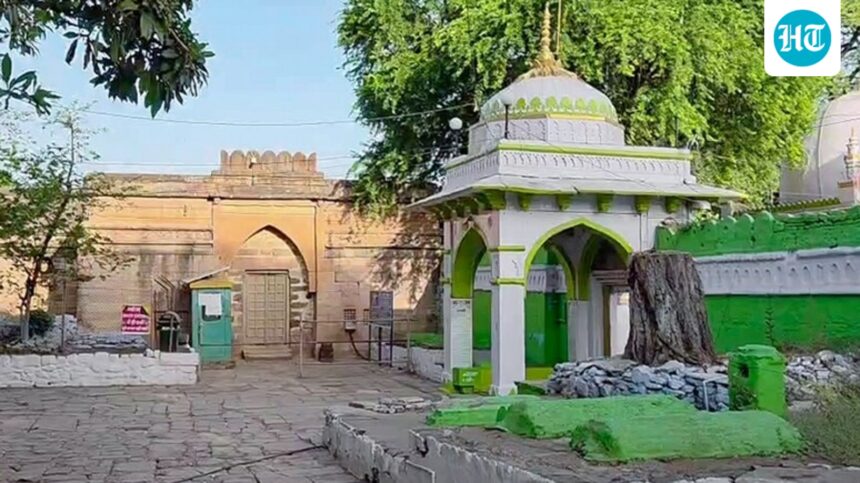
The Bhoshala-Kamal Mula Mosque complex is actually located on two different plots. The Bhojshala, the main disputed structure, was originally a Hindu temple dating back to the 11th or 12th century, and was later converted by the Muslim rulers of Malwa, according to the literature cited in the case. Written by J. Yazdani, director of antiquities in the Nizam’s lands, in 1929 and quoted by the court, described it as being built from “the remains of a Hindu temple”. The 1908 Imperial Dictionary of India, which was also cited by the court, described the naming of the mosque as a “misnomer”.
There is a separate tomb component near the gate of the Bhoshala building, located on a different survey number. It includes four tombs, including one of Sheikh Kamal Mawla, the Sufi figure from whom the complex takes its name. The state government has also mentioned the cemetery as “separate and distinct”.

Arish Chhabra is an associate editor on the Hindustan Times online team, where he writes news reports and explanatory features, as well as overseeing the site’s coverage. His career spans nearly two decades across India’s most respected newsrooms in print, digital and broadcast. He has reported, written, and edited across formats—from breaking news and live election coverage, to analytical long-reads and cultural commentary—building a body of work that reflects editorial rigor and a deep curiosity about the community for which he writes. Areesh studied English Literature, Sociology and History along with Journalism at Punjab University in Chandigarh, and began his career in that city, eventually moving to Delhi. He is also the author of Little Big City: What Life is Like from Chandigarh, a collection of critical essays originally published as a weekly column in the Hindustan Times, which examines the culture and politics of a city that is much more than just its famous architecture – and in doing so, holds up a mirror to modern India. During his stints at BBC, The Indian Express, NDTV and Jagran New Media, he has worked across formats and languages; Mainly English, as well as Hindi and Punjabi. He was part of the crack team for the BBC Explainer project which was replicated around the world by the broadcaster. At Jagran, he developed editorial guides and trained journalists on integrity and quality content. He has also worked at the intersection of journalism and education. At the Indian School of Business (ISB) in Hyderabad, he developed a website to streamline academic research in management. At Bennett University’s Times School of Media in Noida, he taught students the craft of digital journalism: from newsgathering and writing to social media strategy and video storytelling. Having moved from small town to larger town to megalopolis for education and work, his intellectual passions lie at the intersection of society, politics, and popular culture—a perspective that guides his writing and worldview. When he’s not working, he’s constantly reading long-form journalism or watching Cerebral content, and sometimes both at the same time.Read more