New Delhi: India reiterated its commitment to Palestine and continued humanitarian aid to the region when ministers and senior officials from Arab League states met Prime Minister Narendra Modi on Saturday, people familiar with the matter said. An Indo-Arab foreign ministers’ meeting also endorsed the two-state solution.
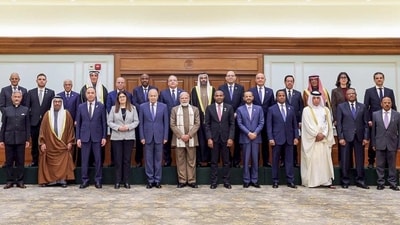
Prime Minister Narendra Modi, centre, poses for a photo with foreign ministers and representatives of the Arab League in New Delhi. (@narendramodi)Representatives of 22 Arab League member states, including Palestinian Foreign Minister Versen Agabekian Shaheen, met Modi, who described the Arab world as part of India’s “extended neighborhood” linked by civilizational ties and a shared commitment to peace, progress and stability.
“Enhanced cooperation in technology, energy, trade and innovation will unlock new opportunities and take the partnership to new heights,” a confident Modi said on social media about the meeting.
The Indian side reaffirmed its commitment to the Palestinian people, including a long-standing development partnership, said the people cited above on condition of anonymity. India has provided bilateral development aid and assistance through organizations such as the United Nations Relief and Works Agency for Palestine Refugees (UNRWA) worth $170 million. Projects worth $40 million are currently being implemented, the people said.
Although the Indo-Arab foreign ministers’ meeting had been planned since last year, it came ahead of Modi’s expected visit to Israel in late February.
More Read

Discussions focused on the shared priorities of advancing the Gaza peace plan, the conflicts in Sudan and Yemen and the common threat of terrorism, with New Delhi stressing the need for coordinated action to strengthen security and stability across the region.
Both sides supported a just, comprehensive and lasting peace in West Asia. A declaration issued after the meeting called for “a sovereign, independent and viable state of Palestine based on the 1967 borders, living side by side in peace with Israel”. Both sides supported the “exercise of the inalienable rights of the Palestinian people”.
Both sides welcomed the outcome of the 2025 Sharm el-Sheikh peace conference, which led to a ceasefire in Gaza, and praised the role of the United States and Arab states, particularly Egypt and Qatar. They called on all parties to fully implement the agreement and noted the launch of an Arab-Islamic plan for relief, recovery and reconstruction in Gaza.
More Read

They welcomed the establishment of the Palestinian Technocratic Committee as a temporary transitional body for the administration of Gaza in line with UN Security Council Resolution 2803, a preparatory step for the second phase of the ceasefire agreement.
Both sides have endorsed a policy of zero tolerance towards terrorism, termed as the most serious threat to peace and security. They condemned cross-border terrorism and called on “all States to refrain from using terrorism against other States, to act collectively to combat terrorism, to dismantle terrorist infrastructure and terrorist financing networks”, and to bring perpetrators to justice. They agreed to strengthen joint efforts to counter terrorism, including recruitment, transfer of funds and misuse of new technologies to carry out terrorist activities.
The foreign ministers of the Arab states strongly condemned the terrorist attack in Pahalgam which targeted tourists and reiterated their full support to India and the Arab states in countering terrorism.
All members of the Arab League attended the meeting, although only seven countries sent ministers, including the United Arab Emirates, Libya, Oman and Qatar.
External Affairs Minister S Jaishankar said that advancing a comprehensive plan to end the Gaza conflict based on UN Security Council Resolution 2803 is a widely shared priority. Pointing to the transformation of the global order due to politics and economics, he said: “Nowhere is this more evident than in West Asia or the Middle East, where the landscape itself has undergone a dramatic change in the last year. This obviously affects all of us and affects India as a nearby region.”
While the situation in Gaza has been focused on, Jaishankar pointed out other challenges such as the conflicts in Sudan and Yemen, which have implications for the security of maritime navigation.
More Read

“Then there is the concern over Lebanon, where India has troops committed to UNIFIL. Where Libya is concerned, we all have an interest in advancing the national dialogue process. The direction of events in Syria is also important for the well-being of the region,” he said.
Jaishankar described terrorism as a common threat in both regions. “Border terrorism is particularly unacceptable because it violates the basic principles of international relations and diplomacy,” he said.