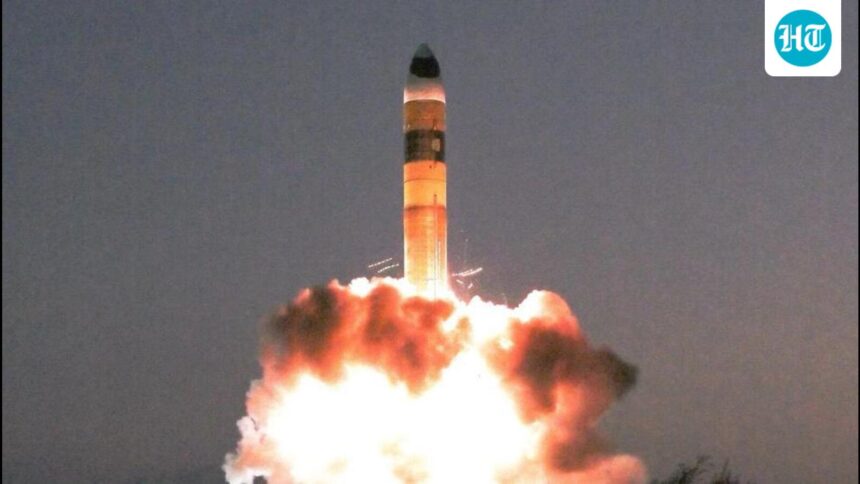
The Indian Ministry of Defense said on Saturday that it had conducted a successful flight test of the advanced Agni missile equipped with Multiple Independently Targetable Reentry Vehicle (MIRV) technology. This capability allows the weapon system to launch multiple nuclear warheads at enemy targets spread across hundreds of kilometers.

The indigenously developed Agni-5 missile with MIRV technology was test-fired on Friday from Dr APJ Abdul Kalam Island in Odisha, a step towards enhancing the country’s strategic deterrence capability. “The missile was tested with multiple payloads… (directed) at different targets spatially distributed over a large geographical area in the Indian Ocean region,” the Ministry of Defense said, adding that the flight data confirmed the achievement of all mission objectives.
Telemetry and tracking were performed by multiple ground and underground stations. These systems tracked the missile’s path from liftoff to impact. He added: “With this successful experiment, India has once again demonstrated the ability to target multiple strategic targets using a single missile system.”
There was no official information on how many warheads the MIRV version of the Agni-5 could carry, although military scientists tracking the project estimated the number at four or five. Defense Minister Rajnath Singh said this would add “an amazing capability to the country’s defense preparedness against rising threat perceptions”.
India conducted the first flight test of the Agni-5 missile with MIRV technology in March 2024. Prime Minister Narendra Modi then revealed the code name for the historic test, Mission Divyastra (Divine Weapon). It has pushed India into an exclusive league of countries with the capability to deploy MIRV missile systems, including the US, UK, France, Russia and China.
The Agni-5 missile, which uses a three-stage solid-fuel engine, has a range of more than 5,000 kilometers. MIRV can cause greater destruction than conventional missiles carrying a single warhead. Other versions of Agni missiles developed by the Defense Research and Development Organization (DRDO) include the Agni-1 (700 km range), Agni-2 (2000 km range), Agni-3 (3000 km range) and Agni-4 (4000 km range).
The Agni-5 MIRV system is equipped with domestic avionics and high-resolution sensor packages. A woman scientist from DRDO guided the 2024 test, in which other women scientists also participated.
India’s nuclear doctrine, which India announced in 2003, adheres to the “no first use” principle, whereby weapons may only be used in response to a nuclear attack on Indian territory or forces. In a position that reflects the capabilities India has built up over the years, the doctrine states that nuclear retaliation in the event of a first strike would be massive and designed to inflict unimaginable damage.
Retaliatory attacks can only be launched with the permission of the civilian political leadership through the Nuclear Command Authority, which consists of a political council and an executive council. The Prime Minister heads the Political Council, while the National Security Advisor heads the Executive Council.
The state can carry out nuclear strikes with combat aircraft and missiles launched from land and sea. In April, the Navy commissioned its third nuclear-powered ballistic missile submarine, INS Aridaman, during a closely-guarded ceremony in Visakhapatnam, where it was built under a top-secret program to strengthen the sea portion of the country’s nuclear triad — the ability to launch strategic weapons from land, air and sea. The United States, Russia, the United Kingdom, France and China are the only other countries that can launch nuclear warheads from a submarine.
India has more nuclear weapons than Pakistan, but Beijing’s strategic arsenal is larger than New Delhi’s, the Stockholm International Peace Research Institute (SIPRI) said in a yearbook released last June. It pegged the number of nuclear warheads in the Indian arsenal at 180 as of January 2025, compared to 600 for China and 170 for Pakistan.