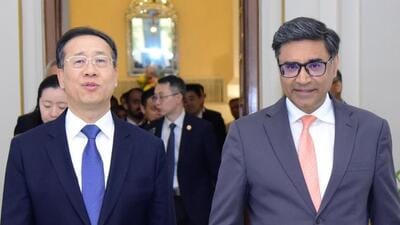
Foreign Secretary Vikram Misri and his Chinese counterpart Ma Zhaoxu held a strategic dialogue on Tuesday to review the process of stabilizing and rebuilding bilateral relations, including increasing air connectivity and visa facilities and discussing “concerns on sensitive issues”.
Misri cited the successful resumption of the Kailash Mansarovar Yatra, which the two sides agreed to resume in 2025 after a gap of five years, the statement said. (X/MEAI India)Ma, Executive Vice Foreign Minister of China’s Ministry of Foreign Affairs, was in New Delhi to attend the BRICS Sherpa meeting on February 8-10. His meeting with Misri was part of the ongoing engagement between the two sides since they reached an agreement to end the military standoff in the Ladakh sector of the Line of Actual Control (LAC) in October 2024.
Misri and Ma discussed various bilateral, regional and international issues and their talks “primarily focused on recent progress in stabilizing and rebuilding bilateral relations and ways to advance bilateral engagement”, the foreign ministry said in a readout.
External Affairs Ministry spokesperson Randhir Jaiswal said on social media that the two sides “discussed ways to further advance relations by increasing people-to-people exchanges and addressing concerns on sensitive issues”. He did not elaborate.
“Both sides emphasized the importance of peace and stability in the border areas for the overall progress of bilateral relations,” the readout said. They reiterated their commitment to implement the guidelines given by the leaders of India and China, which include “the need to move forward in a political and strategic direction to address issues and concerns related to bilateral trade”.
More Read
India has long raised concerns about China’s limited market access and non-tariff barriers, which have hindered exports and hampered two-way trade in favor of China. With bilateral trade touching a record high of $155.62 billion in 2025, India’s trade deficit widened to $116.12 billion.
India is also concerned about China’s ban on exports of strategic items including rare-earth magnets, fertilizers and heavy machinery. These concerns were taken up with the Chinese side last year, leading to limited concessions.
The readout said Misri noted the successful resumption of the Kailash Mansarovar Yatra, which the two sides agreed to resume in 2025 after a five-year gap, and hoped for “continuous expansion of the scale” of pilgrimages to Tibetan holy sites.
More Read

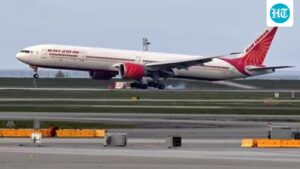
Both sides “recognized the need for early completion of an updated air services agreement”, and agreed to continue “concrete steps to facilitate visa facilitation and promote people-to-people contacts”, the readout said.
The two sides discussed multilateral cooperation, in the context of India’s BRICS presidency this year, and the Chinese side expressed support for a successful summit. Ma “expressed that China understands and respects India’s desire for UNSC membership”, the readout said.
A statement by China’s foreign ministry focused on the need for New Delhi and Beijing to build better bilateral relations against the backdrop of “complex and profound changes in the international situation”. It noted that the two sides had “friendly, frank and deep communication” on international and regional situations and bilateral relations.
The Chinese side called for the implementation of the common understanding reached by the leadership of both countries and to support the strategic concept of “China and India are cooperative partners rather than rivals” and each other’s “opportunities for development rather than threats”. They should deepen mutual trust and properly manage differences, the statement said.
Soon after agreeing to end the deadlock in the LAC, Prime Minister Narendra Modi and Chinese President Xi Jinping met in Russia in October 2024 and agreed to normalize relations and revive various processes to resolve the long-standing border dispute. Clashes at the LAC and a brutal clash in the Galwan Valley in June 2020, in which 20 Indian soldiers and at least four Chinese soldiers were killed, took bilateral relations to their lowest level since the 1962 border war.