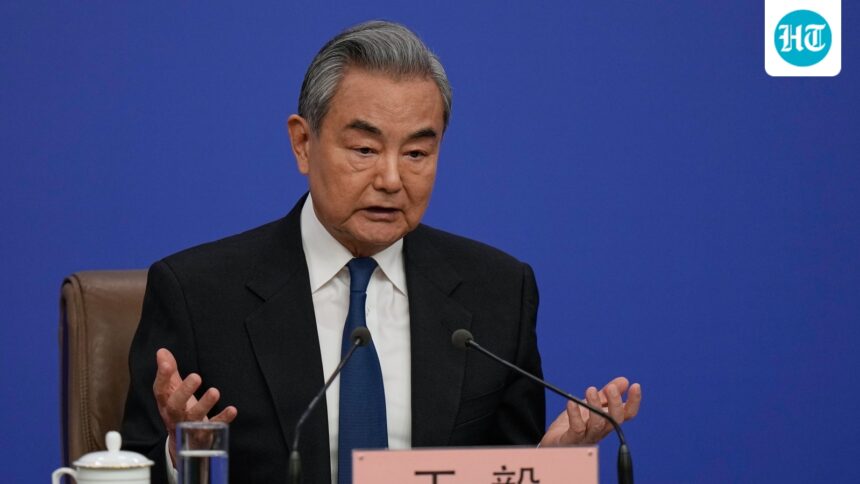
India and China should view each other as “partners rather than competitors” and “an opportunity rather than a threat,” Chinese Foreign Minister Wang Yi said here on Sunday.

In his annual press conference on the sidelines of the meetings of China’s parliament, the National People’s Congress, Wang said that the two countries should adhere to the direction set by Prime Minister Narendra Modi and President Xi Jinping to improve relations without interference.
Wang said Modi and Xi had a successful meeting in Tianjin last August. He added: “Building on the fresh start provided by their meeting in Kazan in 2024, the Tianjin Summit brought about further improvement in China-India relations.”
“We are pleased to see the revitalization of interactions at all levels, a new record in bilateral trade, and closer people-to-people exchanges. All of this has brought tangible benefits to the two peoples,” he said.
Regarding the future course of relations, Wang said the two countries “should maintain the correct strategic perception of each other as a partner rather than a competitor, and an opportunity rather than a threat.”
He added: “The two sides should also uphold good-neighborly and friendly relations, jointly work to safeguard peace and stability in the border areas and focus on development.”
“As each other’s important neighbors and members of the Global South, China and India enjoy profound civilizational ties and share broad common interests,” Wang said.
“Mutual trust and cooperation are beneficial to the development of the two countries, while division and confrontation are harmful to the rejuvenation of Asia,” the Chinese foreign minister said.
He added that both sides should follow the directions set by the leaders and remove interferences.
He said that India and China should support each other in hosting the BRICS summits. While India is scheduled to host the summit this year, China is scheduled to host the summit in 2027.
BRICS, which originally consisted of Brazil, Russia, India, China and South Africa, later expanded with the inclusion of Saudi Arabia, Egypt, the United Arab Emirates, Ethiopia, Indonesia and Iran.
India-China relations, which were frozen for five years due to the military standoff in eastern Ladakh, began the normalization process after two summits between Modi and Xi in Kazan in Russia in 2024 followed by a second meeting on the sidelines of the Shanghai Cooperation Organization summit in Tianjin last year.
The two sides resumed visa and flight services, in addition to initiating a series of measures to normalize their relations.
China hopes this year will be a “historic year” for its relationship with its biggest rival, the United States, Wang said, striking a largely positive tone ahead of an expected summit between the leaders of the two countries later this month.
Wang said it was a “big year” for the relationship between the two world powers. He said that although there were many differences, “the presidents of the two countries personally maintained good exchanges at the highest level,” providing a level of “strategic guarantee” for bilateral relations.
US President Donald Trump is scheduled to visit Beijing to hold a summit with Chinese President Xi Jinping at the end of March. Although Wang did not confirm the visit, he indicated that Beijing was looking forward to a less tense relationship. “The agenda for high-level exchanges is already on our table. What we need to do now is for the two sides to make comprehensive preparations, foster a favorable atmosphere, manage existing differences, and eliminate unnecessary distractions,” Wang said. “China’s attitude has always been positive and open, and the key is for the US side to meet us halfway.”
Trump and Xi agreed to a temporary trade truce last October, which temporarily halted the highest tariffs, but did not resolve any of the deeper underlying issues.