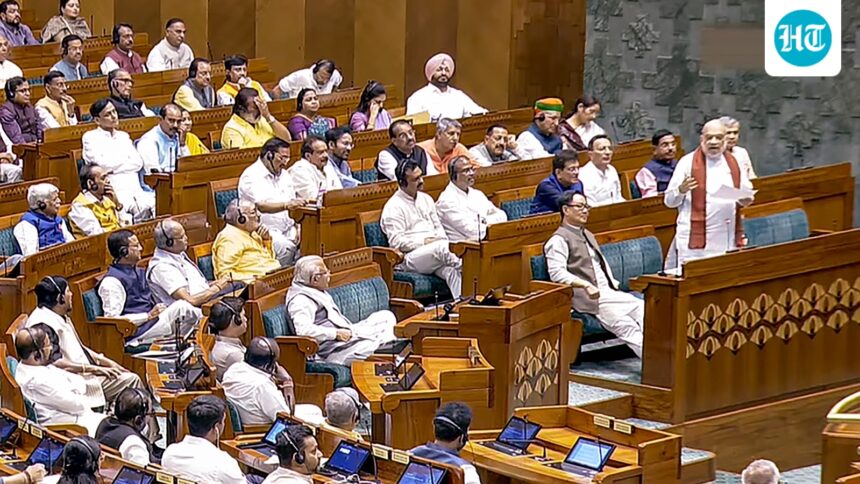
Parliament reconvened on Thursday to discuss and (possibly) vote on three bills that would lead to the redistribution of Lok Sabha seats among states, the delimitation of constituencies, and the reservation of 33% of new constituencies for women. The women’s reservation portion of the legislative agenda is, historically, the least controversial.

While the bills still do not provide for this in writing, the government is insisting – and the Union Home Minister has confirmed in the House – that the proportion of Lok Sabha seats at the state level will remain the same after the changes. This brings us to the third exercise: demarcation, which will involve redrawing electoral district boundaries.
Demarcation to redraw the boundaries of electoral districts
In a majoritarian system (FPTP), it is always difficult to predict the translation of vote shares into seat shares – the latter determining the win or loss of power. The main driver here is the nature of the competition. Fragmented competitions can generate a higher share of seats even with lower vote shares than bipolar competition. However, redrawing electoral district boundaries could also make a big difference.
This is especially true when political loyalties are divided along caste and religious lines, as is often the case in much of India. In theory, there is also the possibility that redrawing electoral districts that could confine potential opposition supporters (a particular caste or religion) to a smaller number of electoral districts could help the ruling party.
Perverse incentives around redrawing electoral boundaries are not limited to India. This feature and debate exists in many democracies and there is a term for it: gerrymandering.
No change in seat share state wise?
At least one Congress speaker in the Lok Sabha, Gaurav Gogoi, has accused the government, alleging that its real intention behind the proposed delimitation exercise is to manipulate for political gain. How true are such allegations? It is impossible to answer this question now. The currently proposed demarcation is certainly not the first in Indian history. What are the previous experiences on this front?
Close examination of this argument requires comparing quantitative and qualitative changes in the characteristics of electoral districts in previous delimitation processes.
There is no reliable data on the qualitative characteristics of electoral districts because electoral lists are not disaggregated by class and religion. This leaves us with limited opportunity to compare quantitative characteristics of electoral districts.
Concerns have been raised about cheating
Yesterday, these pages showed that the number of voters varies greatly between parliamentary constituencies and even within states. This means that the guidelines and legal provisions for delimitation cannot help in creating ideal constituencies where each constituency has an approximately equal number of voters.
The latest delimitation guidance document only stated that “the constituencies should be redrawn so that the population (based on the 2001 census) of each parliamentary and assembly constituency in the State is, so far as practicable, the same throughout the State.”
It is clear that there is no mandate to reach an equal number of voters per electoral district, only the number of residents. Even if the proportion of voting-age population in each constituency’s population is the same, registered voters can always differ depending on dead voters, as the Special Intensive Review (SIR) exercise has shown.
The new demarcation bill has not yet been passed, but there is no reason to believe that its guidelines, at least on paper, will suggest something very different from the demarcation of 2008. We also have a preliminary look at what the demarcation process will look like under the current government since demarcation has already been done in the union territory of Jammu and Kashmir and in the state of Assam. These two were not subject to border demarcation in 2008.
How can the boundaries of 2023 in Assam and 2022 in Jammu and Kashmir be drawn on the basis of the principle that the constituencies are largely equal in terms of number of voters? Does it represent an improvement or deterioration over the previous arrangement in this regard compared to the previous arrangement for border demarcation?
Here’s what the data shows.
The constituencies still show very high variation in the number of voters.
In Assam, the Assembly constituency (AC) with the smallest electorate had just 50% of the average electorate per constituency in the 2024 Lok Sabha elections, the first post-delimitation election. This number was 63% in the 2019 Lok Sabha elections. At the other extreme, the number changed from 220% in 2019 to 156% in 2024.
The overall picture is certainly less radical than these extremes suggest, but a quarter of state advisory boards had a deviation of more than 20% in both cases from the average number of voters per AC in 2024. This situation was much the same in 2019 as well. Things are not much different in Jammu and Kashmir before and after demarcation either. These trends also hold true when looking at the parliamentary constituencies of Assam and Jammu and Kashmir. (See chart 1)
What about the 2008 demarcation that happened when the Congress, not the BJP, was in power? Comparing the country-level divergence between the actual voters in a parliamentary constituency and the average electorate for each constituency shows that outliers were present in both 2009 and 2004, i.e. in the post-demarcation and pre-demarcation elections. However, the degree of extreme divergence in most major countries decreased after border demarcation. Most major states also saw PC counts decline by more than 20%. (See chart 2)
As discussed above, the quantitative distribution of voters is only one part of the debate over what the government will call gerrymandering, while the opposition calls gerrymandering.