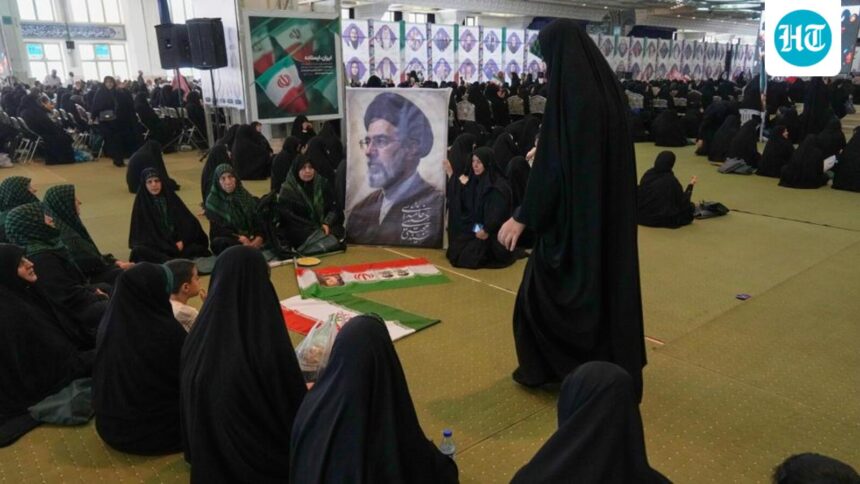
For more than a decade, India has been steadily deepening its ties with the Gulf, while trying to balance competing interests across West Asia. But today, that strategy is under pressure – amid the Iranian conflict, shifting regional alliances, and a resurgent Pakistan.

How does the Iranian crisis affect India? What do these geopolitical shifts mean for India’s policy in West Asia? Kabir Taneja, a West Asia analyst, discussed these questions and more in a recent episode of Grand Tamasha, a weekly radio show on Indian politics co-produced by Hizb ut-Tahrir and the Carnegie Endowment for International Peace.
Taneja is executive director of the Observer Research Foundation’s Middle East office. He has worked extensively on India’s relations with the Middle East, studying domestic political dynamics, terrorism, non-state armed actors, and the evolving security architecture in the region. He is also the author of The ISIS Menace: The World’s Most Feared Terrorist Group and Its Shadow in South Asia.
Speaking to host Milan Vaishnav, Taneja highlighted Israel’s increasing centrality in India’s foreign and defense policy. “India sees Israel as a Walmart for high-end defense technologies,” he joked. “India has fought wars with Pakistan and China, with varied outcomes, over decades, and has a constant requirement and appetite for advanced defense equipment because its borders are so fluid.”
Israel is one of the countries “where India has found comfort — where it can go and pick up everything it needs for its defense needs,” Taneja said. He pointed out that the rapprochement between India and Israel stems from the fact that both countries face significant opposition regarding their national security requirements.
When it comes to Pakistan’s new importance as a mediator in West Asia, Taneja strikes a skeptical note. He said: “I do not believe that Pakistan has the ability or insight to develop a strategy beyond three months.” “The Pakistanis know they have nothing to lose. When you have nothing to lose, it is very easy to shoot in the dark. If something happens, that’s great, and that’s pretty much what happened.” Pakistan currently enjoys the blessings of many regional players, but this does very little to fix its long-term institutional problems, Taneja added.
Regarding the feasibility of India’s strategy of multiple alliances, Taneja expressed doubts that India’s hedging strategy will change any time soon. “India can choose not to hedge in West Asia, but I don’t see how India would benefit from going completely in one direction — whether with the Gulf states, Iran, or Israel,” he said. “The fact that all these players in the region have appreciated for decades that India does not take positions on regional conflicts and deals with every relationship bilaterally has benefited India,” he added.
He added that the broader question that India must confront is whether it wants to become a global geopolitical power. “If that happens, India will at some point be at a turning point where it will have to decide which path to take,” Taneja said. “For India to become a superpower, its fundamental calculus may have to change and move a little more towards grand strategy rather than how to win the next election,” he added.