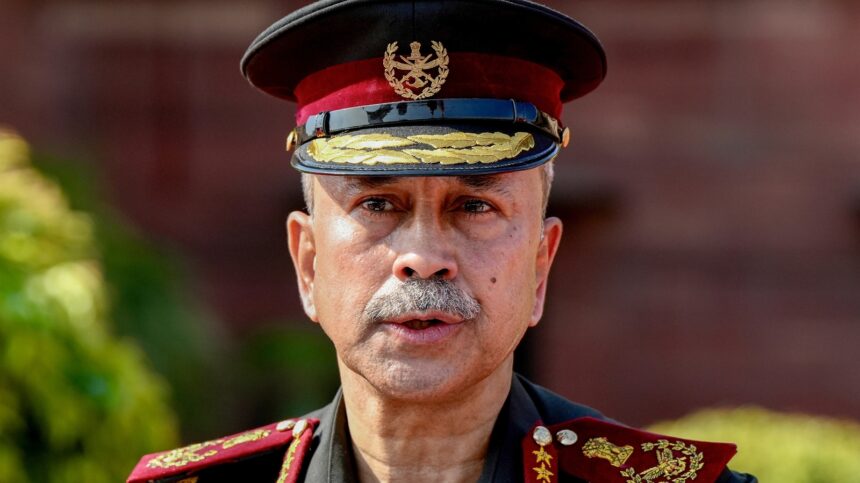
General NS Raja Subramani took charge as India’s new Chief of Defense Staff on Sunday, succeeding General Anil Chauhan, who completed his tenure as the country’s most senior military officer on Saturday.

This appointment comes at a critical time as the armed forces move forward with theater transition, a long-awaited reform aimed at combining military resources and capabilities for future warfare.
The primary focus of the new CDS
Soon after assuming charge, the officer said promoting the transformation of the armed forces and implementing organizational reforms to improve the integration and coordination of the tri-services would be among his top priorities.
“We will work to accelerate the development, introduction and integration of indigenous weapons into our armed forces,” he said in a brief media statement.
He said, “Our armed forces have consistently demonstrated professionalism and operational decisiveness in protecting our national interests. We are committed to protecting our country’s sovereignty and territorial integrity.”
“I assure the citizens of India that the Armed Forces will continue to serve the nation with dedication, courage, honor and professionalism,” he added.
He also said that efforts would be made to accelerate the development, introduction and integration of indigenous weapons systems across the armed forces.
India gets a new CDS: Who is General NS Raja Subramani?
General Subramani is the third Army officer to serve as Defense Commander, after General Bipin Rawat and General Chouhan.
A graduate of the National Defense Academy in Khadakwasla and the Indian Military Academy in Dehradun, he was commissioned into the 8th Battalion of the Garhwal Rifles on 14 December 1985.
He is a year younger than Army Chief General Upendra Dwivedi and Indian Air Force Chief Marshal AB Singh, who are scheduled to retire in June and October respectively.
The new CDS is expected to accelerate the establishment of joint services commands, one of the central goals of the theater program. These orders are intended to bring together personnel, assets, and operational resources from the Army, Navy, and Air Force under a single commander-in-chief.
With input from agencies