Dear reader,

Do you find it difficult to read some award-winning novels?
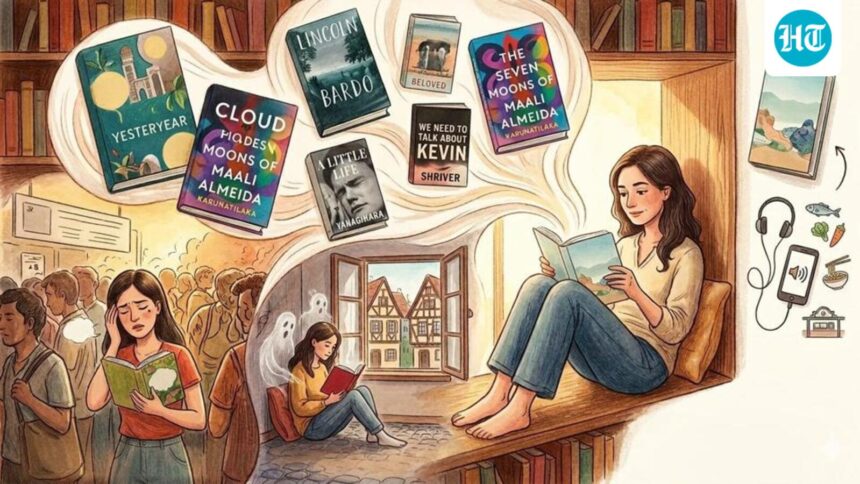
Like One Hundred Years of Solitude? I was eighteen and staying at my uncle’s house, taking Delhi Transport Corporation buses to Delhi University and standing in long queues for admission, when I started reading this beloved book about magical realism. I would read a page or two and then put it aside.
This continued for several days. I think there was a lot going on in my life at that time. But somehow, it made me feel like a failure, not being able to read a book the world was raving about.
Over the years, I have collected evidence. I read Beloved by Toni Morrison a few years ago. I spent evenings alone in a small studio apartment on a cobblestone street in Colmar, France, living and breathing the horrific ghostly world of Sethe and Beloved. I read Russian novelists, loved reading the very complex Cloud Atlas, and stuck to tough, sexy books like A Little Life. Wasn’t this proof enough that I was not lazy in my literature?
But then I would pick up books like Lincoln in the Bardo by George Saunders, winner of the Booker Prize, and The Seven Moons of Her Excellency Almeida. And every time, after ten or twenty pages, I would stop. Both books felt surreal and strange, with no characters I could identify with or a story that made sense to me. Critics said: “Devastatingly moving”, “an luminous feat”, “a biting satire”. I tried again. And I failed. The third time, both books were book club reads. Because I needed to read them, I read the first fifty pages of each as if it were a textbook. And then I couldn’t put either of them down.
Maybe that’s what I need to do with “Taiwan Travelogue,” winner of this year’s International Booker Prize. When it first appeared on the Booker Prize longlist, I snapped it up. I was immediately overwhelmed by the unfamiliar Japanese and Taiwanese geography and history. I put it aside and picked up Yesterday’s Lively instead.
I tried again, this time with an audio version. Listening to the names of stations on the railway, the names of cities and tourist attractions gave the book a different flavour. Hearing the cadence of the unfamiliar language spoken aloud stripped the page of visual terror; My eyes no longer stumbled over the syllables, allowing the atmosphere to finally wash over me.
Additionally, there seems to be an interesting tension between the Japanese writer visiting Taiwan and her local guide. But it was night, the end of a long day full of errands, and I quickly fell asleep.
One rainy evening, after spending a day with the plumbers trying to locate the source of the leak, I decided to go to bed early. Raindrops fall steadily on the tin roof above me, and the wind whistles. But inside, a bedside lamp casts a warm yellow glow on my room, and I feel warm and dry. I picked up the Taiwan trip book again. For the third time.
The geography, history, and even the descriptions of the food seem somewhat obscure. Here is one such clip:
“I was able to eat a packet of sushi rice, a banquet-sized plate of sashimi, stewed sweet fish, grilled mushrooms, fried burdock roots, bamboo shoot salad, sweet tamagoyaki omelet, shredded yam with salted seaweed, steamed chawanmushi egg custard, clear clam broth, and finally unagi.”
I know sushi. I know sashimi. But then – burdock roots? Chawanmushi? The list keeps moving, not caring whether or not I keep up with it. I read about Aoyama eating all this and I can’t even pronounce it.
But this time, I stay with the novel, slow down, and pause to highlight sentences like these:
“Rushing to catch a bus or train, rushing from one attraction to another – this kind of ‘touring’ is just getting around, not ‘travelling’.”
Does this apply to books as well? There is a difference between rushing through a book and immersing yourself in it, living with its characters, feeling their feelings, and inhabiting it.
I finished reading the “Jute Soup” chapter, then turned off the Kindle and the light, thinking about this Japanese-to-English translation of a novel with the word “Journey” written by a Japanese writer traveling to Taiwan.
There is something familiar about these classes, even if the geography is completely foreign. I grew up in a country that was still sorting out what the British left behind – railways and bureaucracy – where the English language was always declared superior even as it languished inside our beings like a borrowed tongue. Japanese-occupied Taiwan has its own version of these deposits.
The Taiwan trip feels like a trick of the light, a prism at times.
Four languages, three countries, a rainy evening, and finally, a way into a world of shared sedimentary colonial and sectarian histories that are inextricably linked to my own. Beneath the unfamiliar geography, hierarchies of food, family, and power force me to think about my own. I’ve stopped rushing. I’m finally traveling.
(Sonia Dutta Chowdhury is a Mumbai-based journalist and founder of Sonya’s Book Box, a personalized book service. For all questions on life and literature, email sonyasbookbox@gmail.com.)