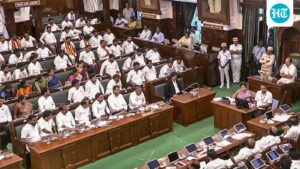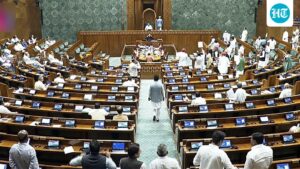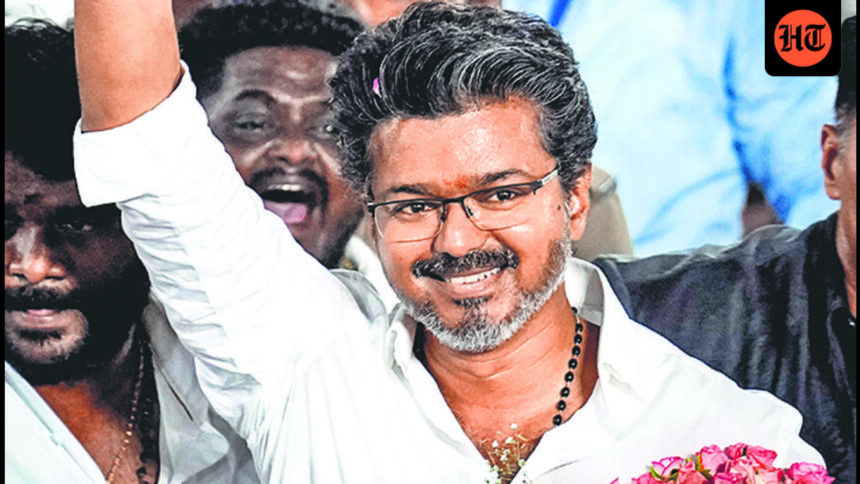
The question on everyone’s mind when Thalapathi (Tamil for leader) Vijay announced the formation of Tamilaga Vettri Kazhagam (TVK) in 2024 was simple: Will his on-screen persona convert the fan base into a huge political following? Answered by the ruling of May 4. Joseph Vijay Chandrasekar, the 51-year-old film star who began his film career in the 1990s with the Chocolate Boy romances and, over the course of three decades, veered into playing a savior who spoke out against injustice and corruption, has secured a decisive mandate in his first-ever election outing. The two-year-old party won 107 seats in the 234-seat Tamil Nadu Assembly, leaving behind the ruling Dravida Munnetra Kazhagam (DMK) and the All India Anna Dravida Munnetra Kazhagam (AIADMK).

Vijay, who has played the lead role in 68 films, most of them blockbusters, has built his appeal in phases. His early films in the 1990s were not political in any overt sense. They were romantic novels and family dramas in which he played the serious and down-to-earth ‘boy next door’. In films like Poove Unakkaga (1996) and Kadhalukku Mariyadhai (1997), his character is defined by sacrifice, compassion and moral clarity. These roles did not express an ideology, but they did something more foundational. They have built trust. The audience saw in him an accessible, relatable and emotionally honest character. This was the first layer of his political capital, a strong foundation.
The second phase arrived in the 2000s, when Vijay transformed into a champion of teamwork. Films like Jelly (2004) and Bokiri (2010) recast him as decisive and courageous, a figure capable of bending regimes that would otherwise be entrenched and corrupt. Here too, the texts remained largely apolitical, but they carried an important subtext. Institutions were ineffective, distant, or corrupt, but the individual achieved justice. The hero is no longer just someone relatable, but also trustworthy and dependable.
The third phase, which began in 2010, made the transformation clear. In Thuppakki, Kathi, Mesal and Sarkar – all films released between 2012 and 2018 – Vijay’s characters begin to speak directly about governance, rights and accountability. Corruption, corporate power, health care, and electoral integrity are no longer essential; They were the tool and the plot. As commercial entertainment, these films simplified complex issues into emotionally resonant frames. The hero, Vijay, succeeded in achieving justice where traditional institutions could not, and this perhaps resonated deeply in a society fed up with bureaucratic laxity and political incompetence. For example, Mersal (2017, directed by Atlee) offered a sharp critique of the healthcare system and its increasing commercialization, with Vijay in a triple role, highlighting him as a doctor who treats the poor for only a fee. $5, symbolizes the ethics of alternative care, against for-profit medicine. Sarkar (2018, AR Murugadoss) portrayed Vijay as Sundar, a technology CEO who returns to India to find his name missing from the electoral rolls, prompting him to challenge the system and, in the process, confront electoral malpractices while asserting the rights of disenfranchised voters.
By the time Vijay entered politics, the public had viewed him not just as a hero, but as a spokesman for public concerns.
This was no coincidence. This scenario is also not new to Tamil Nadu. The late M G Ramachandran or MGR, who founded the AIADMK, was the first to use his films to build an ideological and emotional connection with audiences. Show em. Karunanidhi, of the DMK, described how sharply choreographed dialogues could carry ideological heft, turning cinema into a powerful vehicle for political messaging long before the actor came to office. His political rival, J Jayalalithaa (MGR’s heroine in many films and his political heir) translated her authority and on-screen charisma into a powerful political presence that resonated deeply with voters. Even superstars Rajinikanth and Kamal Haasan gained a moral voice through their films and got involved in politics. Vijay’s path varies in its pace. His transition was gradual, allowing the public to grow into his political image rather than suddenly confront it. But once he launched his party, he moved quickly.
Vijay’s young fan base is key to this transformation. These are voters who are less tied to traditional party structures and more responsive to personality-driven narratives. For them, cinema is not separate from politics. It is often the first site where political ideas are encountered, simplified and internalized. In practice, this translated into remarkably simple voting behavior. At the polling station on St Mary’s Street in Mylapore constituency, this writer met five young voters, four of whom did not even know the name of their local candidate. They were voting for Vijay Anna, the “whistle”. The symbol has replaced the individual, and the image has replaced the individual.
There is a structural reason why this translation works. Vijay’s films are rarely alienating. It combines populist rhetoric with widely accepted themes such as justice, well-being and accountability. This allowed him to speak across constituencies without appearing ideologically extreme. His politics, like his cinema, remained accessible to all.
Rumor has it that Jana Nayagan (yet to be released), directed by H Vinoth, was Vijay’s attempt to position himself as the modern ideological heir to MGR. In the film – whose release was halted by the Madras High Court in January, but whose high-definition version was leaked earlier in the month – Vijay’s character must fight against a selfish political class that is neither incompetent nor willing to exploit the nation for power.
Vijay’s political victory sets him up for his next, unwritten phase. Cinema simplifies the conflict into individuals defeating regimes. Real-world governance requires systems that outlast individuals. The same qualities that made Vijay effective will now be tested on screen in an inherently complex and negotiated space. As Tamil Nadu watches his next move, one thing is clear: Vijay’s political journey did not begin with just a party launch or a provocative speech. It started on screen, in stories that gradually turned the hero into a leader. After years of carefully building his character in films layered with political symbolism and turning them into votes at the ballot box, the question is: Will he succeed?