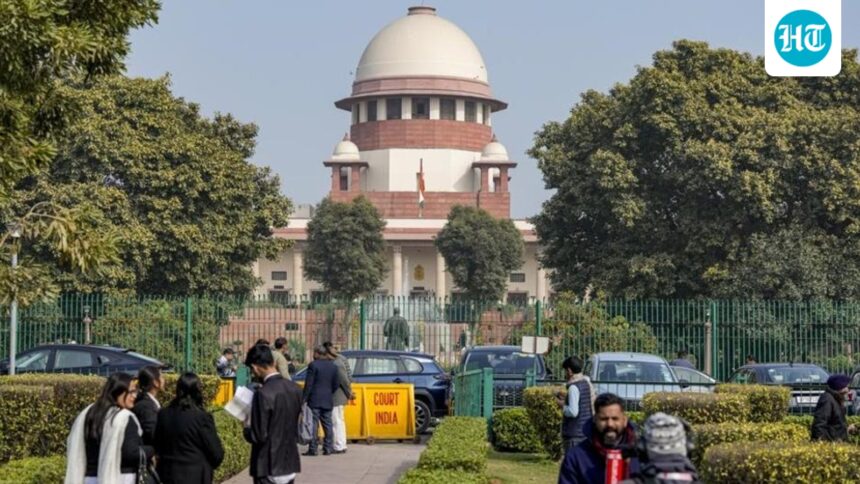
Observing that Hinduism is a way of life, the Supreme Court on Wednesday said that it is not necessary for a Hindu to compulsorily go to a temple or perform rituals, and even lighting a lamp inside the house is enough to prove his belief.

The observation was made by a nine-judge Constitution Bench headed by Chief Justice Surya Kant while hearing petitions relating to discrimination against women in religious places, including the Sabarimala temple in Kerala, and within the scope of religious freedom exercised by multiple religions, including the Dawoodi Bohras, according to news agency PTI.
Justices B V Nagarathna, M M Sundresh, Ahsanuddin Amanullah, Aravind Kumar, Augustine George Masih, Prasanna P Varali, R Mahadevan and Joymalia Bagchi are also part of the nine-judge bench.
As the hearing entered its 15th day, advocate Dr G Mohan Gopal, representing one of the interveners, asserted that there is a demand for social justice emerging from within religious communities.
“Hinduism was defined as a religious category. Then, in 1966, a Hindu was considered to be one who accepts the Vedas as the highest authority in all matters of religion and philosophy. They never asked me. None of us ever said that,” the agency quoted the lawyer as saying.
“Now, I have great respect and admiration for the Vedas. But is it a fact that every person today classified as a Hindu accepts the Vedas as the highest authority in all matters spiritual and philosophical?” he asked.
“It is not necessary for Hindus to visit the temple.”
Responding to his submission, Justice Nagaratna said: “That is why it is called Hinduism as a way of life. It is not necessary for a Hindu to compulsorily go to a temple or perform rituals to remain a Hindu.”
She said that one need not be ritualistic and no one can stand in the way of people having their faith.
The CJI also observed that “even if an individual lights a lamp inside his hut it is enough to prove his religion.”
The Supreme Court had earlier observed that if individuals start questioning every religious practice or religious matters before the Constitutional Court, there will be hundreds of petitions and every religion will be “broken” because of it.
A five-judge bench lifted the ban barring women between the ages of 10 and 50 from entering the Sabarimala Ayyappa temple in a 4:1 majority ruling in September 2018, ruling that the centuries-old Hindu religious practice was illegal and unconstitutional.