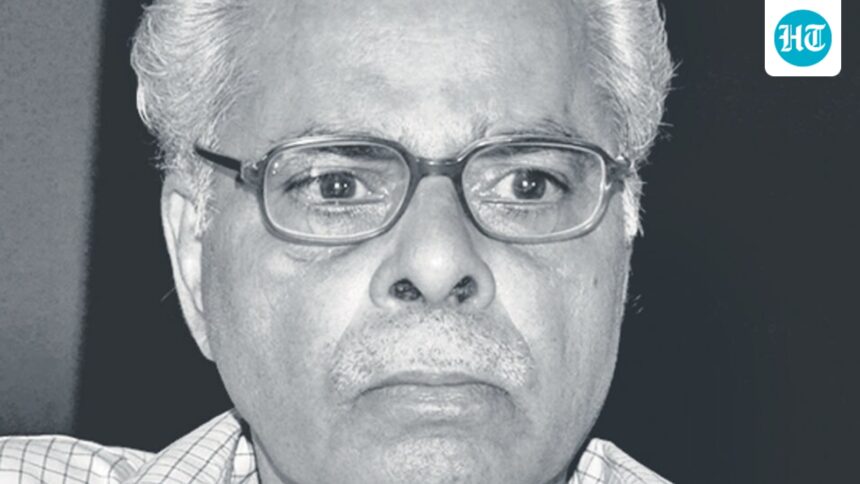
New Delhi/Thiruvananthapuram: Eminent historian, public intellectual and dear mentor to many generations of students at JNU, KN Panikkar, died in Thiruvananthapuram on Monday at the age of 89. He suffered from age-related health complications and is survived by his two daughters, Ragini and Shalini. He was preceded in death by his wife, Usha, in 2022.

“Through his writings, teachings and speeches, he (Panikar) constantly reminded people that India’s pluralism was shaped by the course of history, and its collapse would lead to the collapse of the country itself. His words were like a light in people’s minds at a time when Indian secularism was shrouded in the dark clouds of communalism,” Kerala Chief Minister Pinarayi Vijayan said in a statement.
Panikkar worked as a professor of history at Jawaharlal Nehru University. After retirement, he moved his base to Kerala and served as Vice-Chancellor of Sri Sankaracharya University of Sanskrit, Kaladi, and headed the Kerala Council of Historical Research (KCHR) for 10 years between 2008 and 2018. The council was planning special programs in his honor on his upcoming 90th birthday.
Read also | Renowned historian KN Panikkar dies at the age of 89
Panikkar was born in Guruvayur, a temple town in central Kerala in 1936, graduated from Victoria College, Palakkad, and completed his postgraduate studies and doctorate at the University of Rajasthan, where he met his partner Usha. He taught at the University of Rajasthan and the Indian Institute of Public Administration before joining JNU in 1972 as professor of history. His doctoral thesis was on British diplomacy in India.
Panikkar was part of a galaxy of renowned scholars and teachers at JNU’s Center for Historical Studies, including Bipan Chandra, Romila Thapar, Satish Chandra, Harbans Mukhiya, Sabyasachi Bhattacharya and Madhavan Palat, who attracted students from all over India to pursue history in the national capital. Thapar remembers him as a highly respected researcher and a very helpful colleague at the center. “His knowledge of history, contemporary life, India today and politics was very helpful to understand the contemporary situation,” she said.
As a teacher, Panikkar was much loved by his students, who described him as a gentleman, a calm and collected scholar who never lost his temper in or outside the lecture hall. “He never imposed his ideas, but gave us complete freedom to follow our own line of thinking,” says Shobana Warrier, a historian and professor at Kamala Nehru College in Delhi, who did her PhD under Panikkar. “He made us think critically, pushed us to look deeply into our subject, but he never asked us to follow the way he thought, which is very rare.” Students remember that Panikkar House was always open to students, who could come for tea or even a meal, and of course for discussions on any topic under the sun.
Ganesh, a historian and president of the Kerala State Council of Historical Research, describes Panikkar as a historian of ideas who unraveled the many complex threads of Indian nationalism and social reform movements of the 19th and 20th centuries. He adds that he was committed to a just, equal and stable social system in opposition to all forms of sectarianism. Ganesh, who was a student of Panikkar, highlights the diverse topics on which his teacher wrote, among them seminal work on the Malabar Mutiny of 1921, essays on marriage reforms in Kerala, the Ayurvedic tradition, Malayalam fiction (focusing on Indulekha, a pioneering work of fiction from the 19th century), social reform, tradition, and even “The Great Boot Question.” The final article was about the British practice of prohibiting Indians from wearing shoes in courtrooms, and highlighted how the colonial administration used public policies to separate European rulers from indigenous colonial subjects. Some of his books include Culture and Consciousness in Modern India; Cultural action agenda; culture, ideology and hegemony; Before night falls; and an edited volume on Caste in Kerala.
Among the many works published by Panikkar, his work on the Malabar Rebellion of 1921, Against God and State: Religion and the Peasant Uprising in Malabar, opened new vistas regarding the history and lineage of the popular uprising in Malabar against the backdrop of the Khilafat movement. The insurgency was defined for most of the twentieth century as a communal uprising targeting Hindus. Panikkar’s works established that the Malabar Rebellion was essentially a revolt of the peasants, the majority of whom happened to be Muslims, against the British colonial administration and the local zamindars, many of whom were Hindus. He also traces the lineage of the rebellion to smaller revolts by Muslim peasants in the nineteenth century against the East India Company and, later, against the colonial administration, which introduced an oppressive and exploitative form of revenue extraction.
An associate of the Left, Panikkar was close to the giants of the Indian communist movement, including its founding leaders, P. C. Joshi and K. Damodaran, and conservator of the BC Joshi Archives at JNU. Since the 1980s, Panikkar began to be actively associated with social organizations in Delhi. He was the president of Janasamskriti, a broad leftist platform founded by Malayalis in the national capital, for six years in the late 1980s, was associated with the political-cultural group, Sahamat, and later helped found the activist organisation, Anhad. Haridas, who worked closely with Panikkar at Janasamskriti, recalls a mentor who ensured that the organization became a platform for discussing broad topical issues rather than being limited to the nostalgia of the Malayali diaspora. Shabnam Hashmi, who led ANHAD for many years, recalls how she traveled to Panikkar’s home in Kerala in the wake of the 2002 Gujarat riots to discuss building an activist group to organize and educate people about secular values and communal harmony. Panikkar traveled extensively in Gujarat and wrote about the divided and polarized society he witnessed.
In his late 80s, Panikkar remained a magnet for young scholars, academics and activists who flocked to his apartment in Thiruvananthapuram, where he had retired, for talks and, in one activist’s words, for assurances about values. Panikkar leaves behind an inspiring legacy of scholarship, teaching, and activism rooted in democratic and secular values.