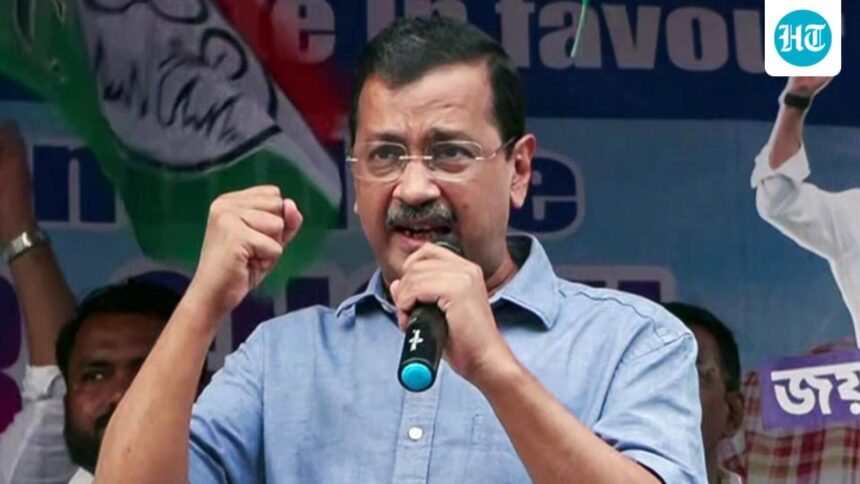
On April 24, seven of the 10 Rajya Sabha members, including Raghav Chadha, defected from Arvind Kejriwal’s Aam Aadmi Party (AAP) to the Bharatiya Janata Party (BJP), marking the first major defection of legislators from the party.

The defection was the latest in a series of setbacks for the party, which was founded by novice politicians in 2013 to “root out corruption from public life.” Kejriwal’s image as a frugal politician has also taken a hit over allegations of his extravagance at his official residence when he was Delhi Chief Minister. The BJP went to town ahead of the 2025 Delhi elections, calling the residence a “sheesh mahal” or luxurious palace of mirrors, and stormed to power in the national capital.
Kejriwal’s insistence on staying in a bungalow in Delhi’s upscale Lutyens area after his loss in the Delhi elections has proven the truth to his opponents, who contend that his pledges to end VIP culture lacked sincerity.
Kejriwal’s turn to realpolitik initially led to the ouster of lawyer Prashant Bhushan and psychologist Yogendra Yadav over disagreements over selection of candidates in 2015. Kejriwal, who resigned as an Indian Revenue Service official and formed an NGO before founding AAP, wanted to focus on being able to win. Bhushan and Yadav wanted integrity to be at the core in selecting candidates for the Delhi Assembly elections.
Since then, senior leaders, such as poet-turned-politician Kumar Vishwas, have left the party. Some resigned because the party was not following its founding ideology. Others left because they did not receive a desirable position in exchange for their contributions to the party.
Public service and integrity appear to have taken a backseat as winning elections has become the greater focus. For a party that was initially formed and run through public contributions, the RJD has pumped significant funds into polls in Uttarakhand, Goa and Himachal, with the sources of the funds ambiguous.
The BJP has alleged that bribes from the now-scrapped Delhi Excise Policy 2021-2022 had funded the AAP’s 2022 Goa election campaign, dealing a major blow to the party founded on an anti-corruption agenda. A lower court in February acquitted Kejriwal and other AAP leaders in the tax policy case. The joy of acquittal was short-lived as Rajya Sabha members defected, most of them from Punjab, the only state where the party is in power.
AAP provided an alternative to the Congress and the Shiromani Akali Dal (SAD) in Punjab. It won 20 seats in the 117-member assembly in 2017, becoming the main opposition party, replacing the Social Democratic Party. Sensing the opportunity, the RJD deployed all its resources and won the 2022 Punjab Assembly elections. Kejriwal gave Chadha the responsibility of supervising the work of the Punjab government. Chadha was once seen as more powerful than Prime Minister Bhagwant Mann.
What went wrong? An AAP leader said the problems started when central agencies started investigating alleged irregularities in the Delhi Jal board when Chadha was its vice-chairman. A second leader told AAP that Kejriwal knew that Chadha was trying to create a back channel with the BJP even when several party leaders were facing arrest or were in jail.
The second leader added that Chadha’s absence during the 2025 Delhi Assembly elections on the pretext of an eye ailment and refusal to confront the BJP head-on led to escalation of tensions with Kejriwal. He said Chadha’s removal as deputy leader of the Rajya Sabha was a calculated move. Kejriwal had expected Chadha to join the BJP before the Punjab elections.
What Kejriwal did not expect was that Ashok Mittal, founder chancellor of Love University and a Rajya Sabha member, would resign. Mittal, in a letter to Kejriwal, is believed to have referred to mounting pressure from central investigating agencies to align with Chadha.
Neither Chadha nor any of the other six defectors has much political influence in Punjab. Their joining the BJP was timed to make maximum impact in Gujarat, where local polls were held on April 26, to put forward the idea that Kejriwal could not keep his rags together. Kejriwal campaigned extensively in Gujarat for over a month, pitching the RJD as an alternative to the Congress and the BJP.
For Kejriwal, the biggest challenge is keeping his MLAs together in Punjab ahead of elections scheduled for February 2027. There is a buzz about discontent among MLAs, and the possibility of a split in the RJD legislature party ahead of the 2027 elections.
Overall, all is not well. AAP leaders at the district level have been accused of corruption, and there are reports of infighting as well. The killing of at least three PJD leaders in Punjab in the past six months has damaged the party’s image. Kejriwal’s continued influence in government administration is another sensitive point.
A former RJD leader, who has worked closely with Kejriwal, said the Punjab elections will be his toughest political test yet. “He faces three opponents [Congress, Akalis, and BJP] She doesn’t have much to show. One thing he has is the quality of perseverance.
Will his persistence pay off in Punjab, where Kejriwal is seen as an outsider? He put his most trusted lieutenant, Manish Sisodia, in charge of Punjab. The two want to save the RJD in Punjab, just as they did in 2014, eight months after Kejriwal resigned as Delhi chief minister and returned with a full majority.