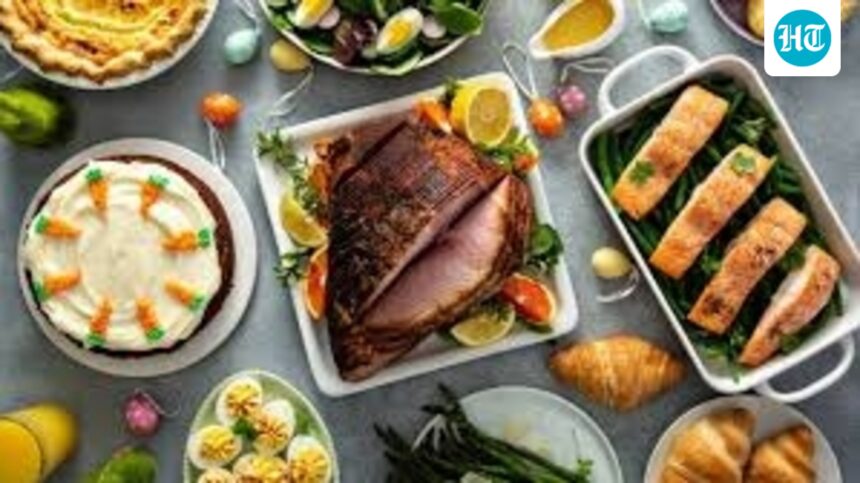
My non-vegetarian friends rejoice when Easter comes and bring along a feast of their favorite meat dishes.

But first, there is the dreary Good Friday, when “we drink rice Kanji “The chutney is just that,” said Grace Bice, who grew up in Hubballi but has lived in Bengaluru for more than 35 years. There are differences, of course, depending on taste. Brinjal sauce is popular and red rice is the staple. “Some families choose a high-protein combination of rice and sauce.” Badinji (green moong dal).
After the rein of Lent, this Kanji It works almost as a bar cleanser, before the flavor explosion during Easter. Grace likens it to stopping.
She is an excellent cook. Like most people from the Konkan coast who have now settled in Bengaluru, Grace’s cuisine is distinct from her community, and her use of ingredients is closely linked to the coast.
Being a vegetarian, the lion’s share of the Easter lunch served at my friends’ homes is not to my liking, especially pork Pafat.
Pafat (Also spelled baffat, bafath and bafad. You’ll thank me when you Google the recipe) is a type of powder-masala traditionally used as a staple (and favourite) in Goan and Mangalorean Catholic homes.
The basic spice blend includes red pepper, coriander seeds, cumin seeds, mustard seeds, black pepper, turmeric, cinnamon, and cloves. They are all dried in the sun, then lightly roasted before being ground and packed, ready for use when cooking pork, beef, lamb or chicken.
As with most home recipes that involve drying spices in the sun, the Konkan Coast is full of tales of how grandmothers used to dry the unique spice of this powder on the balcony in the tropical sun, sometimes covering it with a white muslin cloth to prevent crows from eating the spices. Each house had different ratios in the mixture and therefore each dish would taste different. Today, most people buy the powder, as I did, to use not with pork, but with paneer, and although my non-vegetarian friends won’t buy it, I would argue that paneer Pafat It was more flavorful than any pork can be.
This then is the difference between Christmas and Easter. In Bengaluru, Christmas still carries the flavors of our colonial past – English spices, mulled wine and fruit-laden baked goods that are a legacy of British and Anglo-Indian communities. In contrast, the city’s Easter celebrations feature the distinct spice traditions of Mangalore and Goa. The centerpiece of this extreme feast is pork.
There is pork PafatOf course, then its more wonderful cousin – pork Sorbutel. Some families eat chicken and mutton dishes alongside it, and most make a sweet pulao with a sweet chutney of bananas and dates to offset the spices in the meat. immature SnasIt is light and used for scooping broth, which is a must have. Desserts vary and depend on the community and family, but are often an afterthought after the main dishes.
The other community where pork is the star is, of course, Korg. As Kaveri Ponnappa writes in her book and interactive website The Coorg Table, the Corgis (they hate to be called Corgis) “smoke, curry, preserve, curry, braise, fry, and roast the pork, extracting every ounce of flavour, altering the texture as much as we can, and sometimes scooping a spoonful of preserved pork fat from an earthen pot into a plate, enhancing the flavours. Roast, there is always a deep and rich pande curry.
To release the flavors of the pork, Kodava Kitchen uses the acidity of the pork kachumpulithe deeply flavored fermented vinegar that is a mainstay of this cuisine, and a peppery bite.
While pork is a delicacy for some communities in Bengaluru, its use as an aphrodisiac goes back centuries. For example, pork fried with cardamom was considered an aphrodisiac not only by the Vijayanagar kings but also dating back to the 12th-century King Somesvara III, who wrote a foundational text on the enjoyment of the arts. Ruler of the Kalyani Chalukya Kingdom, located in the present-day state of Karnataka Manasolasa (Enjoying the Mind) covers topics in politics, economics, medicine and architecture, but also notably the culinary arts. Here too, pork is a strong, health-giving meat. In fact, the book details how to clean a wild boar’s hair by pouring hot water over its skin until the hair becomes soft and easy to remove.
The strange thing is that modern Bengaluru doesn’t have many good Coorg restaurants. But pork culture stays in the sun Pafat Konkan Coast Masala, smoked and acidified Pandey Curry of Kodavas, or marinated wild boar in the Chalukyan court. In Bengaluru, roast pork is not European cultivation but part of the city’s strong indigenous heritage. In fact, it provides a bridge between the medieval palaces of Vijayanagar and the modern Easter table.
(Shobha Narayan is an award-winning author based in Bengaluru. She is also a freelance contributor who writes about art, food, fashion and travel for a number of publications.)