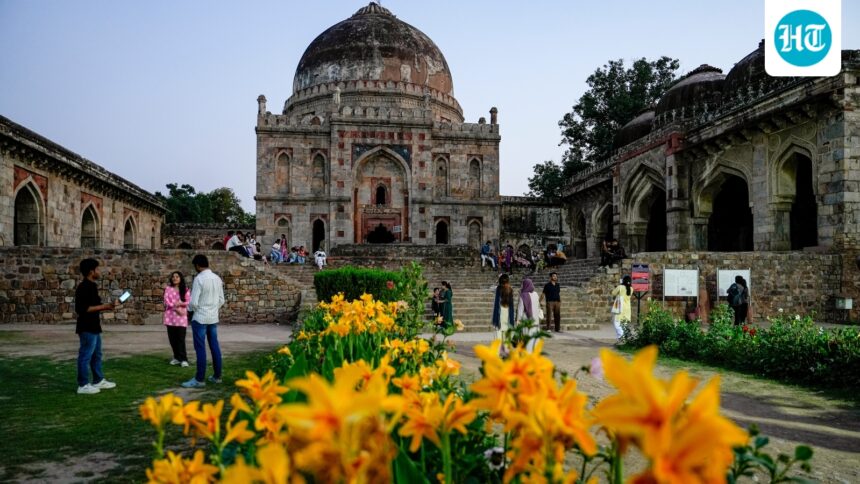
New Delhi: Delhi’s famous Lodhi Garden – often described as “Asia’s best urban oasis” – celebrated its 90th anniversary on Thursday, and is home to centuries-old tombs and some of the most exotic species of plants and birds.

This horticultural garden, located in the heart of the national capital, bordering the posh Lodhi area and the upscale Khan Market, was inaugurated on April 9, 1936, as ‘Lady Willingdon’s Garden’, named after the then MP of India.
Spread over 90 acres, the expansive green space is Delhi’s lungs, a favorite spot for many for morning and evening walks, as well as for runners, or those just looking for quieter moments away from the hustle and bustle of the city.
This park was designed after changing what was then known as Khairpur village, on the outskirts of New Delhi.
In 1911 at the Delhi Durbar, the British announced the transfer of their imperial capital in India from Calcutta (now Kolkata) to Delhi, and a new capital was built – later called New Delhi – which was officially opened on 13 February 1931, by the then Viceroy Lord Irwin.
With its beautiful flora and fauna, Lodhi Park is a great choice for many trekkers and tourists, both local and foreign.
In addition, scattered tracks and a variety of plants and trees, such as neem, jamun, royal bottle palm, bamboo and eucalyptus, and numerous birds, including parrots, mynas, kingfishers, babblers and hornbills, can be found here.
“The park happens to contain an extraordinarily rich variety of architectural styles, ranging from Sid and Lodi to Mughal styles. The current landscape was designed by American architect Joseph Allen Stein (in 1968), and has been modified by a group of Japanese landscape designers,” according to INTACH.
Incidentally, the Indian National Trust for Arts and Cultural Heritage (INTACH), a Delhi-based non-profit body that works to preserve the country’s unprotected heritage, is located near the park.
Purnima Datt, Head of HECS (Heritage Education and Communications Service) at INTACH Headquarters, says the garden is “our close neighbour” and is also a “living classroom for students” as it is home to many species of plants, trees, birds, butterflies and other animals.
“INTACH and Lodhi Park have a very symbiotic relationship. For us, we see it every time we go to work, and we have so many beautiful memories associated with it. Whether visiting it just for a picnic or to do a heritage walk, every time the experience is amazing, just to be there in such an open space in the heart of the city,” she told PTI.
INTACH teams have also done some maintenance work at the park in the past, and a booklet documenting the park was published several years ago, Datt said.
INTACH’s HECS is dedicated to spreading awareness, especially among the youth, about India’s natural, built and cultural heritage – its natural environment, historical buildings, living traditions and artistic beauty.
Places like Lodhi Garden should be preserved, cherished and cherished by people of all age groups, especially in a time of rapid urbanization.
The old wrought-iron entrance gate to the park which opens onto Rajesh Pilot Marg (the old name of Southend Road) has stone-built pillars on each side, with ‘The Lady Willingdon Park’ and ‘April 9, 1936’ inscribed on each pillar.
The tomb of Muhammad Shah (the last ruler of the Sayyid dynasty) was one of the oldest tombs built in Lodhi Park (renamed after independence) in 1444.
The octagonal tomb located near the perimeter of the park on the side of Lodhi Road is one of the most photographed monuments in the park, and has also been featured in numerous films and advertising campaigns.
The park, including many of its monumental buildings, has also featured in several Bollywood films such as Chashmi Budur (1981), Chini Kum (2007), Vana (2006), and others.
It also contains the tombs of Sikandar Lodi, along with Shesh Gumbad, Bara Gumbad and a mosque.
The monuments are decorated with intricate stonework and calligraphy.
The park also contains a stone bridge called ‘Athbulla’, built over a stream, which was a ‘nullah’ at the time the village was there. Hence it is also called ‘Khairpur ka Bol’, according to experts.
The famous post-colonial buildings of Lodhi Estate – India International Center (IIC), India Habitat Center (IHC), Ford Foundation, designed by Stein – sit nicely with the old park.
The area around Lodhi Park, where the Stein-designed buildings stand today, bears the nickname “Steinabad,” says Datt.
“The famous architect designed the structures in such a way that they appear to be a harmonious extension of the garden,” she said.
The trail heading toward the park from Max Müller Road is named after Joseph Allen Stein.