New Delhi: The sprawling 33-year-old colonial-era Sham Nath Marg House, which has long been seen as a “jinx” among political and administrative circles, is set to be demolished and replaced with a new office complex, officials familiar with the Delhi government’s plans said.

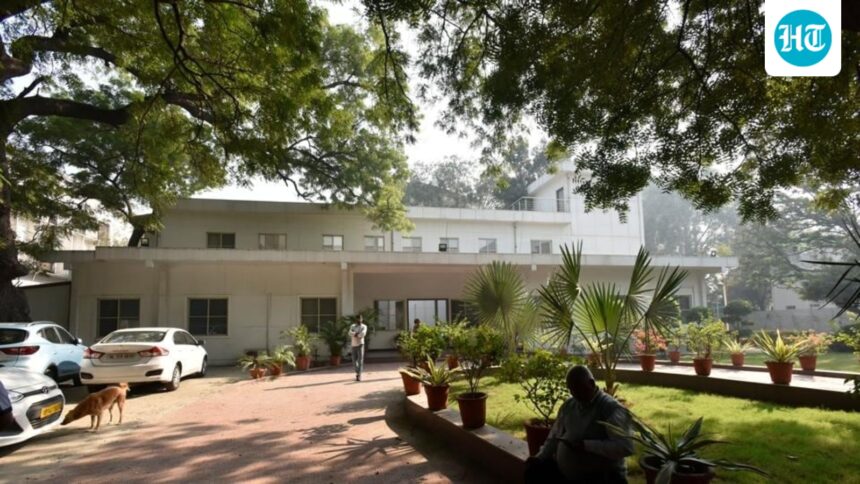
The two-story building, built in the 1920s, has remained largely empty for more than two decades, according to officials. The Public Works Department (PWD) has repeatedly failed to secure a permanent occupant despite multiple attempts, with Delhi’s political class describing the property as “unlucky”.
The redevelopment plan aims to put the prime plot of land to functional use by constructing a modern office building, officials said. “Once the structure is demolished, a completely new layout will be planned. We can also consult a Vastu expert, and some floors can be added. An office complex is proposed to be set up on the site, and after construction, it will be included in the PWD pool for allotment to government offices,” said a senior official, requesting anonymity.
The building’s long-standing reputation has contributed to its underutilization, according to officials HT spoke to.
“Over the years, the bungalow gained notoriety, and many ministers, legislators and senior officers were reluctant to occupy it. Even when it was allotted, it often remained vacant or was used only for limited official purposes,” another official said.
Originally designed as the official residence of the Delhi Chief Minister, the four-bedroom house features an expansive front garden with fountains, a large living and drawing area, an outbuilding and seven staff quarters.
But for more than two decades, no politician has wanted to live there.
Delhi’s first Prime Minister, Chaudhary Brahm Prakash, moved into the residence in 1952 but left office in 1955 before completing his term.
After the revival of the Delhi Legislative Council in 1993, the property was allotted to the then Chief Minister Madan Lal Khurana – making him the second Prime Minister to occupy the house. But his term ended in 1996 after his resignation in connection with the hawala issue.
By this time, the bungalow’s reputation as “unlucky” was beginning to gain momentum.
Khurana’s successor, Sahib Singh Verma, did not move in with his family and only used it as a camp office during his term, which also ended before his full term.
Later, former Prime Minister Sheila Dikshit chose not to occupy the bungalow during her tenure that began in 1998, choosing instead to remain in her private residence.
The sprawling property on Sham Nath Marg was then used intermittently for official events, including meetings and press briefings.
The last full-time political occupant of the house was former Labor Minister Deb Chand Bandhu, who remained there until his death in 2003 after falling ill.
Since then, the building has not been inhabited for long. A few short-term occupants of the building, including senior bureaucrats, stayed briefly, but the building never returned to regular use.
People with disabilities have explored many alternatives over the years. It was considered to be converted into a government guest house. In 2015, the Aam Aadmi Party (AAP) government repurposed it as an office of the Delhi Dialogue and Development Commission (DDDC), a political advisory body. But bad luck seems to have followed the DDDC as well – the body was disbanded on the orders of the lieutenant governor in 2022, and the building was vacated again.
Parts of the bungalow are currently being used by employees attached to the LG office, officials said, adding that the structure itself has aged significantly and requires major maintenance. “Through the redevelopment, the government intends to improve land use and create office infrastructure that can serve existing administrative needs,” the official said.
Certainly, no specific timeline for demolition and construction has been announced. The redevelopment marks the end of a decades-long chapter for one of Delhi’s legendary properties that was supposed to be the CM’s official residence. In the corridors of power, it was also pointed out that after this house was deemed ill-fated, the national capital was also unable to find an ‘official residence of the CM’, which is a standard practice in many other states where the same house is handed over from one president to his successor.