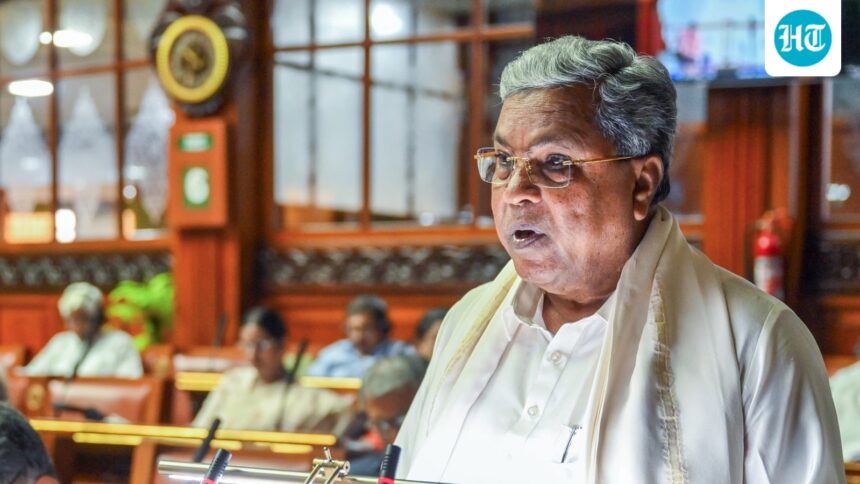
Karnataka Chief Minister Siddaramaiah on Friday announced a ban on the use of social media by people below the age of 16 in the state while presenting the Budget, triggering a range of reactions from optimism to skepticism.

The Prime Minister said that the decision aims to prevent the harmful effects of social media on children.
“With the aim of preventing the harmful effects of increased mobile phone use on children, the use of social media will be banned for children under 16 years of age.” Siddaramaiah said while presenting the state budget for 2026-27.
But he did not explain how this would be implemented.
Australia will become the first country to ban social media for children under 16 in 2025, blocking access to platforms including TikTok, YouTube, Instagram and Facebook. Since then, it has become a hot topic across the world, including in India.
The central government’s Economic Survey, which was tabled in Parliament in January this year, said access to online platforms should be considered based on age, with online teaching also reduced to avoid digital addiction.
Karnataka Electronics, IT/BT Minister Priyank Karg informed the Legislative Assembly in January that the state government was holding consultations on measures to ensure responsible use of artificial intelligence and social media, especially among children.
Now that the ban has been announced, a wide segment of parents, experts, and even opposition politicians have welcomed this step. But some are concerned about the practicality of implementation.
Reactions to Karnataka’s social media ban for children under 16 years of age
Appreciating the move taken by the Karnataka government, consultant psychologist and child development at Maternity Hospital in Bengaluru, Saritha Nagaraj, said social media increases the risk of poor mental health among children and adolescents – including symptoms of depression, anxiety, lack of sleep and body image issues arising from unhealthy comparisons, which can lead to eating disorder – will decrease.
“Their cognitive performance and emotional regulation are also likely to improve. Exposure to dangerous content will decrease, and this can help improve attention span as well as academic performance,” she told PTI.
Medianama founder Nikhil Pahwa said on LinkedIn that while banning children under 16 from social media may seem like a solution, it avoids the real problem. “The real problem is not social media, but how platforms are designed to deliver constant dopamine hits through algorithmic feeds, rapid-fire content, and behavioral feedback loops. These design choices shape how people behave online, what creators produce, and how attention is captured.” He said in his message.
Clinical Director of Rainbow Children’s Hospital, Dr Rakshay Shetty, said that although there are many disadvantages to excessive use of mobile devices in children, due to its ill effects on their psychology, it also provides great practical benefit to parents, teachers and children. He said that the role of parents is greater than that of the government.
He said: “We need to look at a balanced solution because a blanket ban could be counterproductive because its implementation is not practical, and it may remain like a paper tiger where there is a rule, but no one follows it. Instead, giving guidelines on how to make practical use of mobile devices and limit their excessive use would be more practical.”
Restricting social media for children under 16 may be good in some ways, but implementing it will be difficult, said Manohar NH, a resident of Bengaluru’s Jallahalli who has two school-going children — a 16-year-old boy and a 13-year-old girl.
“These days, teaching in many schools and colleges is done through apps. For example, SSLC and PUC students, especially PUC II students, rely heavily on apps for classes and communication. Controlling the use of social media will be very difficult, especially in government schools and colleges. The rule may be introduced, but I doubt it will work,” he said. “The success rate may only be about 10 percent.”
However, the opposition Bharatiya Janata Party welcomed the move, with Rajya Sabha MP Lahar Singh saying he had raised the issue through a special reference in Parliament.
He said on Channel
Founder and CEO of brand consultancy Jajabor, Upasna Dash, said the move is likely to have ripple effects across the ecosystem and change the way advertisers reach this age group.
“In this sense, while social media has become a dominant channel, communicating with this audience has always taken multiple forms,” Dash added. “What we may now see is a shift back to some of these methods, including word of mouth, offline marketing, and embedding the brand within broader content.”