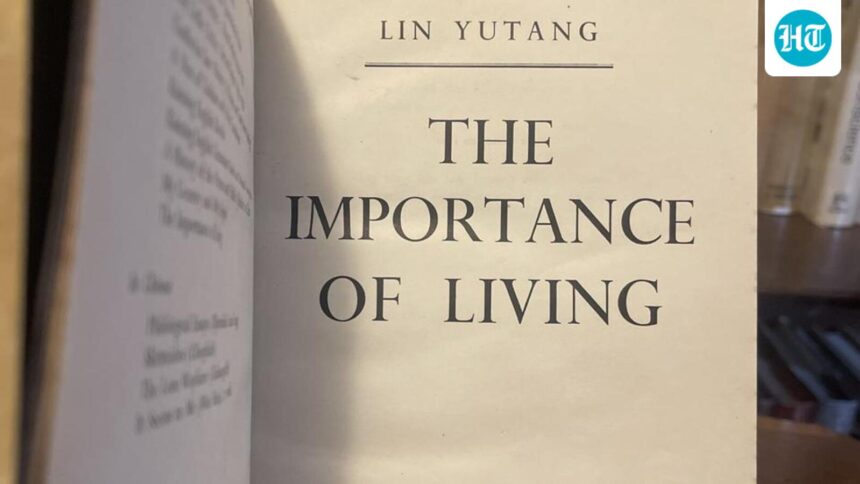
Every time I’m asked to list my favorite books, The Importance of Life by Lin Yu Tang is always there. I know that many readers may not have read it, or even heard of it. But it was a best-selling classic when it was published in 1938, has been reprinted numerous times, and left an indelible impression on me as a college student when I first read it. This remains a consistent primer that I often dip into when I need to restore sanity, wisdom, and humor to my life.

Lin Yu-tang was a Chinese writer who settled in America later in life, a man deeply immersed in the well-known and obscure texts of his native country’s philosophy and traditional wisdom. From these essays, he extracted a philosophy of life that was humorously humane and gently wise, with irresistible chapters such as “On Being Human,” “The Feast of Life,” “Enjoying Nature,” “Enjoying Culture,” and even a delicious essay on “The Importance of Lounging.” By closely observing the “busyness” of American life, its obsession with wealth, fame, power, success, and perpetual youth, Lin Yu-Tang arrives at a contrarian view that asserts that in the life one lives, the ability to enjoy it fully—with distinction, passion, and detachment—is the true goal of both human and spiritual endeavors. The rest is frankly crap.
“The Chinese philosopher is one who looks at life with love and gentle irony, and combines his irony with gentle tolerance,” Lin writes. “He sees with one eye closed and with the other open the futility of much that goes on around him and the futility of his own endeavours. He is rarely disappointed because he has no illusions, and he is rarely disappointed because he has no extravagant hopes. In this way his soul is freed.”
Lin summarized the great Taoist philosophy (founded by the Tao in the 4th century AD) in just four lines:
It contains the wisdom of fools
And the grace of slow,
stupid accuracy,
Low lying feature
He says that among the great “nonsense” in life is man’s obsession with fame, wealth and power. “There is a convenient American word that again combines these three mistakes into one big trick: success.” But many wise people know that the desire for success, fame, and fortune are euphemisms for fears of failure, poverty, and obscurity. Lin quotes Tao after the great philosopher quits a coveted government job to return to his native land and tend his garden with conviction: “Ah, I’ll go home!” enough! How long will I remain in this mortal form? Why not take life as it comes, and why hustle and bustle like someone on a mission? Wealth and power are not my ambitions, and the home of the gods is beyond my reach!
For Lin, the ideal life is one that finds a middle ground between excessive ambition and unacceptable passivity. This was summed up in the Song of Half and Half by the ancient Chinese thinker Li Mian:
To live halfway between the city and the land,
Be half scientist, half companion, half
In business; Lives half the nobility,
Half of it relates to the general public;
He owns a house that is half elegant and half ordinary.
Half elegantly furnished and half empty;
The food is half delicious and the other half is simple fare.
He who has tasted life only half of it is wiser and smarter.
One of my greatest favorites is the rediscovered ancient Chinese poem by Lin Yu Tang about the love between husband and wife, man and woman:
‘Twix you and me
There are so many feelings,
This is why
There is such a buzz!
Take a piece of clay,
Wet it, pat it,
And make a picture of me
And a picture of you,
Then smash them, smash them,
We add a little water
Break it and remake it
In a picture of you
And a picture of me.
Then in my mud, there’s a little of you,
And in your mud there is a little of me.
We will never cut anything;
Lying, we’ll sleep in the same quilt,
If we die, we will be buried together.”
Lin also has a great chapter on the art of aging gracefully, and admits to being very confused by the West’s preoccupation with hiding a person’s age. For him, age is a blessing. With lyrical simplicity, he writes: “No one can stop growing old; He can only deceive himself by not admitting that he is getting old. Since there is no point in fighting against nature, it is better to grow old gracefully. “The symphony of life should end with a grand finale of peace, tranquility and spiritual contentment, not with the beating of a broken drum or a broken cymbal.”
Readers, if you can get a copy of Life Matters, get it. It is never too late to change your life, so that you can truly learn how to enjoy – while it lasts – this great gift from God Almighty!
(Pavan K Varma is an author, diplomat and former Member of Parliament (Rajya Sabha). Views expressed are personal)