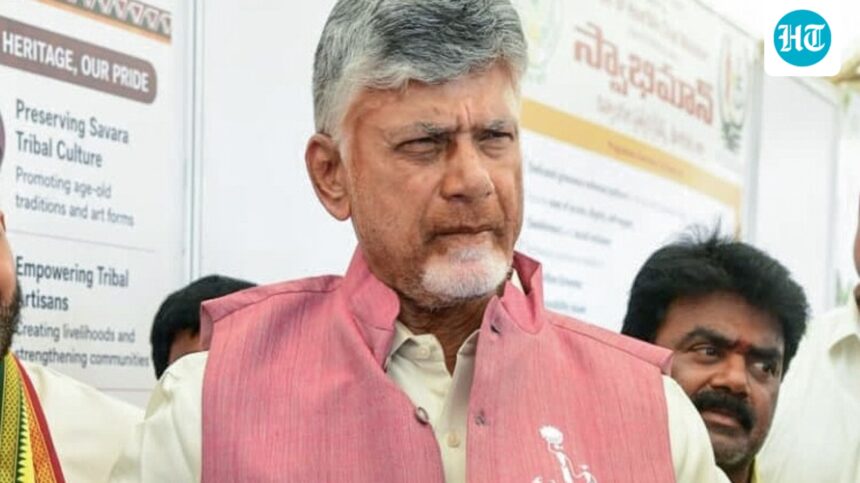
Andhra Pradesh Chief Minister N Chandrababu Naidu on Saturday announced enhanced financial incentives for families with more than two children. Under the scheme, $It will receive 30,000 families $30,000 for the birth of a third child $40,000 for the fourth child.

Addressing a public gathering in Tamrapalli village in Srikakulam district, Naidu said the government wants to encourage large families as part of its new population management policy.
“Children are our wealth. This is the message I want to drive home across the state,” he said, explaining the rationale behind the move.
Why is Andhra Pradesh changing its policy?
Explaining the reasoning behind the move, Naidu said the state government was focusing on what he described as “population welfare”, amid concerns about declining fertility rates and an aging population.
While presenting the draft Population Management Policy in the Assembly on March 5, the Prime Minister said that the total fertility rate in Andhra Pradesh has declined sharply over the past decades.
According to him, the state’s total fertility rate is currently 1.5, down from 3.0 in 1993. He said the ideal fertility rate should be 2.1 to maintain demographic balance.
“If the total fertility rate continues to decline rapidly, the number of people of working age could decline significantly, which could lead to a slowdown in economic growth,” he told the General Assembly.
Naidu also warned that Andhra Pradesh may face demographic challenges similar to those seen in countries such as Japan, South Korea and Italy, where aging populations and declining birth rates have become a major economic concern.
Concerns about population aging
Citing 2023 figures, Naidu said about 670,000 births were registered in Andhra Pradesh during the year. If current trends continue, nearly 23% of the state’s population could become senior citizens by 2047, he warned.
Such a shift could put pressure on the economy and social welfare systems in the future, he said.
The Chief Minister also shared data on family size trends in the state. According to him, about 300,000 families – equivalent to 58% of the total – currently have only one child, while about 217,000 families have two or more children.
Five-pillar policy approach
Naidu said the proposed policy would follow a five-stage life cycle approach to population management.
The framework will be built around five pillars – Matrutvam (motherhood), Shakti (empowerment), Kashima (well-being), Nipuniyam (skills) and Sanjivani (healthcare).
The Prime Minister also linked the population policy to economic participation, saying that the state’s labor force participation rate of women currently stands at 31%.
If it rises to 59%, Andhra Pradesh’s GDP may rise by about 15%, he said.
Financial support for large families
The proposed policy includes multiple benefits aimed at encouraging childbirth.
Parents with a second or more child will get it, Naidu said $25,000 on delivery.
“Under the plan, parents with a second or more child will receive… $25,000 on delivery. He said this move would be a major political intervention to encourage population growth.
Apart from the one-time incentive, the government is also proposing $1000 monthly food support for five years for the third child. The policy also promises free education for the child up to the age of 18 years.
The state is also considering extending paternity leave benefits for families with a third child, including 12 months of leave and two months of paternity leave for fathers.
(With inputs from Srinivasa Rao Aparso)