From Andersen to Modern Life, fairy tales reveal desire, loss, and survival—stories that speak less about children and more about the human condition.

Dear reader,

“I wanted to talk at length about / the happiness of my body and / the joy of my mind, because it was / April, a night, / a full moon and–” says Mary Oliver.
And then you stop. She pauses to pay attention and listen to the frogs.
And so it was with me the first week of April.
In Manali, there are cherry blossoms, spring showers, and translucent light. I find myself slowing down, and spending the week researching and listening.
I’ve been thinking about Hans Christian Andersen, born this month, whose fairy tales I first read as a child and never put them down.
These are not feel-good or redemptive tales of Cinderella, Snow White, or Little Red Riding Hood, where good triumphs, the stepmother is banished, the evil wolf is slain, and the handsome prince comes to the rescue.
Hans Christian Andersen’s fairy tales are dark and existential. They read like modern psychological fiction.
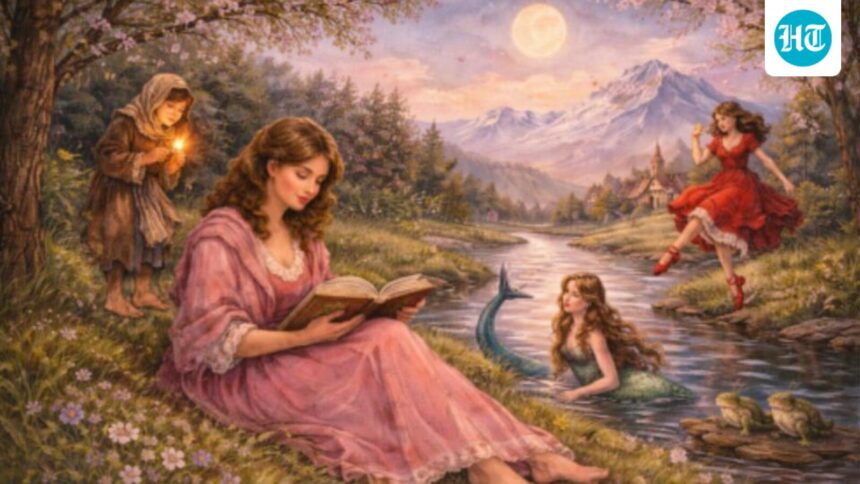
The ugly duckling feels ashamed of her body and hates herself. The Little Mermaid goes further; She denies her body and drinks a potion to get rid of her beautiful fishtail to win the prince’s love. When she walks on the ground, every step feels like knives cutting through her body. Even with this terrible sacrifice, she fails. The prince doesn’t see her.

And then Andersen did something extraordinary. He gives the little mermaid a choice: to get her life back, she must kill the prince. The girl who has given up everything – her voice, her tail, her world – is now required to give up her conscience as well. She refuses. They melt into seafoam instead. There is no rescue.
In the movie The Little Match Girl, a poor girl wanders around barefoot on New Year’s Eve. She doesn’t dare go home because she hasn’t sold any matches. It’s freezing, and she starts lighting matches one by one to warm herself. In the first flame, you see a dining table, a Christmas tree. And in the second, a shooting star. And then her grandmother. Each of the visions is very ordinary: the warmth, the meal, the loved one. However, to the little match girl, she is everything. The next morning, she was found dead in the cold, “smiling” from the visions she had seen.

I didn’t consciously know it then, when I first read it, but here was my first lesson: that a story can feel warm even when there isn’t. If you have books and stories, you can smile, and your soul can stay alive – and that is no easy feat. It might be the only thing.
“The Red Shoes” is darker than “Matchgirl,” a moral and psychological warning wrapped in a fairy tale.
Karen, a poor girl, becomes obsessed with a pair of red shoes. She dares to wear it to church, preferring fun over conformity. Of course she must be punished. The shoe begins to take control of her, and she cannot stop dancing until she is finally freed – by cutting off her feet.

“The Red Shoes” is a story I want MBA students to read. They need to read it as adults to realize how afraid societies are of female desire and what extremes they still go to to limit this desire. Your clit is mutilated, your feet are broken and bound. Sometimes, you are simply taught, when you are very young, to stop wanting to dance.
If “The Red Shoes” warns of the price of outward emotion, “The Snow Queen” explores the quiet coolness of withdrawing inward. It is the story of Gerda, who travels through an icy enchanted world to rescue her friend Kay, whose heart has been frozen by the Snow Queen.
Today, I realize how modern this fairy tale is. When someone withdraws into the digital frost of screens and routine, they become Kai – physically present but emotionally absent. The other becomes Gerda, traveling through the silence to thaw. It is, in many ways, modern therapy – a story of the push and pull of family, friendships and marriage. A story that says maybe your tears will melt the shards of ice and turn them into feelings, and maybe they won’t.
Sometimes there is no thaw, and the mermaid melts into the foam. And this is the truth that Andersen knew, and Mary Oliver knew: sometimes a fairy tale and a full moon don’t get a perfect resolution. But in the pause, the moment we stop to listen to the frogs or to close a story, there is a completely different meaning.
(Sonia Dutta Chowdhury is a Mumbai-based journalist and founder of Sonya’s Book Box, a personalized book service. Every week she brings you books specially curated to give you a comprehensive understanding of people and places. If you have any reading recommendations or reading dilemmas, write to her at sonyasbookbox@gmail.com. Views expressed are personal)