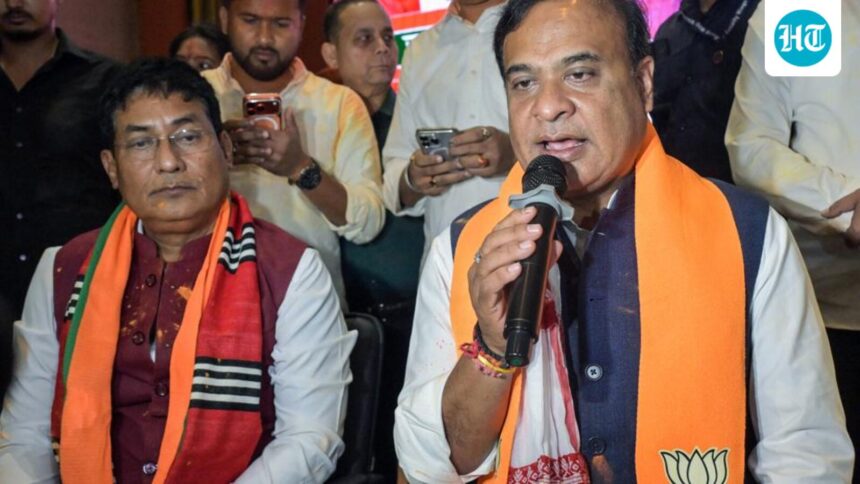
The Bharatiya Janata Party (BJP) on Monday secured an absolute majority and registered a landslide victory in Assam, winning 82 of the total 126 seats, retaining power for a third consecutive term.

Prime Minister Himanta Biswa Sarma said, “This is a historic victory because of the majority we are heading towards. I extend my sincere thanks to the people of Assam on behalf of the BJP and our allies and assure that the promises we have made to you will be kept.”
He said that the process of forming the next government will take place in accordance with due legal procedures, with the resignation of the current government and the election of a new leader of the legislative party.
“Our state president will discuss the formalities with the party high command after which we will demand formation of the next government and decide a date for taking oath,” Sarma said.
According to the results reported on the Election Commission of India (ECI) website (7pm), the BJP won 69 of the 90 seats it contested and was leading in 13 seats. His allies, Asom Gana Parishad (AGP) and Bodoland People’s Front (BPF) were winning and leading in 10 seats each, taking the total to 102 seats. The BJP alone got nearly 40% of the total votes while the Congress got 29%.
“The results were as expected and we were hoping to get more than 90 seats. This time the BJP was able to secure an absolute majority on its own, but we will continue to stick with our NDA.” [National Democratic Alliance] “Allies are the same as they were in the past,” said Dilip Saikia, state president of the BJP.
“The outcome is a combination of several factors including the Centre’s policies under Prime Minister Narendra Modi, the able leadership of Prime Minister Sarma and various development projects and measures taken to secure the rights of indigenous people,” he added.
Read also:Assam Election Results: NDA is strong in Bodoland as BPF leads in majority seats
The Congress fought these elections as a united opposition of six parties and won 19 seats, 10 fewer than the 29 seats it won in 2021. The party’s ally, Raijor Dal, bagged two seats, taking their total to 21 seats.
Sarma retained the Jalukbari seat for the sixth consecutive term, thrice as a Congress and BJP candidate.
Other notable BJP winners include ministers Bijosh Hazarika (Jagirud), Ranoj Biju (Dhemaji), Chandra Mohan Patwari (Tihu), Ranjit Kumar Das (Bhowanipur-Surbhuj), Ajanta Neog (Golaghat), Jayanta Malla Baruah (Nalbari) and Bimal Bora (Tengkung).
Congress turncoats, former state unit president Bhupen Kumar Bora and Pradyut Bordoloi, who joined the BJP a few days before the elections, also registered victory in Bhipuria and Dispur respectively.
The winners from AGP are Atul Bora (Bokakhat) and Keshab Maanta (Kaliapar) and from BPF are Siuli Mohilari (Kokrajhar) and Rehun Daimary (Udalguri).
The biggest surprise was the loss of state presidents for several parties, including Congress’ Gaurav Gogoi (Jorhat), RJD’s Lorinjyoti Gogoi (Kawang), and UPA’s Liberal leader Pramod Boro (Tamulpur).
Raijor Dal chief Akhil Gogoi retained the Sibsagar seat and All India United Democratic Front (AIUDF) chief Badruddin Ajmal won the Binakandi seat.
Kaustubh Deka, professor of political science at Dibrugarh University, said that the massive victory achieved by the BJP is a confirmation of the politics that the party plays by creating a large number of beneficiaries with different schemes and through fragmentation or polarization by playing identity politics that highlights the threat of illegal immigrants.
“With the party getting an absolute majority, it is expected that this particular kind of politics will continue and the Assam model of delimitation could be followed in other BJP-ruled states,” Deka said.
“The Congress elections were do-or-die. But with the party failing to increase its tally from 2021 and losing in key strongholds like Nazira and Titapar, it will be very difficult for the Congress to make a significant comeback from there,” he added.
The AIUDF was one of the biggest losers in these elections, managing to win only two seats in Dhalgaon and Bhinkandi. This is the party’s lowest tally in the past five elections since its founding in 2005. In 2021, it won 16 seats.
“It is bad news for the AIUDF as the party’s main support base, as Bengali-speaking Muslims of Bangladeshi origin seem to have turned away. The fact that many view the party as a subsidiary of the BJP could also have played a role in the outcome this time. AIUDF’s loss is Congress’s gain,” Deka said.
The other big loser was the United People’s Party Liberal (UPPL), which failed to win a single seat. The party, which was part of the ruling coalition, won 6 seats in 2021, but ran these elections alone.
The Trinamool Congress (TMC) is expected to win one seat this time with its candidate Sherman Ali Ahmed, a former Congress MLA, leading the Mandya constituency.
The delimitation exercise implemented in 2023 that redrew Assembly seats in the state could also be a factor in the BJP’s record win, the Congress’ failure and the AIUDF’s dismal show.
“Reducing the Muslim majority seats in Assam through arithmetical delimitation has led to a significant reduction in the community-related vote bank politics this time,” Deka said.
“As part of the delimitation process, Muslim-dominated seats were merged with other seats or completely redrawn to make the votes of this community insignificant in the outcome. The number of Muslim-dominated seats in Assam was reduced from 35 to 22 after the delimitation process,” he added.
The saffron party first came to power in Assam in 2016, ending 15-year Congress rule. In the last two Lok Sabha elections, the BJP won 60 seats (in both 2016 and 2021), four short of a majority, and formed governments with the support of its regional allies in the NDA.