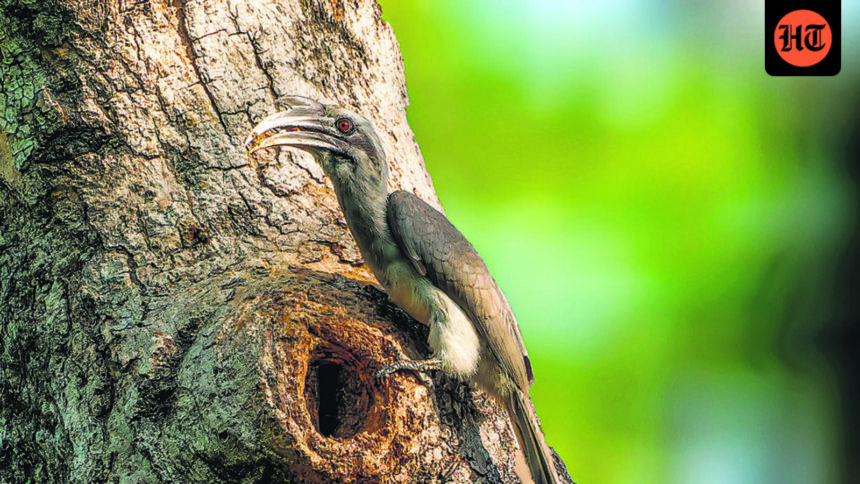
Every morning in Lodhi Park, under an ancient simal tree, a strange domestic drama unfolds between hornbills that don’t quite belong together.

The resident Indian Gray Hornbill, a common species in Delhi, nests inside the tree cavity. And then there is the stranger: a lone female Eastern Hornbill, a bird not usually found in the capital, arrives every day to feed her chicks indoors as if they were her own.
What started as an unusual sighting became stranger by the day — a story of adoption, territorial conflict, and, by Saturday morning, the apparent murder of children.
“This has become a complete psychological drama of sorts,” said Sheela Chhabra, a Delhi birder, who spent two consecutive mornings birdwatching alongside famous Delhi bird hunter Nikhil Devasar.
The eastern hornbill is not native to Delhi. It is largely a Terai and Himalayan species, with historical records reporting only sporadic sightings in the 1940s and early 1970s. After decades of silence, isolated reports began to emerge again after 2013. According to bird watcher Sudhir Vyas, these birds may be long-term escapees from captivity or wandering vagrants that have spread unusually far south in the Indo-Gangetic plains.
Delhi now appears to have at least two, believed to be female. One of them is frequently spotted around Jamia Millia Islamia; The other stunned bird watchers at Lodhi Park.
On Friday morning, observers saw a female spotted hornbill repeatedly reach into the nest cavity, regurgitating berries and fruit into the narrow crevice. Two beaks emerged from inside to accept food. Moments later, the resident male gray hornbill will arrive and feed the chicks in turn. The coexistence was not always peaceful: during one feeding bout, a spotted hornbill aggressively chased a male gray hornbill around a tree before returning to the nest himself.
“Did loneliness make a woman become a psychological patient?” Chhabra wrote in her field notes. “Did her maternal instinct become so strong that she decided to steal someone else’s children?”
Then came Saturday with more drama. Devasar later summed it up in three words: “Love, deception, murder.”
At dawn, a female Gray Hornbill appeared to be repairing the nest wall from inside the cavity. An hour later, the spotted hornbill returned carrying in its beak what observers feared was a dead gray chick.
“I tried to stuff it in the hole,” Chhabra told HT. “The gray female vehemently refused.” The gesture could, in its own way, reflect the affection of the spotted hornbill, offering protein-rich food to the nesting mother, Chhabra added.
The spotted hornbill flew off, was chased by the kites, and then returned again with the carcass. Again the offer was rejected. At some point, the dead chick fell into the nearby bamboo while crows and kites flew overhead.
By late morning, the resident male Gray Hornbill had resumed feeding the female inside the cavity. Three more gray hornbills gathered in the nearby branches.
Devasar, who photographed both birds – the one in Jamia and the one in Lodhi Park – said they were distinctly different. “They are both females, but their appearance is different. Both have been seen for at least the last two months. We believe they are on the run,” he told HT.
No one knows for sure what’s unfolding atop that small tree—whether a hornbill is displaying confused maternal behavior, trying to integrate itself into the nesting cycle, or something more troubling. More bird watchers plan to visit on Sunday. The next episode is waiting for you.