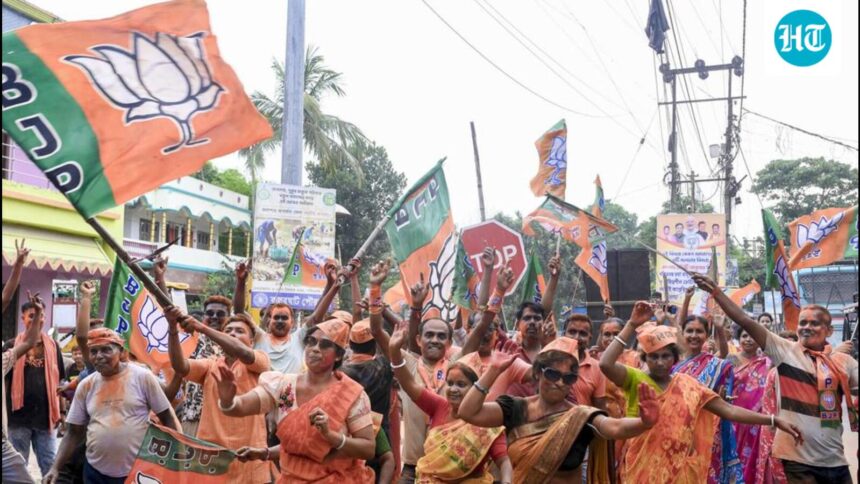
After winning two electorally difficult states – West Bengal and Bihar – the Bharatiya Janata Party is preparing to hold important parliamentary elections next year.

Assembly elections are scheduled to be held in Punjab, where the BJP is still a nascent party, and in Uttar Pradesh, where it will seek a third consecutive term under Prime Minister Yogi Adityanath.
In all, seven states will go to the polls next year: Goa, Himachal Pradesh, Manipur, Uttarakhand and Gujarat. Of these states, the BJP rules five states, while the Congress and the Aam Aadmi Party (AAP) rule one state each.
First, UP, the most populous state, sends key national leaders to the Lok Sabha; The current list of UP LS members includes Prime Minister Narendra Modi, Defense Minister Rajnath Singh and Leader of the Opposition in Lok Sabha Rahul Gandhi.
Their slogan “Jai Sri Ram” emerged from the land where the three major Hindu religious shrines – Ayodhya, Mathura and Kashi – are located. Thanks to this slogan, the Saffron Brigade won the Lok Sabha elections in 2014 and 2019 and the Federation Council elections in 2017 and 2022. The momentum in the 2024 Lok Sabha elections was disturbed when their number declined.
The BJP weathered the 2024 Lok Sabha election turmoil with stunning victories in Bihar and West Bengal. However, the battle in UP and Punjab will not be easy as both states have their own complexities.
The opposition cannot simply resort to disputes over administration or alleged manipulation of ballot boxes – from SIR (alleged deletion of real voters during a Special Intensive Review) to vote counting – Trinamool Congress (TMC) chief Mamata Banerjee has also downplayed anti-incumbency against her government, as well as consolidating Hindutva votes.
The aftershocks of Banerjee’s defeat were felt in UP. Now, as the opposition prepares to win the next elections, it is discussing reconciliation or rebuilding the opposition bloc. Apparently, Samajwadi Party (SP) leader Akhilesh Yadav will have to fight a solo battle as Banerjee may be busy in the legal battles while DMK leader and former Tamil Nadu Chief Minister M K Stalin is angry over the Congress abandoning his party.
The contentious issue is the uncomfortable relationship between Congress and its partners, many of whom are splinter groups such as the TMC. The clash of vote banks affects them more than ideology. For example, both the SP and the Bahujan Samaj Party (BSP) have withdrawn their traditional vote banks from the declining Congress, and now the revival of the grand old party could come at their expense. The BJP remains unmoved.
The question is whether the Congress and AAP will cooperate in Punjab or whether the friendliness shown by Gandhi and Yadav will trickle down to the grassroots. Despite the BJP’s disdain, a section of Congress leaders are still courting the Mayawati-led party.
In simple words, the opposition has to decide whether they will fight the BJP first and then come up with their own revival plans in the states or they will fight each other, which is in the interest of the BJP.
Political experts believe that the weakening of regional parties was a prerequisite for the country’s much-discussed bipolar policy. But at whose expense? Can a weak TMC pave the way for a Congress revival in West Bengal? Maybe not. Can Congress fight BJP alone in Uttar Pradesh or can it trust BJP?
On the other hand, aware of the peculiarities of both the states, BJP leader Amit Shah has not only deployed his best minds to supervise the polls, but is also said to be ready to devise plans for them.
Modi himself had started campaigning from his Lok Sabha constituency Varanasi much before the West Bengal elections were completed. The message to staff was clear: there is no time to rest.
In quick succession, the BJP expanded the state cabinet to correct its caste calculations, even as the Congress, an ally of its main rival, the SP, was caught in a dilemma over the Kerala cabinet.
Read also:UP Keeping Up: Will Women Help BJP Retain Power
What is the BJP’s strategy and advantages?
The BJP has a well-oiled party machinery with its ‘soldiers’ spread across the state. The incumbent also has a constellation of articulate leaders and the necessary resources, including money.
The strategy is clearly to focus on “women”: they make up 50% of the vote bank and have largely supported the BJP, cutting across caste lines, for a variety of reasons, including welfare schemes, security and religious inclinations. Lok Sabha passed 33% reservation for women in 2023 but voted against the 2026 bill when it was combined with delimitation.
Correcting sect accounts: As Akhilesh Yadav’s PDA formula has already weakened the BJP in 2024, the party high command has appointed ministers belonging to the Dalit and OBC castes and is likely to reward them with more tickets. However, they will have to appease the Brahmin voters.
Target them: He described the opposition as “anti-Hindu and pro-Muslim” because society is divided along sectarian and sectarian lines.
Encourage multi-angle competition: Splitting the anti-BJP vote.
Anti-incumbency: Use the TINA factor (there is no alternative) to bring the advantage home.
Social media spread: Outperforming the opposition in the field and on social media. Akhilesh Yadav has already spoken about the funding crisis.
Governance: Emphasizing governance by the dual-engine government, playing on the Modi-Yogi brand.
Spring surprise: Offer a last-minute subsidy or make announcements.
Breaking the opposition parties: The BJP is on a winning spree, and the morale of its cadres is upbeat. However, the party fights every election – in safe or difficult areas – as a war. The party operates throughout the year, but intensifies its activity during elections.
Read also:KEEP UP | How will the Bengal poll results impact the battle for UP
The West Bengal results have intensified the battle for the SP. Naturally, Yadav is back in the fold, perhaps strategizing his plan for the 2027 elections.
Yadav is counting on a young brigade he has been building. They are all educated, articulate and may soon hit the roads.
While the 2024 results boosted confidence, 2026 could have dampened morale. Perhaps Yadav will have to use the 2022 Assembly polls, rather than the 2024 Lok Sabha polls, as a base to prepare for 2027. Although the party’s graph is on the rise, West Bengal and Bihar have halted their 2024 momentum.
In Punjab, the BJP consolidated its strength by appointing key leaders from the APC, including seven of the nine Rajya Sabha members. The AAP government is also under pressure. As of now, the BJP is consolidating its position in the state where the Congress is in much better health than Uttar Pradesh. But its old ally, the Shiromani Akali Dal, remains in disarray.