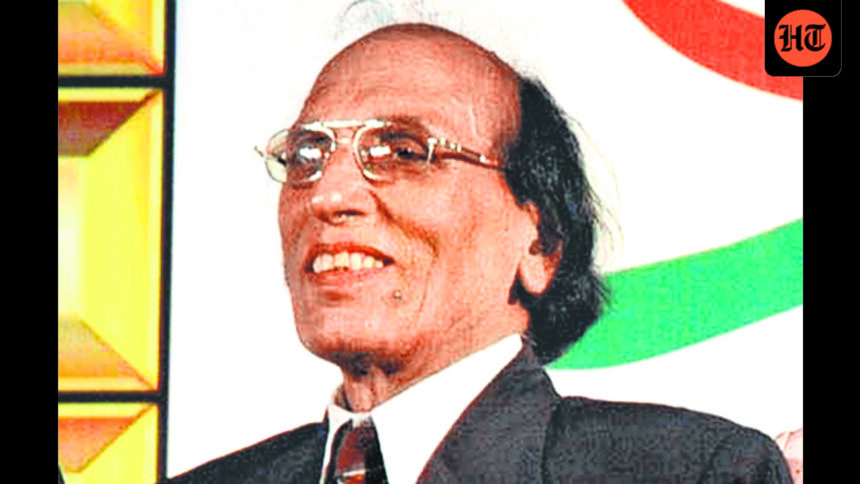
Bashir Badar, a popular and admired Urdu poet with a huge fan base, passed away on Thursday. He was 91 years old and suffered from dementia and other age-related problems.

Born on February 15, 1935, in what was then the United Province of India before its independence, Badr was an ardent student of ghazal. Like his contemporary Nasser Al-Kadhimi (a decade older than Badr), Badr used everyday language to great effect, ensuring that his poems spoke directly to the listener.
An alumnus of Aligarh Muslim University, Badr has authored several books of ghazals and literary criticism of the form, and taught at Meerut University for several years.
His popularity was such that in 1972, then Pakistani President Zulfikar Ali Bhutto quoted him when Pakistan and India signed the Shimla Agreement, signaling the end of the Indo-Pakistani War: Dushmani jam kar karu lekin yeh gungaesh raheen/ jab kabhi hum dost ho jayin, toh sharminda na ho (We can pursue enmity with all our might but let us leave a little room / When we become friends again, we must not feel ashamed.) His popularity also carried over to the Hindi film industry, where director Vishal Bhardwaj and lyricist Varun Grover used his clips in their works.
Badr received numerous awards during his life, including the Sahitya Akademi Award and the Padma Shri Award, for his contribution to Urdu literature.
HT spoke to Azra Naqvi, a poet and translator who knew Badr well and had sung with him on several occasions.
Edited excerpts:Sweater Yeh Zafrani usi ka hissa hai — koi aur pehne toh dusra hi lage. (This saffron jacket was hers, and it looked different to everyone else.)
Girls in our college in Aligarh swooned over these lines; It became an instant hit when Bashir Sahab responded to it when I was still a teenager. That was his charm and fan base. He was, in every sense of the word, a poet of the masses. His style was unique – his hair felt instantly relatable. Everyone who heard his verses identified with them.
We lived in Aligarh, and my mother was also a poet. He knew my family and treated us like his own. I grew up listening to him on marches around town. After I got married, we moved to Saudi Arabia. We approached him when he came there for reference and hosted him at our house.
At that time I was working for an Urdu newspaper and interviewed him. Even in the interview he spoke very freely, reflecting the purity of his soul. He never spoke ill of competitors or contemporaries. When I asked him about a particular critic, he answered with one sentence: This shayari is the same time as this one (Let him read one poem properly.)
He regularly attended marches around the world, especially in Riyadh, where people often invited him. Many of these gatherings were in homes where men and women sat separately, or women sat behind a veil. In one of the demonstrations, I was performing with him, but he refused to allow me to sit behind the veil. “How will she perform behind the curtains?” He asked, making sure I sat next to him. His gestures, as much as his words, showed how far he had come. That is why generations loved his verses.
Everyone wrote verses about the same feelings, but his poetry about love and loss reached deeply into people’s hearts. Every poet has written about love and separation, but his words have touched lovers all over the world:
Ek samandar ke pyase kinare the hum, apna paigam lati thi mauj-e-rawan / Aaj do rail ki patriyon ki Tarah, sath chalna hai aur bolna tak nahI. (We were once like thirsty ocean shores, waiting for the waves to carry messages. Today we are like two railway lines – walking side by side but never speaking.)
The first time I visited his house, I noticed a quilt hanging on the wall made of small square blocks. It was gifted to him by a fan. Each block was embroidered with one of his verses.
I saw pictures from his final years after being diagnosed with dementia. He was bedridden and had a guard. But that’s not how I want to remember him. He was a lively and cheerful spirit, and the heart of every lodge. He will remain alive in our memories, embodied in his favorite verses: This is what happens next to me – what’s the matter with you on this one? (God is the name of such a feeling: present before you but invisible.)