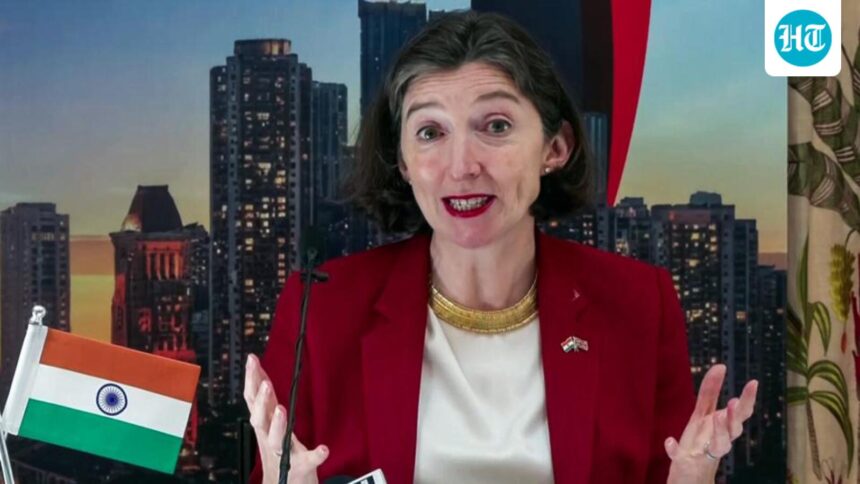
British High Commissioner Lindy Cameron said the India-UK Free Trade Agreement, which came into effect on Wednesday, is the “new gold standard” for trade deals and has boosted confidence that will drive bilateral engagement in other vital sectors such as maritime security and technology.
Signed in July 2025, the India-UK Comprehensive Economic and Trade Agreement (CETA) gives Indian exports immediate duty-free access to approximately 99% of the UK’s tariff lines, while India will provide preferential market access to approximately 90% of UK exports over time to protect sensitive sectors.
“The UK-India FTA is the new gold standard for trade deals – pro-labor, pro-innovation, pro-growth. It is a force multiplier and a model for future trade agreements,” Cameron said at a press conference hours after the agreement came into effect.
Cameron also described the FTA as “the largest, most ambitious and modern free trade agreement” ever to come into force for both countries. “It is an opportunity to grow our economies, advance maritime security, and keep supply chains safe together from the global economic shocks we are currently experiencing… But the FTA is not the ceiling, it is the floor of our ambitions,” she said.
Two-way trade is currently worth £48 billion, and Cameron said the free trade agreement was expected to increase trade by more than £25 billion a year in the long term.
India and the UK see their Vision 2035 as the basis for a much broader partnership, Cameron said, referring to a ten-year roadmap adopted last year that includes five pillars focusing on economic growth, technology such as artificial intelligence, defense and security, climate and clean energy, and education.
“What’s really been great is the political warmth on both sides, since this deal was signed. The sense of partnership that this deal has created has done so much in every area of cooperation between the UK and India, whether that’s in the technology and security initiative, UK universities, or the broader Vision 2035 sectors that we’re looking at,” she said.
Cameron noted that British Trade Minister Chris Bryant said that the free trade agreement sends a message to the world that the rules-based system works. “I think these rules, when they relate to international trade, are in everyone’s interest and certainly in the interest of the UK and India,” she said.
The British envoy highlighted some of the key benefits of the trade agreement, including a significant reduction in import duties on products such as Scotch whisky, which was reduced from 150% to 75%, and luxury cars manufactured in the UK, which fell from more than 110% to 10% under the new quota.
Along with the reduction in customs duties on British cosmetics, home clothing and sporting goods, 98% of green goods are deregulated and will support India’s energy transition, especially through the export of turbines, generators and components needed for renewable energy storage and green projects.
The FTA will also make it easier for British companies to bid in the Indian procurement market, which is worth £38 billion annually, while at the same time providing guaranteed Indian access to the UK procurement market.
“India is undertaking one of the largest urban infrastructure expansions in the world, and tariffs on many infrastructure products will be reduced or removed, helping to increase investment of specialist British equipment, engineering solutions and innovative technologies here,” she said.
The FTA also improves the mobility of professionals, making it easier for engineers, consultants and professional services teams in both markets to work together seamlessly, Cameron said.
Besides calling for greater cooperation between Indian states and regions in the UK to benefit from the trade deal, Cameron said Britain will send the first joint mayor-led mission from across northern England to India in October to showcase the benefits of the FTA and understand the opportunities in India.
“This will strengthen links in trade, investment, innovation, education, culture and tourism,” Cameron said.