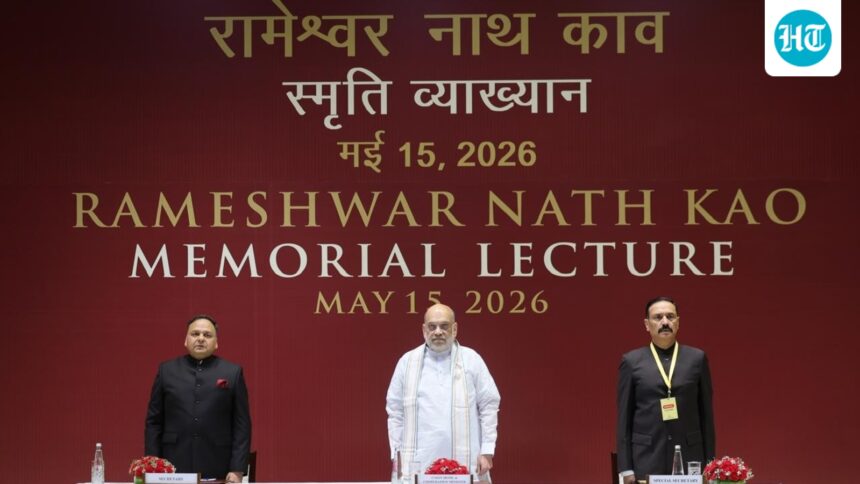
At the RN Khao Memorial Lecture last Friday, Home Minister Amit Shah outlined his next mission to a group of foreign diplomats, law enforcement chiefs and intelligence chiefs and effectively declared war on drugs and precursors after successfully eliminating left-wing extremism in India.

While Shah was speaking at the Research and Analysis Wing (R&AW) headquarters, the Narcotics Control Bureau (NCB) was in the midst of an operation to seize 222.7 kg of Captagon, the so-called jihadi drug, worth Rs. 200 Crores. Since he focused his entire speech on eliminating drug trafficking and narco-terrorism, the Interior Minister clearly defined his agenda for the coming years.
India faces a serious drug threat from its 15,000-km land border and 7,500-km maritime border, as it is sandwiched between what is now called the “Dead Crescent”, the Afghan-Pakistani heroin-producing region, and the “Dead Triangle”, the synthetic heroin-producing region of Myanmar, Laos and Thailand. Moreover, cocaine from South America lands on the shores of the Indian Sea via Sri Lanka via high-speed boats and even drones. Over the years, India has moved from a drug transit point to a drug consumption country as the country’s economy has moved into the top five in the world.
Read also | NCB makes first seizure of Captagon, “jihadi drug,” as part of “Operation Pills of Rage”: Amit Shah
While Shah wants to make India drug-free by 2047, the task is huge and requires transnational cooperation with a strong government taking action on its soil through joint stringent anti-drug laws. Otherwise, drug cartels will grow as countries try to find common ground on the war on drugs by linking it to human rights. There should be a common schedule of prohibited drugs including marijuana and the concept of recreational drugs should be removed as a false narrative.
As a first step towards the war on drugs, India needs to empower the NCB with more human resources and intelligence gathered by India’s foreign and domestic intelligence agencies. Although the NCB is mandated under strong law, it is subject to interpretations by courts that often work in favor of offenders and drug traffickers. The truth is that the majority of Pakistan-sponsored terrorist networks in India are funded by drug money, as revealed by Lashkar-e-Taiba agent and US citizen David Coleman Headley aka Dawood Gilani during his interrogation by the NIA in 2010.
Surrounded by weakly governed, economically poor and military-ruled states in Myanmar, Afghanistan and Pakistan, India faces a drug threat from Nepal, with which it shares a porous land border, and from Sri Lanka.
Given the economic conditions and unemployment in all these countries, drug trafficking has become a path to overnight wealth in the Indian subcontinent. Until these countries take strong action against drug networks and drug cartels, India will face an uphill task despite its best efforts. Beyond law enforcement, the task of eradicating drugs needs an alternative narrative in society and among young people, who find the habit popular after seeing their icons consume it and thrive on it.
Shah has taken on a major task against a formidable global opponent, but this is a war India cannot afford to lose.