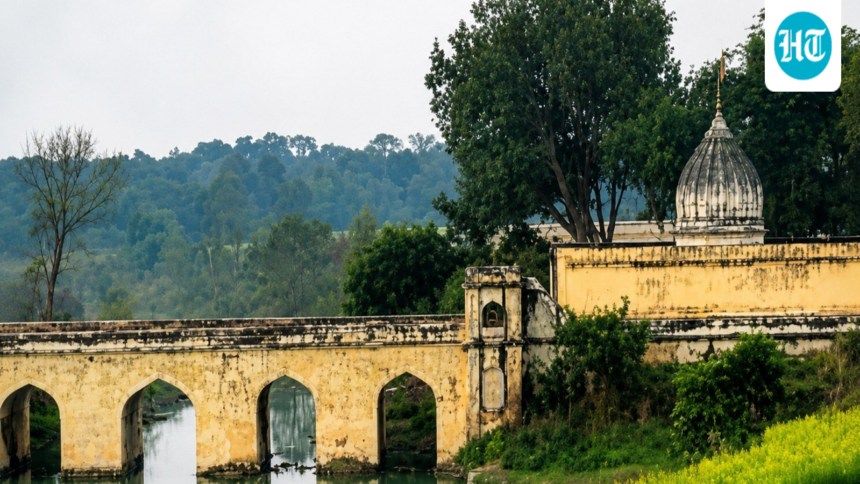
In Shyam Benegal’s classic film Madness (1978), set against the backdrop of the freedom struggle of 1857, an extended scene depicts a British family seeking refuge for the night in a secluded temple beside a ghostly bridge. This scene takes place after the head of the family, an army officer, is killed by Indian revolutionaries during a Sunday church service. The church used in this fictional incident is St Thomas’ Church, which still exists in Lucknow Cantonment, while the temple was a Shiva temple established by ‘Raja’ Tikait Rai. This temple is located next to a Nawabi-era bridge spanning the Behta River near Malihabad, which still bears its name.

Read also | Beyond agriculture, Lucknow is turning to saving trees
Known as Raja Tikait Rai Bahadur, ‘Raja’ and ‘Bahadur’ being honorific titles, not denoting any royal lineage or bravery – his legacy in the history of Awadh is noteworthy as his contributions to the region are evident even today. Born in Dalmau, near Rae Bareli, into a Kayastha Srivastava family, he began his career in the Nawabi administration as a ‘mutsadi’ (clerk), rising through the ranks to become a ‘bashkar’ (superintendent) and eventually attaining the title of ‘dewan’ (supervisor of accounts).
He was later given several honorary titles such as “Maharaj Adhiraj Tikait Rai Narendra Bahadur” – giving rise to a misconception among some writers that he was an unknown Hindu king. Rai’s relationship with Nawab Asaf al-Dawla was complex and marked by loyalty and rivalry.
He found support from figures such as Haider Beg Khan, under whom he began his career, and George Cherry, the British Resident at the court of Asaf al-Dawla. Haider Beg was the deputy of Hasan Raza Khan, Asaf al-Dawla’s deputy. Ray also assumed the position of “Naib” during the temporary absences of Hyder Beg and Hasan Raza Khan, both of whom had moved to Calcutta in 1787 to meet Lord Cornwallis.
When historical details are hazy, superstition rules the roost. One of the many interesting anecdotes from this period is about how Asaf-ud-Daulah was in dire need of funds for his massive Imambada-Rumi Darwaza project. It was the devout Tikait Rai who allegedly identified the “hidden treasure of ancient Hindu kings” buried in the vicinity.
This treasure, referred to as “Khazana-e-Gaib”, was recovered and partly used to fund Asaf-ud-Daula initiatives, including the food-for-work program launched to help populations suffering from famine. The remaining treasure was reburied, possibly within a baoli/stepwell or a ‘bhole’/imambada labyrinth, accompanied by appropriate rituals and incantations by priests. However, it proved to be a curse, as Asaf-ud-Dawla’s lineage did not prosper in the long run.
Although Asaf-ud-Daula was responsible for redefining the landscape and skyline of Lucknow due to his countless palatial palaces and buildings, his diwan, Tikait Rai, was not far behind in building numerous works of public utility and places of worship in and around Lucknow. In addition to the bridge mentioned above, he is credited with building 108 temples of Lord Shiva, as well as rebuilding Hanuman Garhi in its present form in Ayodhya.
Ray’s charitable ways took it to extremes, earning him the title of “Raja Karn” (of Mahabharat fame). Naturally, his generosity did not stem from his own finances, but from state coffers, which did not sit well with Asaf al-Dawla, who dismissed him in 1796.
During his tenure in the Nawabi’s court, Tikait Rai was actively involved in the construction of many bridges, temples, mosques, wells, sarai (lodges), ghats, markets and walled gardens.
In Lucknow, Shitala Mata Temple, Kalyangiri Temple, Baba Gomti Das Temple, Jagannath Temple and Ram Janaki Temple are attributed to Rai, also known as a temple and living in Ichaoli, Barabanki.
Bithore (Kanpur) boasts of the Mahakaleshwar and Baradari temple and the red stone bathing jetty on the banks of the Ganges known as ‘Pithar Ghat’ built by Tikait Rai.
He was an ardent supporter of the arts and education – in addition to offering scholarships to scholars, he also founded a school in Lucknow that provided free accommodation to both students and teachers.
The Nakkhas Sunday market in Chowk, Lucknow, along with the Raja Bazar area and Tikaitganj locality, are attributed to Rai. The pond known as Tikait Rai ka Talab still exists in the area, although it is currently devoid of water. He is also known for his efforts in promoting and organizing chikankari workers in Lucknow, which benefited artisans who were previously part of the unorganized sector.
As he grew older and his fortunes declined, Tikait Rai later chose to distance himself from society and political affairs, choosing instead to move to Ayodhya, where he often sat in isolation on the banks of the Saryu River. He died in 1800, far from the hustle and bustle of Lucknow politics, which was then ruled by Saadat Ali Khan, the sixth Nawab of Awadh.
(PC Sarkar, a former scholar, has authored several books on Lucknow’s forgotten heritage)
(Views expressed are personal)