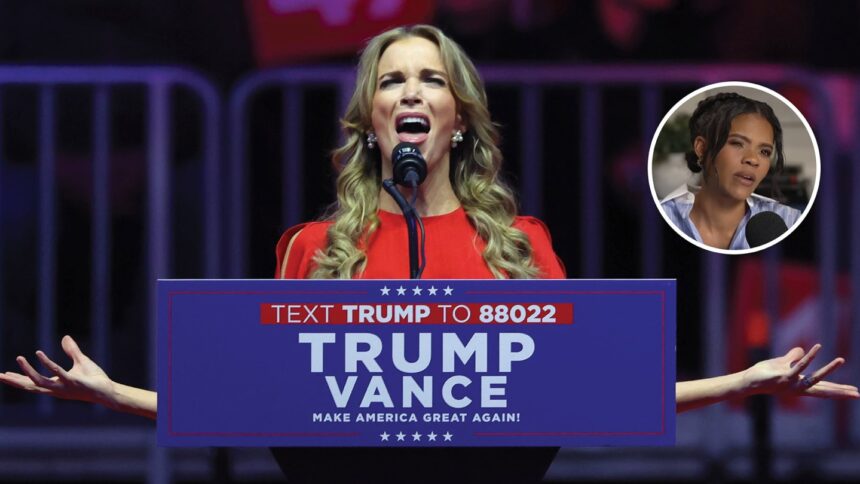
If there were any lingering doubts about the growing rifts between President Trump and the MAGA media ecosystem that helped put him back in power, Megyn Kelly erased them all in March.
The former Trump critic turned ally in his second term used her platform to accuse the administration of misleading the public about the death toll from the US-Israeli military operation in Iran — a stunning break from a figure who, in recent years, has largely moved in lockstep with the president.
“I don’t believe these soldiers died for the United States,” the former Fox News anchor said of the 13 Americans killed so far, many in an Iranian raid on Prince Sultan Air Base in Saudi Arabia. “I think they died for Iran or Israel.”
Kelly has publicly criticized the Iranian operation, but the frankness of her remarks amounted to a clear escalation — combining moral outrage with biting sarcasm — as she mocked Trump’s framing of the conflict as a “fun little trip to Iran” while citing the “missing limbs” and “severe head wounds” of more than 300 wounded.
She went further, venturing into suggestions about a possible cover-up — a speech that until recently would have been almost unthinkable from a former network news anchor, but which now feels right at home in the conspiratorial rules of the online MAGA sphere.
“We don’t think we know the full extent of the deaths either,” Kelly said on her daily web show, the centerpiece of her expanding media operations. “And we don’t think we know the full extent of how all these planes went down — that we’re getting the full story.”
In many ways, Kelly’s path is less anomalous than a case study: what happens when a traditional television career collides with the influencer economy, falters, and then reshapes itself around a completely different set of incentives.
Kelly, 55, is no stranger to reinvention. “I don’t think she has fixed political principles,” says one of her longtime colleagues. “But it has an uncanny ability to adapt to prevailing political winds.” She first gained national fame as a Fox News anchor who, during the network’s first GOP primary debate in 2015, pressed Trump on his treatment of women — a confrontation that sparked a very public dispute and helped precipitate her exit from Fox in 2017. That departure was connected to something bigger: Along with Gretchen Carlson and others, she accused then-Fox News CEO Roger Ailes of sexual harassment — an account that was later depicted Dramatically in the 2019 movie bombmaking her a complex but ultimately sympathetic character who takes on the institutional challenge.

But shortly after achieving mainstream respect, Kelly’s career suddenly collapsed. Her very popular morning show on NBC, Megyn Kelly todaywas canceled less than a year later after widely condemned statements defending blackface Halloween costumes—a public rupture that not only marginalized her from mainstream media but also appears to have reshaped her relationship with it.
Its transformation has been rapid and successful by most measures. In 2020, it was launched The Megyn Kelly Show As an independent podcast. By March 2025, it had expanded into MK Media, a growing podcast network under the Devil May Care Media banner, with ambitions to rival established conservative outlets. Her YouTube channel has now surpassed 4 million subscribers and attracted 138 million views in February.
But size, in this ecosystem, is not neutral, it exerts pressure. Increasingly, this pressure is moving toward provocation. As she worked to expand her empire, Kelly found herself navigating a changing political and media landscape. Her closeness to political commentator and conspiracy monger Candace Owens, and her reluctance to distance herself from Owens’ escalating allegations, have become a defining — and increasingly uncomfortable — feature of her brand.
In the arms race for attention that characterizes political broadcasting, few personalities have been able to expand their reach as quickly as Owens. Since January 2025, she has added an estimated 10.9 million followers across all platforms while racking up nearly 805 million views on YouTube and more than 81 million likes on TikTok, according to Media Matters.
As its audience grew, so did the controversies it fueled. Over the past year, Owens has promoted a series of extreme and often unsubstantiated claims — including repeated assertions that French First Lady Brigitte Macron was “born a man,” at one point declaring Piers Morgan Uncensored And it’s not clear that Macron has a penis. These statements sparked a defamation lawsuit filed by Macron in July.
Owens also offered a series of increasingly baroque accounts of the killing of Charlie Kirk, the founder of Turning Point USA, in September, alleging – without evidence – the involvement of multiple governments and intelligence agencies, and suggesting that the killing was linked to a broader “deep state” agenda. Among her claims: that Kirk was a time traveler, and that he had been monitored by agents linked to the CIA since childhood.
Her rhetoric about Jews and Israel has become more controversial. Owens was promoted Talmud Monasterya 19th-century anti-Semite, which she suggested revealed what Jewish public figures “really believed.” She also repeated her long-debunked claims about Jewish involvement in the slave trade and described Holocaust education as a form of “indoctrination.”

Critics, including her colleague Alex Jones, raised concerns about her speech. But the backlash did little to slow her rise.
What matters here is not just what Owens says, but how many people are listening — nearly 24 million across platforms — and what that scale demands of everyone else in the right-wing conversation. Its rise does not pull conservative media in one direction so much as it imposes a sorting mechanism. On the one hand, there is a personality-driven ecosystem — Owens, Tucker Carlson, Steve Bannon, and, increasingly, Kelly — where provocation, institutional mistrust, and conspiracy-bordering rhetoric are not faults but traits. On the other side is a more traditional faction — Ben Shapiro, Sean Hannity, Mark Levin, and the Turning Point USA orbit — which, though solidly right-wing, has drawn sharper lines around overt conspiracy and anti-Semitism.
This divide is less about ideology than structure: it is a collision between old-fashioned conservatism and influencer economics, where attention — not credibility — is the primary currency.
This tension left Kelly in a tight rut. Parting ways with Owens would mean risking audience erosion. To embrace it is to risk becoming indistinguishable from it. For now, Kelly appears to be choosing a third path: saying just enough to signal independence while refraining from a complete break — a balancing act that becomes increasingly difficult to maintain as the regime’s incentives continue to drift toward extremes.
This story appeared in the April 8 issue of The Hollywood Reporter magazine. Click here to subscribe.